Class 8 Hamara Rajasthan Chapter 10 Question Answer in English Art and Culture in Rajasthan

Engaging with these Our Rajasthan Book Class 8 Solutions and Class 8 Hamara Rajasthan Chapter 10 Question Answer Art and Culture in Rajasthan will strengthen your knowledge and prepare you for assessments.

Class 8 Our Rajasthan Chapter 10 Question Answer Art and Culture in Rajasthan

Our Rajasthan Class 8 Chapter 10 Art and Culture in Rajasthan Question Answer

I. Write the correct answers to the following questions in brackets :

1. Which of the following pairs is not correctly matched?
Temple Place
(a) Dilwara Jain Temple Mount Abu (Sirohi)
(b) Ranakpur Jain Temple Pali
(c) Shree Eklingji Temple Jaipur
(d) Khatushyam Temple Sikar
Answer:
(c) Shree Eklingji Temple Jaipur

2. The highest part of which of the following fort is called Katargarh?
(a) Amer Fort
(b) Kumbhalgarh Fort
(c) Ranthamboit Fort
(d) Jalore Fort
Answer:
(b) Kumbhalgarh Fort

II. Fill in the blanks :

1. The Chhatri of ………….. pillars in Bundi is an important example of architecture.
Answer:
84

2. Bani-Thani painting style is the famous style of ………….. .
Answer:
Kishangarh

III. Very Short Answer Type Questions

Question 1.
From which period did the development of temples begin?
Answer:
The development of temples started from the Gupta period.

Class 8 Hamara Rajasthan Chapter 10 Question Answer in English Art and Culture in Rajasthan

Question 2.
Where was the Moosi Maharani’s Chhatri located?
Answer:
Moosi Maharani’s Chhatri was located in Alwar.

Question 3.
Who built the Vijay Stambh?
Answer:
Vijay Stambh was built by Maharana Kumbha.

IV. Short Answer Type Questions

Question 1.
Name the major forts of Rajasthan and describe any two forts.
Answer:
Major Forts of Rajasthan—The main forts of Rajasthan are- (i) Bundi Fort (ii) Lohagarh Fort (iii) Ranthambore Fort (iv) Jalore Fort (v) Chittorgarh Fort (vi) Kumbhalgarh Fort (vii) Amer Fort (viii) JalDurg, Gagron Fort (ix) Mehrangarh Fort of Jodhpur (x) Junagarh Fort of Bikaner and (xi) Sonargarh Fort of Jaisalmer.

(i) Bundi Fort—TheBundi fort was built by Rao Bar Singh in 1354 AD on the hill of the northern end of Bundi city. A strong wall is built around the fort.ChhatrasalMahal, Yantralaya, Badal Mahal, AnirudhMahal are built in it.The architecture of the chhatris of the buildings, the ornate pillars of the Durbar Hall is unique.

(ii) Lohagarh Fort—This fort was built by Maharaja Suraj Mai of the Jat dynasty of Bharatpur. It has a double rampart built around it, so it is also called fort of soil. There were many attacks on it, but no one could win it. Therefore, it is also called invincible fort.

Question 2.
Write a comment on the art of music in Rajasthan.
Answer:
Music art in Rajasthan- Music has been prevalent in Rajasthan since ancient times. During the war, the atmosphere was stirred by the roaring of the sounds and musical instruments. of encouraging music. Here, along with music with varied colours, Mand Raga with makeup is also notable.

The rulers of this place have always respected musicians and singing. Here, devotees also practised and broadcast various ragas of music, in which the names of Mirabai, Dadu, Charandas, Dayabai, Sahajobai were special.Various musical houses have also developed in Rajasthan. Rites, festivals, awakening of Gods and Goddesses are performed in the folk music among the masses and matrimonial songs are also sung.

Class 8 Hamara Rajasthan Chapter 10 Important Question Answer

Objective Type Questions :

1. The fort built by Maharaja Surajmal of the Jat dynasty of Bharatpur is-
(a) Lohagarh Fort
(b) Mehrangarh Fort
(c) Sonargafh Fort
(d) Gagron Fort
Answer:
(a) Lohagarh Fort

2. Which fort was built by the Parmara kings Dharavarsha and Munj in the 10th century?
(a) Ranthambore Fort
(b) Jalore Fort
(c) Chittorgarh Fort
(d) Bundi Fort
Answer:
(b) Jalore Fort

Class 8 Hamara Rajasthan Chapter 10 Question Answer in English Art and Culture in Rajasthan

3. Abhaneri Temple is located in-
(a) Jaipur
(b) Sikar
(c) Dausa
(d) Kota
Answer:
(c) Dausa

4. Gopal Singh’s Chhatri is located in-
(a) Alwar
(b) Bundi
(c) Ramgarh
(d) Karauli
Answer:
(d) Karau

5. Which of the following colours has been specially used in Bikaner’s paintings?
(a) Green colour
(b) Yellow colour
(c) Red colour
(d) Blue colour
Answer:
(b) Yellow colour

6. In which painting style of Rajasthan, Kadamb tree is found more in the background of paintings?
(a) In Udaipur Style
(b) In Kishangarh Style
(c) In Kota-Bundi Style
(d) In Jaipur-Alwar Style
Answer:
(a) In Udaipur Style

Fill In the Blanks :

1. ……………. were often built strategically and for safety.
Answer:
Forts

2. There were many attacks on Lohagarh fort but no one could win it. Hence it is also called the …………. fort.
Answer:
Invincible

3. Ranthambore fort was built by the ………….. dynasty rulers.
Answer:
Chauhan

4. The Vijay Stambh of Chittorgarh fort is also called the of Indian sculpture.
Answer:
Dictionary

5. ………….. was bom in Katargarh of Kumbhalgarh fort.
Answer:
Maharana Pratap

6 . The JalDurg of ………. is located at the confluence of two rivers Kali Sindh and Aahu River.
Answer:
Gagron

Very Short Answer Type Questions

Question 1.
Write the names of the four major temples of Marwar.
Answer:
The main temples of Marwar are—(i) Dilwara Jain Temple (Abu-Parvat, Sirohi), (ii) Ranakpur Jain Temple (Pali), (iii) Kiradu Temple (Banner), (iv) Temple of Osian (Jodhpur ).

Class 8 Hamara Rajasthan Chapter 10 Question Answer in English Art and Culture in Rajasthan

Question 2.
Write the names of two major temples of Shekhawati-Jaipur.
Answer:
(i) Temple of Khatushyam (Sikar)
(ii) Govind DevJi Temple (Jaipur).

Question 3.
Who has recognised the Molela sculpture globally?
Answer:
The potters of Molela village in Rajsamand district have recognised Molela sculpture globally.

Question 4.
What is the art of making clay idols cooked in fire?
Answer:
Terracotta is the art of cooking clay idols in fire.

Question 5.
What is the meaning of Chhatris and Deval?
Answer:
The memorials built by the rulers of Rajasthan, the feudatories, the superior class, etc. in the memory of their ancestors are known as Chhatris or Deval.

Question 6.
Write the names of any four styles of Rajasthani painting.
Answer:
(i) Jaipur style (ii) Kishangarh style (iii) Kota—Bundi style and (iv) Bikaner and Jodhpur style.

Question 7.
Where were the villages settled, keeping in mind the safety and utility of life?
Answer:
The Villages were often settled in rivers, ponds and hills or between them, keeping in mind the safety and utility of living.

Question 8.
Where were the forts built in terms of security?
Answer:
For safety, the forts were built on high hills, on the banks of deep rivers or in the plains.

Question 9.
Where is Chittorgarh Fort located?
Answer:
Chittorgarh fort is situated on the Matsyakar hill, which is surrounded by two strong ramparts.

Question 10.
Who built the newly converted fort of Kumbhalgarh and when?
Answer:
The newly converted fort of kumbhalgarh was built by MaharanaKumbha in 1458 AD under the leadership of his famous craft Sutradhar Mandan.

Class 8 Hamara Rajasthan Chapter 10 Question Answer in English Art and Culture in Rajasthan

Question 11.
Write tlje names of the two major temples of Mewar.
Answer:
These are the two major temples of Mewar- (i) Shree Eklingji’s Temple (Udaipur) (ii) Shrinathji’s Temple (Nathdwara).

Short Answer Type Questions

Question 1.
Write a short comment on the village and city.
Answer:
Village—Villages were settled near the rivers, ponds or hills so that the purpose of safety and the required source for life can be achieved. The houses in the villages were Kutcha or temporary houses covered with banana leaves or hay. Rich people had pattashalas, dhaliyas, shed for cattle and granaries etc.

City—The settlement of the city was well planned. Towns like Nagda, Chirwa, Kalyanpur etc. were settled in a place surrounded by valleys, hills or forest. The temple, palace, buildings, perkota, reservoir, roads were arranged in the city, such as Dilwara etc. Among the cities settled for safety, Amer, Bundi, Ajmer, Udaipur, Jaisalmer and Kumbhalgarh etc. are notable.

Question 2.
Write a short comment on the fort.
Answer:
Fort—

  1. Forts were built for military construction and for safety. For safely, the fortifications were built on high hills, on the banks of deep rivers or in the plains.
  2. Deep trenches were built near the. fort, which was filled by water and poisonous animals which helped in stopping the enemies from entering the fort. They were said to be Parikhaa.
  3. The forts were the safe place of residence for the rulers, army and general public.Due to the adequate arrangement of agricultural food storage, Vapi, Kund, reservoir etc in the fort, soldiers and warriors able to kept all the routes closed for many months and through this they prevented the attacks by enemy.

Question 3.
Write short notes on the following—
(a) Ranthambore Fort (b) Jalore Fort (c) Amber Fort (d) Gagron Fort
Answer:
(a) Ranthambore Fort—Inaccessible and impregnable fort of Ranthambore fort is located on the summit of high hill. This fort was built by the Chauhan dynasty rulers. In this fort, Naulakha Darwaza, HammirMahal, Chhatri of 32 pillars, etc. are the major historical places. The famous temple of Trinetra Ganesh is located in this fort. Presently, this fort and its adjoining forest area comes under ‘Ranthambore Tiger Project’ therefore special attention is being given to its restoration, conservation and safety.

(b) Jalore Fort—Jalore Fort, a symbol of the valour of Sonagara Chauhan in western Rajasthan, is famous for its antiquity and
soundness. This fort is located on the Sonagiri hill of the Western Aravalli range, this fort has four gates. It was built in the 10th century by the Parmar kings Dharavarsha and Munj. There are also wells, tanks, temples and a dargah in the fort. ,

(c) Amber Fort—The Amber fort of the Dhundar region is very safe fort. There was a special advancement in the architecture of this fort from the time of Maharaja Mansingh. The architecture here reflects a beautiful fusion of Hindu and Mughal styles. The mosaic and coloured glasses work is very attractive. A famous temple of Shila Devi was built at Ganesh Gate, the entrance of the fort.

(d) Gagron Fort—Jal durg of Gagron is the famous Jal durg in Rajasthan, which is located in Jhalawar district. This fort is situated at the confluence pf two rivers Kali Sindh and Ahu River.

Question 4.
What is known as temple? Since when and by whom has the construction of temples been started in Rajasthan?
Answer:
Temple—Goddesses are established in the temple. They are constructed according to the rules of the Shilpashastra (science of art and craft).

The development of temples in Rajasthan is believed to be started from the Gupta period, which has been in the times of Gurjara-Pratihar, Guhil, Chandel, Rathore, Parmar, Solanki, Chalukya and Pala rulers.

The temples are often built from time to time with the help of kings, maharajas, queens, jagirdars, nobles, men and women.

Question 5.
Mention the major temples of Rajasthan state.
Answer:
Major temples of Rajasthan are mentioned under the following points—
1. Major temples of Mewar—Major temples of Mewar are—Jagdish Temple (Udaipur), SahastraBahu (Saas- Bahu) Temple (Nagda- Udaipur), Ambika Temple (Udaipur), Shrinathji Temple (Nathdwara), Shri Eklingji Temple (Udaipur), Rishabhdev Jain Temple (Udaipur), Shri Charbhuja Mandir (Garhbor, Rajsamand).

2. Major temples of Marwar—Major temples of Marwar are—Dilwara Jain Temple (Abu Mountain- Sirohi), Ranakpur Jain Temple (Pali), Kiradu Temple (Barmer), Osian Temple (Jodhpur).

3. Major temples of Hadoti— Major temples of Hadoti are—Hindu Temple Badoli (Rawatbhata), Shivmandir Mandideora (Baran), Kanswa Mandir (Kota), Kamaleshwar Mahadeo (Bundi), Surya Mandir Jhalarapatan (Jhalaawar) etc.

4. Major temples of Shekhwati-Jaipur— Abhaneri Temple (DausaX Khatushyam Temple (Seekar) and Govindevji Temple (Jaipur) etc.

Class 8 Hamara Rajasthan Chapter 10 Question Answer in English Art and Culture in Rajasthan

Question 6.
Write a comment on the Molela sculpture.
Answer:
Molela Sculpture—The Molela art is recongnised globally because of the efforts made by potters of Rajsamand district. They make the mud idols of folk deities and animals such as Shiva-Parvati, Panihari, Bhairauji, elephant, Ganesha, camel, horse, puppet, Hanuman, parrot, bird, peacock, flute, lion, crocodile, rodent, etc. They are famous as Molela sculpture. Art of cooking clay idols in fire is called Terracotta.

Long Answer Type Question

Question 1.
Write comments on the following.
(A) Chittorgarh Fort (B) Kumbhalgarh Fort
Answer:
(A) Chittorgarh Fort—After the fall of Madhyamika Nagari, the foundation! of Chittorgarh fort was laid in the 7th century on Chitrakoot hill. Over time, it was developed and expanded from time to time by the Pratihara, Chalukya, Parmar and Sisodia rulers. The architectural work of the different rulers can be seen who has controlled this fort.
1. Location of fort—Shape of fort is like a large fish and it is located on the hill, which is surrounded by two strong ramparts.

2. Architecture—The fort has seven entrances and has palaces, artistic temples, reservoirs etc in it.

3. Vijay Stambh (tower of victory)—On the north-eastern angle of the ancient Gaumukh kund pilgrimage site on the fort, Kumbha made the Kirti (Vijay) stambh which is 47 feet high and it has nine feet (storeys) monument to a height of 122 feet is unmatched in its architecture. In the Vijay Stambh of nine volumes, statues of innumerable deities are engraved. Hence it is also called ‘Dictionary of Indian Art of Sculpture’.

(B) Kumbhalgarh Fort—Kumbhalgarh fort is discussed under the following points-
1. Location of fort—The fort of Kumbhalgarh is made up of small and big hills and is not easily visible due to being surrounded by valleys and rugged forests. This is the safest fort. It is also called Kumbhalmer.

2. Rebuilding the fort—It has been rebuilt on the ancient remains of the fort. The latest change was made by RanaKumbha. He built it in 1458 AD under the leadership of his famous craftsman Sutradhar Mandan.

3. Architecture of fort—(a) Fort has nine fortified gates and it has surrounded by walls which is very strong.
(b) There are deep trenches and pillars under the walls which make it more inaccessible.
(c) The architectural features built on flat land in the fort are unique, such as the temple of NeelkanthMahadev, many jain temples along with Yajnavedi, Jhaliwab (Baoli), Kund of Mamadeva (Mahadeo), Vishnu temple named as Kumbhaswamy ,Raimal’s son Prithviraj’s memorial etc.
(d) The highest part of the fort is called Katargarh, where MaharanaPratap was bom. This fort has been of great importance from the border and strategic point of view.

Question 2.
Write an article on sculpture in Rajasthan.
Answer:
Sculpture in Rajasthan—
Gupta Era Sculpture—Rajasthan was also influenced by tradition. In Rajasthan, along with Vaishnayism, Shaivism, Shakta etc. Jainism also got state patronage. Therefore their temples and sculptures were made.
(A) Types of sculptures—
1. Shaiva Statues—In the ancient tradition of Shaivism, Linga Deity and human statues of Shiva were made in sufficient quantity. Among these statues, Mahesh Murthy, Ardhanarishwar, Uma-Maheshwar, Harihar, Anugraha idols were engraved more. The beauty of the statues is unique.

2. Vaishnav Statues—In Vaishnava sculptures, AnantTrailokya Mohan in sculptures of Dashavatar, Lakshmi Narayana, Gajalakshmi, Vishnu sat on Garuda etc. are carved beautifully.

3. Shaakt Statues—In Shakti Sculpture the statues of MahishasuraMardini are predominant. Sun statues can be seen in Osian, Varmana (Sirohi), Jhalrapatan, Chittorgarh etc.

4. Jain Statues—Metal jain statues have been found in Basantgarh and Ahar from Sirohi region, Jain statues of Mirpur, Abu, Dilwara Jain temples, Ranakpur, Chittorgarh, Osio are particularly notable.

(B) Importance of sculpture—The main features in sculptures of this era are costume, jewelry, hairstyle which has engraved in different postures.

Class 8 Hamara Rajasthan Chapter 10 Question Answer in English Art and Culture in Rajasthan

Question 3.
Highlight the characteristics of Rajasthan’s painting.
Answer:
Development of Rajasthan’s painting— The painting tradition of Mewar in Rajasthan has been going on for centuries. In order of the tradition of drawing on paper, the ‘Supasnah Charitram’ text depicted in Delwara during Mokal is particularly notable. This art was confined to the courts of kings, but with the fall of the Sultanates, the painters moved here and there to attain state protection. The Rajasthani rulers then granted them the patronage. Mughal painters, working with local artists and paintings traditional, invented a new style of painting which developed as an independent style due to local features.

Various picture styles—
Painting developed in various princely states became a style due to its local characteristics. These different styles can be identified in terms of color, background, different animals and birds etc.
1. Features of Jaipur – Alwar Painting— Main features of these paintings are—Special use of green color, more of peepal or banyan trees are found in the background of paintings and in animals and birds more depictions of peacocks and horses are found.

2. Features of Udaipur Painting—In the style of Udaipur paintings, red color is especially used and Kadamba trees are found more in the background of paintings. Elephants and Chakorbirds are more depicted in the Udaipur style.

3. Features of Kishangarh Paintings— White and pink colour has been used in Kishangarh painting style. The banana plant is depicted more in the background of the paintings.

4. Features of Kota-Bundi Paintings- Special use of blue-golden colors has been done in Kota-Bundi style painting. The tall date palm trees are depicted more in the background of the paintings.

5. ther Features—(a) The shape of men and women are also different in different styles of paintings.
(b) The influence of the mughal painting can be seen in the painting style of Amer (Jaipur), Jodhpur and Bikaner. Along with paintings of hunting, entertainment activities and festivals, pictures related to natural, daily life, customs and traditions were also made.

Class 8 Hamara Rajasthan Chapter 9 Question Answer in English Rural and Urban Administration

Engaging with these Our Rajasthan Book Class 8 Solutions and Class 8 Hamara Rajasthan Chapter 9 Question Answer Rural and Urban Administration will strengthen your knowledge and prepare you for assessments.

Class 8 Our Rajasthan Chapter 9 Question Answer Rural and Urban Administration

Our Rajasthan Class 8 Chapter 9 Rural and Urban Administration Question Answer

I. Write the correct answers to the following questions in brackets

1. The unit of urban self-government is—
(a) Municipality
(b) City Council
(c) Municipal Council
(d) All of the above
Answer:
(d) All of the above

2. Which constitution amendment bill adopted Panchayati Raj system in our country?
(a) 76th Constitution Amendment
(b) 71st Constitution Amendment
(c) 74th Constitution Amendment
(d) 73rd Constitution Amendment
Answer:
(d) 73rd Constitution Amendment

II. Fill in the blanks :

1. The elected representative of the municipal ward is called a ………………. .
Answer:
Councillor

Class 8 Hamara Rajasthan Chapter 9 Question Answer in English Rural and Urban Administration

2. The chairman of the city council is called the ………………. .
Answer:
Chairman

III. Match the column :

A B
1. Head of village panchayat (a) Pradhaan
2. Head of district council (b) BDO
3. Panchayat Samiti official (c) Sarpanch
4. Head of panchayat samiti (d) District Head

Answer:

A B
1. Head of village panchayat (c) Sarpanch
2. Head of district council (d) District Head
3. Panchayat Samiti official (b) BDO
4. Head of panchayat samiti (a) Pradhaan

IV. Very Short Answer Type Questions :
Question 1.
State the functions of the Chief Executive Officer.
Answer:
The Chief Executive Officer. helps the District Head to do all the functions of the Zilla Parishad.

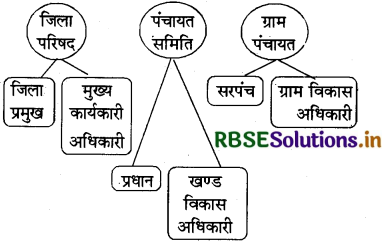
Question 2.
Draw the structure of Panchayat Raj.
Answer:
Class 8 Hamara Rajasthan Chapter 9 Question Answer in English Rajasthan in Rural and Urban Administration

IV. Short Answer Type Questions

Question 1.
What are the source of income of Gram Panchayat?
Answer:
Source of income of Gram Panchayat— The main source of income of Gram Panchayat is— (i) Different types of taxes, such as building tax, vehicle tax, purchase-sales tax, (ii) Income from fair and Haat bazaar (iii) Government Grants (iv) Grants from communities and (v) Penalty collected from convicts etc.

Question 2.
Explain the tasks of urban administration.
Answer:
Functions of Urban Administration / Urban Institutions—
(I) Compulsory work—
(i) Arranging pure water for the city.
(ii) Providing lighting and cleaning on the roads
(iii) Birth and death registration.
(iv) Arranging Fire Brigade etc.

(II) Optional work—
(i) Public garden
(ii) The stadium
(iii) Construction of reading room, library.
(iv) Planting trees.
(v) Get rid of stray animals.
(vi) Organising Fair – Exhibitions.
(vii) Arranging RAIN BASERA etc.

Class 8 Hamara Rajasthan Chapter 9 Question Answer in English Rural and Urban Administration

Question 3.
Write a comment on the Gram Sabha.
Answer:
Gram Sabha—

  1. Gram Sabha is the basic institution of Panchayati Raj, its area is a revenue village. Generally, every gram panchayat has its own Gram Sabha.
  2. The members of the Gram Sabha are all voters living in that revenue village. It is both his right and duty to attend Gram Sabha meetings.
  3. Gram Sabha is an example of direct democracy in India, under which the villagers participate directly in relation to local problems and development.
  4. Usually a meeting of the Gram Sabha is called every three months. The meeting of the Gram Sabha takes place on 26 January, 1 May, 15 August and on 2 October.

Class 8 Hamara Rajasthan Chapter 9 Important Question Answer

Objective Type Questions :

1. The unit of rural self-government is-
(a) Village Panchayat
(b) Panchayat Committee
(c) District Council
(d) All of the above
Answer:
(d) All of the above

2. The main function of the police department is—
(a) Levy a tax
(b) Maintaining peace
(c) Keep the land records
(d) Impart education
Asnwer:
(b) Maintaining peace

3. In which schedule of the Constitution, 29 functions of the three-tier structure of Panchayati Raj system are mentioned?
(a) In the 9th schedule
(b) In the 1st schedule
(c) In the 11th schedule
(d) In the 3rd schedule
Answer:
(c) In the 11th schedule

4. The head of Gram Panchayat is called-
(a) Pradhaan
(b) Sarpanch
(c) District Head
(d) Panchayat Secretary
Asnwer:
(b) Sarpanch

5. The term of Gram Panchayat is of-
(a) 3 years
(b) 5 years
(c) 2 years
(d) 6 years
Answer:
(b) 5 years

Class 8 Hamara Rajasthan Chapter 9 Question Answer in English Rural and Urban Administration

6. What is the minimum age a person must have to become a member of the Panchayat Samiti?
(a) 18 years
(b) 21 years
(c) 25 years
(d) 30 years
Answer:
(c) 25 years

Fill in the blanks :

1. The top level institution of the Panchayati Raj system is the ………………. .
Answer:
Zilla Parishad

2. The area of Gram Sabha is a ………………. .
Answer:
Revenue Village

3. The first village court in Rajasthan was opened in ………………. in Jaipur district.
Answer:
Bassi

4. The president of the municipal corporation is called the ………………. .
Answer:
Mayor

5. Providing pure water is an ………………. task of urban self-governing institutions.
Answer:
Essential

6. Building a library is a ………………. work of urban self-governing organisations.
Answer:
Voluntary

Very Short Answer Type Questions

Question 1.
What is. the minimum age of adult franchise in our country?
Answer:
The minimum age of adult franchise in our country is 18 years.

Question 2.
How will a person get the right to vote after completing the age of 18 years?
Answer:
After completing the age of 18 years, a person gets the right to add his name to the voter list and to vote only when the voter ID card is issued.

Question 3.
What we have to do to get our name added to the voter list?
Answer:
To get our name added to the voter list, we have to fill up a form with a copy of our birth certificate, Aadhaar card and Ration card and submit it to BLO.

Question 4.
Who is BLO?
Answer:
BLO is a government employee (teacher, patwari, gram sevak, clerk, etc.) who is selected by the Election Department, from the employees working in the same area.

Question 5.
Which constitutional amendment has given constitutional status to the Panchayati Raj system?
Answer:
73rd constitutional amendment.

Class 8 Hamara Rajasthan Chapter 9 Question Answer in English Rural and Urban Administration

Question 6.
How many works of Panchayati Raj system are mentioned in 11th Schedule?
Answer:
29 works.

Question 7.
Write the names of the three levels of the three-tier structure of the Panchayati State.
Answer:
(i) At the village level—Gram Panchayat (ii) At the medium or block level—Panchayat Samiti and (iii) Zilla Parishad at the district (higher) level.

Question 8.
What is Gram Panchayat?
Answer:
Gram Panchayat is the first political unit of democracy which is formed by consisting of Ward Panch, Up Sarpanch and Sarpanch.

Question 9.
Which institution of Panchayati Raj is formed at the development block level?
Answer:
A middle level institutionof Panchayati Raj is formed at the development block level.

Question 10.
What is the name of the top level institution of Panchayati Raj?
Answer:
The name of the top level institution of Panchayati Raj is Zilla Parishad.

Question 11.
What is Gram Sabha?
Answer:
Gram Sabha is a basic institution of every gram panchayat, whose area is a revenue village and its members are all voters living in that village.

Question 12.
At what time should the meeting of the Gram Sabha be called?
Answer:
Usually a meeting of the gram sabha should be called every three months.

Question 13.
What is the head of a municipal corporation called?
Answer:
The head of the municipal corporation is called the mayor.

Question 14.
How many forms of urban governance are there? Write their names.
Answer:
There are three forms of urban governance. They are-(i) Municipal council (ii) City council (iii) Municipality.

Question 15.
Municipal Corporation is formed in which cities?
Answer:
In those big cities where the population is more than five lakhs and the annual income is more than one crore, a municipal corporation is formed there.

Question 16.
Where is the city council established?
Answer:
Municipal councils are established in cities whose population is more than one lakh and less than five lakhs.

Question 17.
Where are the municipal boards made?
Answer:
Municipal boards are made in those cities where the population is between fifteen thousand to one lakh.

Class 8 Hamara Rajasthan Chapter 9 Question Answer in English Rural and Urban Administration

Question 18.
What are the presidents of the city council and the municipal board called?
Answer:
The presidents of the city council and the municipal board are called the chairman and the municipal president respectively.

Short Answer Type Question

Question 1.
Who is B.L.O.? What are its functions?
Answer:
B.L.O.—BLO of the booth level officer is a government employee (teacher, patwari, village servant, clerk etc.) who is elected by the Election Department from among the employees working in the same area.
Work of B.L.O.—The main work of B.L.O. is following-
(i) He conducts a house to house survey and adds the names of young men and women aged 18 years to the voters’ list.
(ii) He works to add new deprived voters and remove the names of migrated or dead voters from the list.

Question 2.
Our local level government operates with a three-tier system. Explain how?
Answer:
Broadly our local governments can be divided into two parts -(i) Urban Local Government and (ii) Rural Local Government. Both these types of governments run through a three-tier system. In rural government, this order is in the form of Gram Panchayat, Panchayat Samiti and Zila Parishad in the smallest order and in urban government, it is in the form of Municipality, Municipal Council and Municipal Corporation.

Question 3.
Explain the structure of Gram Panchayat.
Answer:
Structure of Gram Panchayat—The Gram Panchayat is the first political unit of rural local democratic self-government. This ward is made up of Panch, Upsarpanch and Sarpanch. He is the election representative of the people of Gram Panchayat area. Elections to these panchayats are conducted by the ‘State Election Commission’. The village panchayat has a village secretary appointed by the government.

The term of Gram Panchayat is 5 years. It requires at least two meetings every month.

Question 4.
Explain the structure of Panchayat Samiti.
Answer:
Structure of Panchayat Samiti—The structure of the Panchayat Samiti is explained under the following points—
1. Election representative—Panchayat Samiti is an important link connecting Gram Panchayat and Zilla Parishad. The districts of the states are divided into some smaller development blocks in terms of development. Its entire area is divided into a few wards. The people of these wards choose their representatives. These elected members elect the chairman or deputy chairman. A minimum of 25 years is required for a member of the Panchayat Samiti.

2. Ex-officio member—In addition to the elected members in the Panchayat Samiti, the sarpanch of the Gram Panchayat under the Panchayat Samiti area is its ex-officio member.

3. Government officer—A block development officer is appointed by state government to help pradhan and deputy pradhan in the work related to the Panchayat Samiti.

4. Tenure—The tenure of the members of the Panchayat Samiti is 5 years.

Question 5.
Explain the structure of district council.
Answer:
The structure of the Zila Parishad is explained under the following points—
1. Elected Members of District Council—A ward is formed by combining some gram panchayats in each district. One member from each ward constituted in this way is elected by the voters of that ward. These members are called members of the district council.

2. District Head and Deputy District Head— The elected .pembers of the Zila Parishad together elect the district head and deputy district chief from among themselves.

3. Ex-officio member—Apart from the elected members of the Zila Parishad, the head of the Panchayat .Committees of the district, elected members of the district, elected Lok Sabha and Rajya Sabha members of the district are ex¬officio members.

4. Chief Executive Officer—A Chief Executive Officer is appointed by the State Government to assist the District Head in all works of the Zila Parishad.

Question 6.
What is the source of income of panchayat samiti? Write.
Answer:
Following is the source of income of panchayat samiti—

  1. Income from local duties and taxes.
  2. Grants received from state government.
  3. Income from fair and markets.
  4. The amount provided by the government to run various government projects.
  5. Income from levying tax on merchants, businesses and industries.

Class 8 Hamara Rajasthan Chapter 9 Question Answer in English Rural and Urban Administration

Question 7.
Mention the sources of income of district council.
Answer:
Following is the source of income of district council—

  1. Grants received by central and state government,
  2. Recoveries made from panchayat committees,
  3. Fixed share of revenue,
  4. Government and non-government loans, and
  5. Grants given by people.

Question 8.
Write a short comment on the village court.
Answer:
In order to provide speedy and accessible justice at the Gram Panchayat level in rural areas, village.courts have been established under the Village Courts Act 2008. The appointment of judicial officers in these village courts is done on the advice of the High Court.

Question 9.
Before construction of a house approval is required from which institution?
Answer:
Before construction of a house, approval for construction is taken from die Municipal Corporation, Municipal Council or Municipality in the cities and in villages its approval is taken from the Gram Panchayat.

Question 10.
What is government and what does it do?
Answer:
Government—The government is elected by the public. The government works in three places. These are called Central Government, State Government and Local Government.

  1. In the entire country, the central government work to fulfill our needs of equal importance.
  2. The state government completes the important tasks which are done at every state level related to the needs of the people.
  3. The local government meets the needs and problems of the people of a particular place.

Question 11.
How many forms of urban governance are there?
Answer:
There are three forms of urban governance. Municipal Corporation, city council and municipal board. As—
1. Municipal .Corporation—In those big cities where the population is more than 5 lakhs, and the annual income is more than one crore, the Municipal Corporation is formed at that place.

2. City Council—City councils are established in cities where the population is more than one lakh and less than five lakh.

3. Municipal board—Municipal boards are found in those cities where the population is between 15 thousand and 1 lakh.

Long Answer Type Questions

Question 1.
Mention the works of Panchayat Samiti and Gram Panchayat.
Answer:
Following is the work of Panchayat Samiti-

  1. The Panchayat Samiti reviews and supervises the works of the Gram Panchayat.
  2. The Panchayat Samiti provides training and guidance to newly elected sarpanch and panch.
  3. The Panchayat Samiti coordinates between the Sarpancll, the Panchayat Samiti members and the district council members.
  4. The Panchayat Samiti holds a meeting of the General Assembly.
  5. It maintains a register for its meetings and compliance with the decisions of local committees.
  6. It implements boards showing actual expenditure at the workplace and panchayat headquarters.
  7. It organises animal fairs.

Following is the work of Gram Panchayat—

  1. Gram Panchayat arranges sanitation and drinking water in its area.
  2. It arranges light on the streets in its area.
  3. It works for the implementation of MGNREGA program in its area and provides employment to the applicants.
  4. It works to make the public distribution system work smoothly.
  5. It works for the maintenance of rural roads.
  6. It maintains the record of the birth, death and marriage registration.
  7. It coordinates with the district administration in times of disasters and epidemics.
  8. It develops pastures and forests in its region.
  9. It assists in human and animal health, nutrition and family welfare programs.
  10. It works for the development and proper utilisation of local physical resources in its area.

Class 8 Hamara Rajasthan Chapter 9 Question Answer in English Rural and Urban Administration

Question 2.
Write an article on urban local self-government institutions.
Answer:
Urban local self-government institutions have been discussed under the following points—
1. Three types of institutions—There are three types of urban local self-government institutions—(a) Municipal Corporation (b) City Council and (c) Municipal Board. In those big cities where the population is more than 5 lakhs, and the annual income is more than one crore, the Municipal Corporation is formed at that place. City councils are established in cities where the population is more than one lakh and less than five lakh.Municipal boards are found in those cities where the population is between 15 thousand and 1 lakh.

2. Election of representatives—The city is divided into different areas, called wards. From each ward, the people elect a representative (called a councilor) and those representatives are sent to their respective wards. Their responsibility is to look after the development of their wards. These councilors together choose the president and vice-president, who are called by different names. The president of a municipal corporation is called the mayor, the president of the city council is called the chairman and the chairman of the municipality is called the municipal head.

3. Arrangements of reservation—According to the 74th constitutional amendment in the election of these urban institutions, there is a provision to reserve at least one third seats for women. Similarly, there is provision for reservation of seats for scheduled castes, scheduled tribes and other backward classes according to their ratio in the population. This provision of reservation is made so that their share can be increased by them and representation of these classes can be increased.

4. Work—These urban institutions have two functions, (a) Compulsory work and (b) Optional work.
(a) Compulsory Work—the major compulsory work of these institutions are—Arranging pure watef for the city; Maintaining lights and cleanliness on roads; Maintaining the record of birth and death and arrangement of fire brigade.
(b) Optional Work—the optional work of these institutions are – making of Public Paries, stadium, library, reading room etc, plantation, Get rid of the city from stray animals, Organising fairs and exhibitions mid arranging night shelters.

5. Source of Income—These institutions get money through three channels. They are—
(a) They receive funds from the Central and State Governments.
(b) They receive money by levying various fees and fines.
(c) They get money by levying various taxes on their citizens.

Class 8 Hamara Rajasthan Chapter 8 Question Answer in English State Efforts for Public Awareness and Social Reform

Engaging with these Our Rajasthan Book Class 8 Solutions and Class 8 Hamara Rajasthan Chapter 8 Question Answer State Efforts for Public Awareness and Social Reform will strengthen your knowledge and prepare you for assessments.

Class 8 Our Rajasthan Chapter 8 Question Answer State Efforts for Public Awareness and Social Reform

Our Rajasthan Class 8 Chapter 8 State Efforts for Public Awareness and Social Reform Question Answer

I. Write the correct answers to the following questions in brackets :

1. Rajasthan’s female literacy rate according to the year 2011 census is-
(a) 65.46 %
(b) 52.10%
(c) 55.12%
(d) 55.10%
Answer:
(b) 52.10%

Class 8 Hamara Rajasthan Chapter 8 Question Answer in English State Efforts for Public Awareness and Social Reform

2. The father of the Bhoodan Movement is-
(a) Mahatma Gandhi
(b) Hiralal Shastri
(c) Vinoba Bhave
(d) Jawaharlai Nehru
Answer:
(c) Vinoba Bhave

II. Match the column:

A B
1. WPAT (a) United Nations Oiganisation
2. EVM (b) None of these
3. NOTA (c) Voter-verified paper audit trail
4. Mazdoor Kisan Shakti Sangathan (d) Electronic Voting Machine
5. Child Rights Agreement (e) Right to information

Answer:

A B
1. WPAT (c) Voter-verified paper audit trail
2. EVM (d) Electronic Voting Machine
3. NOTA (b) None of these
4. Mazdoor Kisan Shakti Sangathan (e) Right to information
5. Child Rights Agreement (a) United Nations Oiganisation

III. Very Short Answer Type Questions

Question 1.
What is a sweep program?
Answer:
To train voters, citizens and electors about the election process and to increase their participation, a versatile program run by the Election Department is called sweep. It has two main objectives—
(i) Ethical voting (fair and ethical voting) and
(ii) Informed voting (voting with awareness)

Question 2.
Tell us about child rights.
Answer:
Child rights are based on four basic principles. These are—(i) Right to life, (ii) Right to safety, (iii) Right to development and (iv) Right to participation.

Class 8 Hamara Rajasthan Chapter 8 Question Answer in English State Efforts for Public Awareness and Social Reform

Question 3.
When was the State Women’s Commission formed?
Answer:
The State Women’s Commission was formed on 15 May, 1999.

IV. Short Answer Type Questions

Question 1.
Briefly describe the Bhoodan Movement.
Answer:
Bhoodan Movement—On 18 April 1951, a piece of land was donated in a small village of Pochampally in Telangana. This was the beginning of the Bhoodan Movement. The aim of this movement was to promote the ownership of fertile land by removing the inequality of land ownership. Under this movement, Vinoba Bhave was urging landowners to donate one-sixth of their total land. People throughout the country supported this movement. A meaningful effort was made to remove the anomaly of ownership by distributing the donated land among the landless.

Success of Bhoodan—Vinoba Bhave’s Bhoodan appeal became meaningful. After doing padyatras across the country, he accepted the donation of lakh acres of land.

He started the work of distributing about one third of this land to deprived class and tribal landless people. On Vmoba’s appeal, Bhoodan was started in Nagaur district of Rajasthan and the State Government also passed the Milage Donation Act, 1971. ’

Question 2.
Name the social reformers who contributed for social reform.
Answer:
In modem India, Raja Ram Mohan Roy, Jyotiba Phule, Rama Swami Naicker, Mahatma Gandhi also tried to remove caste discrimination and equality. In Rajasthan, before independence, social reformers like Dayanand Saraswati, Govind Guru, Mama Baleshwar, Haribhau Upadhyay etc. contributed for social reform.

Class 8 Hamara Rajasthan Chapter 8 Question Answer in English State Efforts for Public Awareness and Social Reform

Question 3.
Explain Cyber Security measures.
Answer:
Measures of Cyber Security—

  1. For cyber security, we should change our password and ATM PIN from time to time and do not tell anyone.
  2. Use the latest antivirus software in your computer and laptop.
  3. Do not give personal information over phone or email to anyone.
  4. Report the fraud related to ATM and bank accounts immediately to the concerned bank.
  5. In case of cybercrime, citizens can lodge complaints online on the National Cyber Crime Reporting Portal.

Class 8 Hamara Rajasthan Chapter 8 Important Question Answer

Objective Type Questions :

1. Which Article of the Constitution has declared untouchability a punishable offense?
(a) Article 14
(b) Article 15
(c) Article 16
(d) Article 17
Answer:
(d) Article 17

2. The state government constituted Rajasthan State Women’s Commission on-
(a) 15 May, 1999
(b) 8 April, 1971
(c) 8 March, 2018
(d) 1 April, 2011
Answer:
(a) 15 May, 1999

3. ‘Beti Bachao Beti Padhao’ yojana is implemented in Rajasthan since-
(a) 2015
(b) 2016
(c) 2017
(d) 2018
Answer:
(a) 2015

4. Women empowerment is related to—
(a) Beti Bachao, Beti Padhao Yojana
(b) Dowry Prohibition Act
(c) Hindu Succession and Protection Act
(d) All of the above
Answer:
(d) All of the above

5. The Government of India passed the ‘Right to Information Act’ in the year—
(a) 2000
(b) 2005
(c) 2009
(d) 2010
Answer:
(b) 2005

Class 8 Hamara Rajasthan Chapter 8 Question Answer in English State Efforts for Public Awareness and Social Reform

6. In Rajasthan, the rule of ‘Rajasthan Free and Compulsory Child Education’ came into force on-
(a) 1 April, 2010
(b) 1 April, 2011
(c) 1 April, 2009
(d) 1 April, 2008
Answer:
(b) 1 April, 2011

Fill in the blanks :

1. ……………., the main founder of the ‘Mazdoor Kisan Shakti Sangathan’, gave direction to the struggle for the Right to Information Act.
Answer:
Aruna Roy

2. On 20 November 1989, the ……………. Agreement was passed by the General Assembly of the United Nations.
Answer:
Juvenile Crime

3. For cyber security, ……………. your password or ATM PIN from time to time and do not tell anyone.
Answer:
change

4. To make every citizen realize that his vote is important for the country, a ……………. campaign was conducted.
Answer:
Sweep

5. NOTA means ……………. .
Answer:
None of the above.

Very Short Answer type Questions

Question 1.
Name any two efforts made by the Government of Rajasthan for social equality and harmony.
Answer:
(i) Right to education
(ii) Right to information.

Question 2.
Mention any two acts implemented Jby the Rajasthan government for land reforms.
Answer:
(i) Rajasthan Tenancy Act, 1955, (ii) Rajasthan Land Revenue Act, 1956

Question 3.
Which department in Rajasthan performs welfare functions of various sections?
Answer:
Social Justice and Empowerment Department.

Question 4.
‘You can tell the condition of that nation by looking at the status of women in any nation.’ Whose statement was this?
Answer:
The statement was of Pandit Jawaharlal Nehru.

Question 5.
What was the female literacy rate in Rajasthan in 1951?
Answer:
In 1951, the female literacy rate in Rajasthan was 2.51 %.

Question 6.
When did Rajasthan government set up Rajasthan Women’s Commission?
Answer:
The Government of Rajasthan formed the Rajasthan State Commission for women on 15 May, 1999.

Question 7.
Which scheme is being operated for adolescent girls who are not going to school in the age group of 11 to 18 years or leaving school in between?
Answer:
Rajiv Gandhi Scheme for Empowerment of adolescent Girls (RGSEAG) – Sabla.

Question 8.
Keeping in mind the declining child sex ratio across the country in 2015, which scheme was launched to increase the child sex ratio?
Answer:
Beti Bachao, Beti Padhao Yojana.

Question 9.
What does the ‘NOTA’ button in EVM ensure?
Answer:
The voter’decides the vote by pressing the last NOTA button if any of the candidates standing in the election is not considered suitable.

Class 8 Hamara Rajasthan Chapter 8 Question Answer in English State Efforts for Public Awareness and Social Reform

Question 10.
What is the full form of WPAT?
Answer:
The full name of WPAT is Voter Variable Paper Audit Trial.

Short Answer Type Question

Question 1.
What efforts have been made by the Government of Rajasthan for social equality and harmony?
Answer:
Rajasthan Government has made the following efforts for social equality and harmony-

  1. Removal of untouchability
  2. Protective measures
  3. Reservation for deprived and economically weaker sections
  4. Efforts for women education and empowerment
  5. Child rights
  6. Right to education
  7. Right to Information
  8. Rajasthan Public Relations Portal
  9. Free facility to register and receive complaints via phone at Citizen’s call center
  10. To make the election process more transparent and fair and to make citizens aware of their rights.

Question 2.
Write a brief comment on the abolition of untouchability.
Answer:
Abolition of untouchability—Article 17 of the constitution declared untouchability to be a punishable offense. For the abolition of untouchability, the Government of India enacted the Protection of Civil Rights Act, 1955. In this act punishment is prescribed for preaching and practice of Untouchability for the enforcement of any disability arising therefrom and for matters connected therewith.

To implement the Untouchability Act, 1955 effectively, the Rajasthan government also enforced the Scheduled Castes and Tribes (Prevention of Atrocities) Act, 1989 effectively. In Rajasthan, ‘Social Justice and Empowerment Department’ mainly works for the welfare of education, socio-economic development, scheduled castes, tribes, economic backward classes, other backward classes, women, children etc.

Question 3.
Write a brief note on the voting process.
Answer:
Preparation of voting process—In voting process Scheduling of polling stations, publishing of voter list, making list of candidates, preparing EVM machine for election etc. works are involved.

Formation of voting group—A polling party is formed by the District Election Officer for each polling station. The polling party consists of a presiding officer and other voting officers. Voting by voters—As soon as the voter enters the polling station his name is matched to the voter’s list. After this, indelible ink is applied to the finger (index finger) of the voter’s left hand. After his signature in the voter register, voter enters the voting cabin to cast a vote on the EVM machine. There the voter secretly presses button of EVM machine. This is how the voting process is completed.

Counting of votes and declaration of result— In the presence of the candidate or his representative the concerned Returning Officer counts the votes of EVM machine and announces the result.

Class 8 Hamara Rajasthan Chapter 8 Question Answer in English State Efforts for Public Awareness and Social Reform

Question 4.
Write a brief note on WPAT.
Answer:
WPAT—Full name of WPAT is Voter- Verified Paper Audit Trial. This is a printer device. This is connected to ballot unit and control unit of EVM. After voting, a ballot slip is printed by the printer, on which the candidate’s serial number, name and election symbol are printed. This slip is visible to the voter in a transparent box for 7 seconds, after which the slip goes into the printer’s drop box. The sound of a beep is heard. In this way the voting process get completed.

This allows the voter to know whether the candidate he has voted has got the vote or not. Its use has increased fairness and credibility in the election process. In the event of a dispute in counting of votes, the help of these slips can be taken.

Question 5.
How did Rajasthan become the first state to enact the flight to Information Act?
Answer:
In Dev Dungri village of Bhim tehsil of Rajsamand district of Rajasthan, labourers and farmers struggled to get copies of government records related to their wages, such as attendance and payment register. On the basis of this demand, Rajasthan became the first state to enact the Right to Information Act in 2000.

Question 6.
Write a brief note on the Right to Information Act, 2005.
Answer:
Right to Information Act, 2005—In 2000, the Rajasthan government first enacted the ‘Right to Information Act’. Gradually, the struggle for right to information took nation-wide form and became nationwide. The Mazdoor Kisan Shakti Sangathan played an important role in this struggle. Aruna Roy, the main founder and social activist of this organization, gave direction to’ the struggle for the right to information by organizing the people of the lower section of the society. Accepting public sentiment, the Government of India enacted the ‘Right to Information Act 2005’. This law proved to be a powerful step to increase public participation and transparency at the government level. Through this step, the common person can get information from the government or any government department.

Question 7.
Explain the main provisions of the Right to Free and Compulsory Child Education Act.
Answer:
The Rajasthan Government enacted the ‘Rajasthan Free and Compulsory Child Education’ Act in 2010, which came into force from 1 April 2011.

Following are the major provisions of this Act—

  1. This Act provides for free and compulsory elementary education (classes 1 to 8) to children between die ages of 6 to 14, so that no child is denied education.
  2. Under this Act, a child can enter the prescribed class at any time according to his age.
  3. In private schools, 25 percent seats are reserved for the children of weaker and backward classes, instead of which the fixed amount is given by the government to private schools.

Question 8.
What are the actions of the Rajasthan government in the direction of child protection?
Answer:
Following are the actions of the Rajasthan government for child protection—

  1. The State Commission for Protection of Child Rights and the Rajasthan State Child Protection Committee work for community level execution and awareness of child protection issues.
  2. A 24-hour free emergency access service 1098 (Toll Free Telephone Service) is been started in the state for children suffering from difficulties, neglected, abandoned or those who need care and protection.
  3. The state government is making efforts to eradicate and improve the challenges of child protection in Rajasthan such as child marriage, female feticide, female education, child sex ratio, child labor, malnutrition etc.

Class 8 Hamara Rajasthan Chapter 8 Question Answer in English State Efforts for Public Awareness and Social Reform

Question 9.
Briefly explain the land reforms.
Answer:
Land reforms—At the time of the merger with the Union of India, about 75 percent of the population of Rajasthan was engaged in agricultural work. More than half of the land of Rajasthan was dry and deserted. The major problem of the state was related to land reforms. For this, a revenue board was established for ill the integrated princely states of Rajasthan. Land disputes are very complex. Therefore, the peace and order of the state, especially the rural areas, is associated with them.

The revenue board was given the responsibility to provide cheap, speedy and accessible justice to those trapped in the disputes and the Rajasthan Government has implemented the Rajasthan Tenancy Act, 1955 and the Rajasthan Land Revenue Act, 1956 for land reforms.

Long Answer Type Question

Question 1.
Describe the major efforts taken by Rajasthan Government for women’s empowerment.
Answer:
The efforts of the Government of Rajasthan for women’s empowerment have been discussed under the following points—
1. State women’s commission—The state government constituted the Rajasthan Women’s Commission on 15 May 1999. This commission takes action on the basis of direct hearing from the public and complaint and cognizance of the news published in newspapers. The state women’s commission consists of a chairman and three members. The term of the Speaker is 3 years. This Commission takes effective steps with a view to check unfair treatment of women, remove discrimination against women in the State Public Services and improve the condition of women.

2. Women’s Self Help Group Program—This program is being run to give employment to women and to make them financially independent. In this, 10 to 20 women make their own decisions and form groups. Through their small savings, they develop self-reliance and move on the path of self-employment.

The govemmept provides an opportunity to sell the products manufactured by these groups.

3. Women Domestic Violence (Prevention) Act, 2005—The Act has been enacted by the Government of India for the purpose of providing protection and immediate relief to women from domestic violence. Domestic violence is comprehensively defined in this Act.

4. Rajeev Gandhi Scheme for Empowerment of Adolescent Girls (Sabla)— Under this, scheme, efforts are made to improve the status of nutrition and health, literacy, skill development and better understanding on social issues in adolescent girls.

This scheme is being conducted for adolescent girls who are not going to school or left the school in the age group of 11 to 18 years.

5. Beti Bachao, Beti Padhao—It was started in the year 2015 keeping in mind the declining child sex ratio across the country. Its objectives was preventing female feticide, increasing the number of girls in the school, reducing the number of girls leaving schools, implementing the right to education rules and increasing the construction of toilets for girls.

6. Other law—There is also some other laws exist for women empowerment. They are –
(a) Hindu Succession, Adoption and Protection Act, 1956 (Amendment 2005)
(b) Dowry Prohibition Act, 1961
(c) The Child Marriage Prohibition Act, 1925 (Amendment 1986, 2006)

Class 8 Hamara Rajasthan Chapter 8 Question Answer in English State Efforts for Public Awareness and Social Reform

Question 2.
What do you understand by cyber security? While mentioning the types of cyber security attacks mention the measures for cyber security.
Answer:
Meaning of cyber security—Cyber security is a type of security that is used for Internet-connected systems. In this, computer experts and IT trained people work to protect hardware, software and data from cybercrime. Types of cyber security attacks are following—
1. Ransomware—It is a type of virus that causes damage to files by criminals attacking people’s computers and systems. The criminal then demands the ransom/bribe from the computer or system owner to leaves his system.

2. Malware—It damages any file or program of the computer, such as computer viruses, worms, Trojans, etc.

3. Cyber fraud—In this, people are tricked info trap by means of conversation, so that information about their personal data, password etc. can be obtained. Examples of fishing and spoofing are –
(a) Fishing—lids is a kind of fraud in which fake e-mails are sent to people in the name of reputed or trusted institutions, so that they feel that this mail has come from a good organization. The purpose of such mail is to steal the necessary data.
(b) Spoofing—In this, a fraudster tries to obtain the identity or personal information of someone else by pretending to be a legitimate business, neighbor or trust worthy person.

Following is the cyber security measures—

  1. To avoid cybercrime one must change password or ATM pin from time to time and do not tell anyone.
  2. Use the latest version of antivirus or software in your computer or laptop.
  3. Do not disclose your personal details over the phone or e-mail to anyone.
  4. Immediately inform to the bank in the case of ATM and bank account related fraud.
  5. In case of cybercrime, citizens can register online complaints on the National Cybercrime Reporting Portal.

Class 8 Hamara Rajasthan Chapter 7 Question Answer in English Development Plans

Engaging with these Our Rajasthan Book Class 8 Solutions and Class 8 Hamara Rajasthan Chapter 7 Question Answer Development Plans will strengthen your knowledge and prepare you for assessments.

Class 8 Our Rajasthan Chapter 7 Question Answer Development Plans

Our Rajasthan Class 8 Chapter 7 Development Plans Question Answer

I. Write the correct answers to the following questions in brackets :

1. How many goals are included in the Sustainable Development goal?
(a) 15
(b) 16
(c) 17
(d) 18
Answer:
(c) 17

2. Ayushman Bharat is related to which field?
(a) Education
(b) Woman
(c) Health
(d) Agriculture
Answer:
(c) Health

II. Fill in the blanks :

1. Under the ………….. programme, the objective has been to stop female foeticide and to promote girl education.
Answer:
Beti Bachao Beti Padhao

Class 8 Hamara Rajasthan Chapter 7 Question Answer in English Development Plans

2. ………….. scheme has been started for cashless treatment in government and private hospitals.
Answer:
Ayushman Bharat.

III. Very Short Answer Type Questions

Question 1.
State the objective of Rajasthan Janani Shishu Suraksha Yojana.
Answer:
The objective of Rajasthan Janani Shishu Suraksha Yojana is reducing Maternal and Infant Mortality.

Question 2.
Name the two schemes of the economic sector running in Rajasthan.
Answer:
(i) Pandit Deen Dayal Upadhyaya Grameen Kaushalya Yojana (ii) Bhamashah Yojana

IV. Short Answer Type Questions

Question 1.
Describe the schemes for the empowerment of women.
Women Empowerment Schemes

Name of the Plan/Programme Main Objective
1. Beti Bachao Beti Padhao Girl education and saving girls
2. Self-planning scheme Improvement in living standards of poor women, widow abandoners and rural women
3. Shared campaign Getting rid of child marriage
4. Dignity Protection and Respect for Girls Honoring individuals and organisations involved in child protection
5. Mukhya Mantri Rajshri Yojana Improving education and health status in girls
6. IM Shakti Fund Making women self-reliant by providing financial assistance to women self-help groups

Question 2.
Explain Sustainable Development Goal 2030.
Answer:
Sustainable Development Goal 2030—
The Sustainable Development Agenda was adopted in 2015 by the member countries of the United Nations. The main goal of this action plan is to eliminate poverty’ in all its fornis and places so that no one is left behind. Through this agenda, 17 goals were selected, which were targeted to be achieved by 2030. These 17 major goals are as follows :

  1. End of poverty
  2. Ending hunger
  3. Good health and standard of living
  4. Quality education
  5. Gender equality
  6. Pure Water and Cleanliness
  7. Affordable and clean energy
  8. Honourable work and economic development
  9. Industry, innovation and development of infrastructure
  10. Reduction in inequality
  11. Sustainable Cities and Communities
  12. Sustainable consumption and production
  13. Climate change
  14. Life in the water
  15. Life on land
  16. Peace, Justice and Strong Institutions
  17. Collective strengthened institutions in achieving goals.

Our villages are also making special efforts towards achieving these development goals.

Class 8 Hamara Rajasthan Chapter 7 Important Question Answer

Objective Type Questions :
1. ‘Swachh Bharat Abhiyan’ is related to which field?
(a) Agriculture
(b) Economic
(c) Development
(d) Health
Answer:
(c) Development

Class 8 Hamara Rajasthan Chapter 7 Question Answer in English Development Plans

2. The main objective of the “National Food Security Mission’ is-
(a) Providing reasonable prices for farmers’ produce
(b) Production of improved varieties of wheat and pulses
(c) Increasing growth rate in agriculture and allied sectors
(d) To deliver financial and non-financial benefits directly to the needy.
Answer:
(b) Production of improved varieties of wheat and pulses

3. The main objective of the ‘Gramin Gaurav Path’ is—
(a) Connecting rural roads to mega highway
(b) Providing pucca houses in rural areas
(c) Development of roads in rural areas
(d) Make the country free from open defecation.
Answer:
(a) Connecting rural roads to mega highway

4. The education sector scheme of Rajasthan Government is-
(a) Follow up plan
(b) Gargi Puraskar
(c) Support & Gift Scheme
(d) Post-Matric Scholarship Scheme
Answer:
(b) Gargi Puraskar

5. ‘Rajasthan Jan Aadhaar Yojana 2019’ is related to—
(a) Education
(b) Medical
(c) Jan Aadhaar Card
(d) Regeneration of weaker sections
Answer:
(c) Jan Aadhaar Card

Fill in the blanks :
1. Any state moves only when its nature is ……… .
Answer:
Public welfare

2. With a view to providing immediate and free first aid to the citizens near their residence, the locality clinics in the state have been started from …………. .
Answer:
December 2019

3. The main objective of providing pucca houses in the rural area is the …………. Yojana.
Answer:
Pradhan Mantri Awas

4. The main objective of the ……………… Mission is to produce improved varieties of wheat and pulses.
Answer:
National Food Security

Very Short Answer Type Question

Question 1.
What does public welfare state mean?
Answer:
Public welfare state means that state, which does many things for the welfare and prosperity of its people

Class 8 Hamara Rajasthan Chapter 7 Question Answer in English Development Plans

Question 2.
Name any two schemes related to agriculture.
Answer:
(i) Agricultural Welfare Fund (ii) Pradhan Mantri Crop Insurance Scheme

Question 3.
Explain the purpose of Kisan Kalewa Yojana
Answer:
The objective of the Kisan Kalewa scheme is to provide financial assistance to farmers for getting quality food.

Question 4.
Write the names of any two schemes in the field of education.
Answer:
(i) Asha Sahyogini (ii) Chief Minister Free: Medication and Screening Scheme.

Question 5.
Write the names of two health related schemes running in Rajasthan.
Answer:
(i) Free Textbook Delivery Scheme (ii) Free cycle delivery scheme.

Question 6.
What is the main objective of MGNREGA?
Answer:
The main objective of MGNREGA is – to provide minimum 100 days of employment to rural families in a year.

Question 7.
Name two schemes related to development.
Answer:
(i) Pradhan Mantri Awas Yojana (ii) Pradhan Mantri Gram Sadak Yojana,

Question 8.
What is a special area development programme?
Answer:
To develop special areas of Rajasthan State, such as—Mewat, Dang, Magra, developing Frontier Areas.

Short Answer Type Questions

Question 1.
Which institutions are working to promote the industrial sector in the state?
Answer:
Rural non-agricultural development agency, Rajasthan State Industrial Development (RIICO), Appropriation Corporations and Rajasthan Small Industries Corporation Limited (RAJSICO) are working to promote the industrial sector in the state of Rajasthan.

Class 8 Hamara Rajasthan Chapter 7 Question Answer in English Development Plans

Question 2.
Which schemes are being run in the field of education in the state of Rajasthan?
Answer:
Schemes being run in the field of education in the state of Rajasthan are-

  1. Free Textbook Distribution Scheme
  2. Student Safety Accident Insurance Scheme
  3. Gargi Award
  4. Free Cycle Delivery Scheme
  5. Laptop Vitran Yojana
  6. Mukhya Mantri Hamari Beti Yojana and
  7. Akshay Peti Yojana

Question 3.
Which schemes are being implemented by the Government of Rajasthan for the development and upliftment of the weaker and neglected sections of the society.
Answer:
Government implemented many schemes for the development and upliftment of the weaker and neglected sections of the society, such as- Matric Scholarship Scheme, Widow Remarriage Scheme, Cooperation and Gift Scheme, Old Age Pension Scheme, Mukhyamantri Ekal Nari Pension Yojana, Mukhyamantri Vishesh Yogyajan Samman Pension Yojana.

Question 4.
Write a brief comment on Rajasthan Jan Aadhaar Yojana 2019.
Answer:
Rajasthan Jan Aadhaar Yojana, 2019- Main objective of launching ‘Rajasthan Jan Aadhaar Yojana, 2019’ was to make the benefits of the public welfare schemes of the state easy, accessible and transparent to the common man. Under this, the residents of the state will get Jan Aadhaar card. This card can also be used for taking advantage of government schemes and facilities and for proof of identity and address.

Long Answer Type Question

Question 1.
Give details of agricultural schemes being run in the state of Rajasthan.
Answer:
Following is the details of agricultural schemes being run in the state of Rajasthan—

Name of Scheme/Program Main Objective
1. Krishi Kalyan Kosh Providing a fair price for the farmers’ produce.
2. National Food Security Mission Production of improved variety of wheat and pulses.
3. Rashtriya Krishi Vikas Yojana Increasing growth rate in agriculture and related sectors.
4. Pradhan Mantri Krishi Sinchai Yojana Providing water for irrigation to improve crops.
5. Pradhan Mantri Fasal Bima Yojana To provide relief to farmers by insuring crops.
6. Rashtriya Aayush Mission Encourage the cultivation of medicinal plants and facilitate the availability of raw materials for medicines.
7. Kisan Kalewa Yojana To provide financial assistance to formers for quality food.
8. Rajeev Gandhi Krishak Sathi Sahayata Yojana To provide financial assistance to traders, agricultural labourers and labourers for agriculture, agricultural trade.

Question 2.
Give details of health related schemes being run in Rajasthan.
Answer:
Health related Schemes

Name of scheme/program Main Objective
1. Rajasthan Janani Shishu Suraksha Yojana Reducing maternal and infont mortality rate.
2. ASHA Sahyogini Providing safe delivery condition, health care, nutrition and nutritional support services to pregnant women.
3. Rashtriya Swasthya Mission It aims for attainment of universal access to equitable, affordable and quality health care services in rural and urban area.
4. Janani Express Bringing pregnant women and new-boms to medical institutions and taking them home.
5. Aayushmaan Bharat Providing cashless treatment to socio¬economically backward castes in government and private hospitals.
6. Mukhyamantri Nishulk Dava Yojana Yojana and Mukhyamantri Nishulk Jaanch Yojana To make available the most used medicine free of cost in all medical institutions of the state and to provide free testing of diseases there.

Class 8 Hamara Rajasthan Chapter 7 Question Answer in English Development Plans

Question 3.
Write a description of the rural deve opment schemes being run in Rajasthan.
Answer:
Rural development schemes

Name of scheme/program Main objective
1. Mukhyamantri Adarsh Gram Panchayat Yojana Development of democratic values along with agriculture, education, health, environment in selected villages.
2. Swachh Bharat Mission Eliminate open defecation in the country.
3. Atal Bhujal Yojana Improve groundwater management through community support.
4. Special Area Development Program To develop special areas like Mewat, Dang, Magra and Frontier areas.
5. MGNREGA(Mahatma Gandhi National Rural Employment Guarantee Act) Provide minimum 100 days of employment to mral families in a year.
6. Pradhanmantri Awas Yojana Providing houses in mral areas.
7. Gamin Gaurav Path Connecting mral roads to mega highways.
8. Pradhan Mantri Gram Sadak Yojana Development of roads in mral areas.

Class 8 Hamara Rajasthan Chapter 6 Question Answer in English Transport and Tourism

Engaging with these Our Rajasthan Book Class 8 Solutions and Class 8 Hamara Rajasthan Chapter 6 Question Answer Transport and Tourism will strengthen your knowledge and prepare you for assessments.

Class 8 Our Rajasthan Chapter 6 Question Answer Transport and Tourism

Our Rajasthan Class 8 Chapter 6 Transport and Tourism Question Answer

I. Write the correct answers to the following questions in brackets :

1. In which district has the metro rail been developed in Rajasthan?
(a) Ajmer
(b) Jaipur
(c) Jaisalmer
(d) Kota
Answer:
(b) Jaipur

2. Jaisamand lake is situated in which district?
(a) Udaipur
(b) Chittorgarh
(c) Banner
(d) Jalore
Answer:
(a) Udaipur

II. Very Short Answer Type Questions

Question 1.
When and where did the first train run in Rajasthan?
Answer:
The first train ran in Rajasthan in 1874 AD from Bandikui (Dausa) to Agra Fort (Uttar Pradesh).

Class 8 Hamara Rajasthan Chapter 6 Question Answer in English Transport and Tourism

Question 2.
Where is the Sanganer International Airport situated?
Answer:
The Sanganer International Airport is situated in Jaipur city.

III. Short Answer Type Questions

Question 1.
What are the major natural tourist places in Rajasthan?
Answer:
Following are the major natural tourist places in Rajasthan –
(i) Beautiful Sand dunes in Jaisalmer, (ii) Jaisamand, Fatehsagar, Pichhola, Udaisagar lakes and Shilpgram in Udaipur, (iii) Mount Abu andNakki Lake, the famous hill station of Sirohi, (iv) Pushkar lake in Ajmer, (v) Rajsamand Lake in Rajsamand, (vi) Chulia and Menal waterfalls in Chittorgarh, (vii) Ranthambore National Park of Sawai Madhopur, (viii) Sariska National Park of Alwar, (ix) Keoladeo Ghana National Bird Sanctuary of Bharatpur, (x) National Maru park in Banner and Jaisalmer (xi) Chambal Sanctuary for the protection and care of alligators and crocodiles, on the bank of the Chambal river in Kota.

Question 2.
Write a note on Road Transportation in Rajasthan.
Answer:
Road transport in Rajasthan is optimally developed as-

  1. Where the roads network in the state was 17339 km in 1951, it increased to 217707 km by March 2016.
  2. Most of the transport of Rajasthan is completed through roads. Road transport is the most important in rural areas. Under the Pradhan Mantri Rural roads construction Project, roads in different villages have been co-linked.
  3. Roads in Rajasthan are classified as National highways, State highways, District roads, Rural roads etc. Many National highways pass through Rajasthan, The state government has also developed several state highways.
  4. Rajasthan is the first state in the country to declare a state transport policy in 1994.

Class 8 Hamara Rajasthan Chapter 6 Important Question Answer

Objective Type Questions :
1. Liquid and gaseous objects are sent from one place to another by-
(a) Road Transport
(b) Rail Transport
(c) Air Transport
(d) Pipeline Transport
Answer:
(d) Pipeline Transport

2. Which type of transport development possibilities are extremely low in Rajasthan state?
(a) Road Transport
(b) Rail Transport
(c) Pipeline Transport
(d) Water Transport
Answer:
(d) Water Transport

3. The best and cheapest means of transport for transporting large quantities of heavy goods-
(a) Rail Transport
(b) Road Transport
(c) Air Transport
(d) Pipeline Transport
Answer:
(a) Rail Transport

4. Which railway division of Rajasthan is included in most of the railway transport of Rajasthan?
(a) Bikaner Railway Division
(b) Jodhpur Railway Division
(c) Jaipur Railway Division
(d) Ajmer Railway Division
Answer:
(c) Jaipur Railway Division

5. The most expensive and fast transportation is—
(a) Rail Transport
(b) Air Transport
(c) Road Transport
(d) Pipeline Transport
Answer:
(b) Air Transport

Class 8 Hamara Rajasthan Chapter 6 Question Answer in English Transport and Tourism

6. Maharana Pratap Airport is located at—
(a) In Sanganer, Jaipur
(b) In Ratanada, Jodhpur
(c) In Kishangarh, Ajmer
(d) In Dabok, Udaipur
Answer:
(d) In Dabok, Udaipur

7. Nakki Lake is situated in which district?
(a) Sirohi
(b) Udaipur
(c) Ajmer
(d) Jaisalmer
Answer:
(a) Sirohi

8. The Vijay Stambha of Chittorgarh in Rajasthan is a—
(a) Historical tourist place
(b) Natural tourist place
(c) Religious tourist place
(d) None of the above
Answer:
(a) Historical tourist place

Fill in the blanks :

1. The highway connecting the four metros of India-Delhi, Mumbai, Chennai and Kolkata is called ………. .
Answer:
Golden Quadrilateral Plan

2. The metro rail has started from June, ……….. for the best urban traffic in Jaipur.
Answer:
2015

3. Travelling from one place to another is known as …………. .
Answer:
Tourism

4. Keoladeo Ghana National Bird Sanctuary of Bharatpur is a ………….. tourist place.
Answer:
Natural

Very Short Answer Type Questions

Question 1.
Define transportation?
Answer:
The movement of human and goods from one place to another is called transportation.

Question 2.
What are the main modes of transport in Rajasthan?
Answer:
The main modes of transport in Rajasthan are road, rail and air transport.

Question 3.
Why are the chances of development of water transport in Rajasthan extremely low?
Answer:
The possibilities of development of water transport in Rajasthan are less because the state does not meet the boundary of the sea and the rivers are small and impermeable.

Class 8 Hamara Rajasthan Chapter 6 Question Answer in English Transport and Tourism

Question 4.
Which type of transport has been the most developed transport in Rajasthan?
Answer:
Road transport has been the most developed transport in Rajasthan.

Question 5.
When and where did the first train run in India?
Answer:
The first train started in India in 1853 between Mumbai and Thane in Maharashtra.

Question 6.
How many railway zones are there in Rajasthan? Write their names.
Answer:
Rajasthan has two railway zones, (i) Northern Western Railway Zone (ii) Western Central Railway Zone.

Question 7.
How many railway divisions are there in Rajasthan? Write their names.
Answer:
(i) Jaipur, (ii) Bikaner, (iii) Jodhpur, (iv) Ajmer, (v) Kota

Question 8.
Why is the development of rail transport in Rajasthan relatively low?
Answer:
The development of rail transport is relatively low in Rajasthan due to the majority of Rajasthan being desert and mountainous.

Question 9.
Which is the busiest and first international airport of Rajasthan state?
Answer:
‘Jaipur International Airport’ situated at Sanganer, Jaipur is the busiest and first international airport in the state.

Question 10.
In how many parts of Rajasthan’s major tourist destinations can be divided?
Answer:
Major tourist places of Rajasthan can be divided into three parts—(i) Historical, (ii) Natural and (iii) Religious.

Short Answer Type Questions

Question 1.
Write a brief note on Rajasthan’s rail transport.
Answer:
Rajasthan’s rail transport
1. Development of Rail Transport in
Rajasthan— The first train in Rajasthan ran between Bandikui (Dausa) to Agra Fort (Uttar Pradesh) in’ 1874 AD, since then the rail transport has been continuously developing in the state. At present the total length of railways in the state is about 6000 km. .

2. Railway Zone—There are two railway zones in Rajasthan—(A) North Western Railway Zone (B) West Central Railway Zone.

3. Railway Division—State has total five railway division. They are—Jaipur, Bikaner, Jodhpur, Ajmer and Kota.

4. Major Part of Rail Transport—Most of the rail transport of Rajasthan is included in the North-Western Railway Division of India, whose headquartered is in Jaipur. For better urban transportation Metro rail has started from June 2015 in Jaipur.

Class 8 Hamara Rajasthan Chapter 6 Question Answer in English Transport and Tourism

Question 2.
Write a brief comment on air transport in Rajasthan.
Answer:
Air Transportation in Rajasthan—Due to high cost, the development of air transport in Rajasthan is relatively less. Presently efforts are being made to develop its facilities here for industrialisation and development.

Jaipur International Airport is located in Sanganer which is the busiest and first international airport in the state. In addition, the state has Maharana Pratap Airport at Dabok in Udaipur, an airport of military and civilian importance in Ratanada, Jodhpur and airports at Ajmer Kishangarh, Jaisalmer and Kota.

Question 3.
Currently, for what reasons does human move from one place to another?
Answer:
Presently, humans have to move from one place to another due to many reasons. Such as – entertainment, enjoying natural scenery, watching historical sites, observing culture related facts, religious travel, study, sports, health, office work, business, conference, expedition, family work etc.

Question 4.
Who is the tourist?
Answer:
A tourist is a person who temporarily stays for some time in a place different from his normal daily living environment. After fulfilling his purpose, he returns to his original place.

Question 5.
The state of Rajasthan is a major tourist state of India. Why?
Answer:
Rajasthan is famous all over the world in terms of tourism. Millions of tourists come here every year from many countries of the world and from all the states of India, because of its glorious history and historical events, physical forms like Aravalli, lakes, deserts of Thar, various wildlife, forts, mausoleum , Temples, dargahs, fairs, cultural variations etc. attract tourists. Apart from this, many tourists come here for the purpose of knowing and learning about the cultural variations of Rajasthan, such as folk music, dance, etc.

Question 6.
Explain the importance of tourism.
Or
Why do we encourage tourism?
Answer:
Benefits of Tourism {Importance of tourism)—

  1. Tourism is beneficial for our income and for the economy. We promote tourism to earn domestic and foreign exchange.
  2. Tourism creates job opportunities in various sectors such as hotels and restaurants, guides, drivers of vehicles, transport agents, traders, industry and other related sectors.
  3. Tourism gives protection to our cultural heritage and promotes them.

Long answer type questions

Question 1.
Into how many parts Rajasthan’s major tourist places can be divided ? Discuss them.
Answer:
Rajasthan’s major tourist places can be divided into three parts. They are—
(1) Historical
(2) Geographical and
(3) Religious
(1) Historical Tourism Place—Due to the glorious history of Rajasthan, tourist places of historical and archaeological importance are found in different areas of the state.
(i) Archaeological—Kalibanga and Pilibanga in Hanumangarh, Ahad in Udaipur, Bairath in Jaipur and Ganeshwar in Sikar are famous as tourist destinations.
(ii) Historical—Tourist destinations such as Hawa Mahal, Amber Fort, Jantar-Mantar in Jaipur; Vijayastambh in Chittoigarh, Kumbhalgarh Fort in Rajsamand, Mehrangarh Fort in Jodhpur, Sonaigarh Fort in Jaisalmer, Ranthambore Fort in Sawai Madhopur, Gagaron Fort in Jhalawar, City Palace in Jaipur and Udaipur etc are main destinations.

(2) Natural Tourism Place—Natural tourist spots of Rajasthan include the attractive sand dunes in Jaisalmer; Jaisamand, Fatehsagar,
Pichola, Udayasagar etc lakes and Shilpgram in Udaipur; Mount Abu and Nakki Lake in Sirohi, Chulia and Menal Waterfalls in Chittorgarh, Ranthambore National Park in Sawai Madhopur, Sariska National Park in Alwar, Keoladeo and Ghana national bird sanctuary in Bharatpur, National Mara Park in Barmer and Chambal Sanctuary in Kota are prominent.

(3) Religious tourist place—Religion is very important in the customs and folk culture of Rajasthan. The pilgrimage sites and religious places here are considered as the main centres of tourism. Prominent among them are – Brahma temple (Pushkar), Khwaja Moinuddin Chishti Dargah (Ajmer), Kapil Sarovar (Kolayat, Bikaner), Ramdeora (Jaisalmer), Srinathji (Nathdwara, Rajsamand), Eklingji (Udaipur), Govind Dev Ji (Jaipur), Karani Mata (Bikaner), Shri Mahavir Ji,(Sawai Madhopur), Tripura Sundari (Banswara) etc. Apart from these, Jain temples of Rishabhdev (Udaipur), Ranakpur (Pali) and Delwara (Sirohi) also attract tourists.

Class 8 Hamara Rajasthan Chapter 6 Question Answer in English Transport and Tourism

Question 2.
Write an essay on the efforts being made to promote tourism in the state of Rajasthan.
Answer:
Rajasthan Government has made the following efforts for the development of tourism in the state-
1. Rajasthan Tourism Development Corporation—To promote tourism, Rajasthan Tourism Development Corporation (R.T.D.C.) has been established in state.

2. Several Slogans—For the development of tourism in Rajasthan, slogans like ‘Padharo Mahare Desh’, ‘Rajasthan Padhariye’, ‘Rangilo Rajasthan’, ‘Suranga Rajasthan’, ‘Incredible Rajasthan’, ‘Jaane Kya Dikh Jaaye’ etc. have been given.

3. Tourism Circuit—For the convenience of tourists, Rajasthan has been divided into different tourist circles, out of which Jaipur-Amer Circuit, Maru Circuit and Mewar Circuit are more important, where both domestic and foreign tourists come more.

4. Industry status—To promote tourism in the state, it has been given the status of industry. Tourism is a hospitality industry. For the development of tourism, hotel construction and paying guest scheme are operated.

5. Transportation facility—Reservations for transportation, guides, taxis, information on major tourist destinations, etc. are available on the Internet so that tourists can gather information about all these. An attempt has been made to connect all the major tourist spots by road, rail and air. The transportation facilities available in the state, folk art, folk dance, folk songs, traditional costume etc. have played an important role in the development of tourism.

6. Royal Rajasthan on wheels—Royal trains like Royal Rajasthan on Wheels takes tourist to all the major tourist destinations. This train attracts all the foreign and domestic tourists due to its ultra modem facilities. Starting from Delhi, this train goes through Jodhpur, Chittoigarh, Udaipur, Jaipur and Ranthambore in Rajasthan and fUrther it goes to Madhya Pradesh and Uttar Pradesh.

7. Major festival—Many fairs are organised by the state government to promote tourism, such as Camel Festival in Bikaner, Mam Mahostav in Jaisalmer, Kite Festival in Jaipur, Kumbhalgarh Festival in Rajsamand, Marwar Festival in Jodhpur, Mewar Festival in Udaipur etc. Thousands of domestic and foreign tourists visit every year in such festivals.

Class 8 Hamara Rajasthan Chapter 5 Question Answer in English Industry

Engaging with these Our Rajasthan Book Class 8 Solutions and Class 8 Hamara Rajasthan Chapter 5 Question Answer Industry will strengthen your knowledge and prepare you for assessments.

Class 8 Our Rajasthan Chapter 5 Question Answer Industry

Our Rajasthan Class 8 Chapter 5 Industry Question Answer

I. Write the correct answers to the following questions in brackets :

1. Which of the following is the oldest industry of Rajasthan?
(a) Cotton Textile Industry
(b) Cement Industry
(c) Leather Industry
(d) Sugar Industry
Answer:
(a) Cotton Textile Industry

2. Which industry is called seasonal industry?
(a) Ornament Industry
(b) Granite Industry
(c) Sugar Industry
(d) Dairy Industry
Answer:
(c) Sugar Industry

II. Very Short Answer Type Questions

Question 1.
In which district has the most development of Granite industry taken place?
Answer:
The most Development of Granite industry has taken place in Jalore district in Rajasthan.

Class 8 Hamara Rajasthan Chapter 5 Question Answer in English Industry

Question 2.
Give examples of any four cottage industries of Rajasthan.
Answer:
Rajasthan has four major cottage industries
(i) handloom industry,
(ii) agarbatti industry,
(iii) leather industry and
(iv) earthen pots industry.

III. Short Answer Type Questions

Question 1.
Which city of Rajasthan is known as ’City of GariAent’ and why?
Answer:
Bhilwara is known as the ‘City of Garment’ and ‘Manchester of Rajasthan’ because Bhilwara district is the biggest centre of manufacturing cloth.

Question 2.
Describe the major industries of Rajasthan.
Answer:
Presently, due to the rapid development of large industries in Rajasthan, the state has got an industrial recognition. Large Scale Industries of Rajasthan are as follows:
1. Cotton-Textile Industry : It is the oldest industry of Rajasthan. In present Bhilwara district is the main centre of producing readymade clothes in Rajasthan. Jaipur, Jodhpur, Churn, Bikaner and Nagaur are the main centre of dyeing and pripting or Bandhej.

2. Cement Industry—Rajasthan is considered the leading state of India in the cement industry. Chittorgarh district is considered ideal for the production of cement because of the easy availability of raw materials for making cement. Among the major cement in the state are Birla Cement Works, Udaipur Cement Works, Mangalam Cement, J.K. White Cement, Shree Cement, J.K. Cement Works.

3. Sugar Industry—It is agriculture based seasonal industry and sugarcane is its raw material. The first sugar mill was established in Rajasthan in 1932 in Chittorgarh district, presently net in operation. Similarly another sugar industry is in Ganganagar distsrict.

4. Other industries—Apart from this, there are glass industries (Dholpur, Udaipur), vegetable ghee industries (Jaipur, Kota, Bharatpur, Chittorgarh, Ganganagar) and salt industries (Nagaur) etc.

Class 8 Hamara Rajasthan Chapter 5 Important Question Answer

Objective Type Questions :

1. Where the raw material is obtained from primary activity, it is changed and defined, and its value is increased, it is called-
(a) Primary Occupation
(b) Secondary Occupation
(c) Tertiary Occupation
(d) None of the above
Answer:
(b) Secondary Occupation

2. An example of a secondary business is-
(a) Making clothes from cotton.
(b) Making sugar from sugarcane.
(c) Jewellery making with gold.
(d) All of the above.
Answer:
(d) All of the above.

3. The district where Telghani and small scale industries are found due to high yield of mustard is …………. district.
(a) Bharatpur
(b) Kota
(c) Bundi
(d) Bhilwara
Answer:
(a) Bharatpur

Class 8 Hamara Rajasthan Chapter 5 Question Answer in English Industry

4. Food parks have been developed for the development of agro based industries in Rajasthan in-
(a) Alwar
(b) Jodhpur
(c) Kota
(d) All of the above
Answer:
(d) All of the above

5. Which state is known as the museum of minerals?
(a) Uttar Pradesh
(b) Maharashtra
(c) Rajasthan
(d) Bihar
Answer:
(c) Rajasthan

6. The market in Jaipur, which is a world-famous centre for gold-silver jewellery and gemstones, is—
(a) Kishanpole Bazaar
(b) Chandpole Bazaar
(c) Johari Bazaar
(d) Ramganj Bazaar
Answer:
(c) Johari Bazaar

7. Which city is known as Manchester of Rajasthan?
(a) Ajmer
(b) Jaipur
(c) Udaipur
(d) Bhilwara
Answer:
(d) Bhilwara

Fill in the blanks :

1. …………. is considered as the leading state of India in the cement industry.
Answer:
Rajasthan

2. The largest area of the state of Rajasthan is established in …………. .
Answer:
Sitapura (Jaipur)

3. The unit which manufactures the goods we use from raw materials with technical assistance is called an …………. .
Answer:
Industry

4. The most available mineral in Rajasthan is …………. .
Answer:
Rock Phosphate

5. The name of a place in England, which was the major textile producing region of the world is …………. .
Answer:
Manchester

Very Short Answer Type Questions

Question 1.
What is meant by industrial unit?
Answer:
Industrial unit refers to a particular industry.

Question 2.
What do you mean by industry?
Answer:
The unit that manufactures the items we use from raw materials with technical help is called industry.

Class 8 Hamara Rajasthan Chapter 5 Question Answer in English Industry

Question 3.
Give any two examples of secondary business.
Answer:
(i) Making clothes from cotton (ii) Making sugar from sugarcane etc. are secondary businesses.

Question 4.
In which state 90% of the country’s rock phosphate is found?
Answer:
In Rajasthan.
Answer:
As of March 2017, Rajasthan has an estimated 385 large industries and 251 medium industries.

Question 5.
Which organisation is striving for the development of cottage and small scale industries in Rajasthan?
Answer:
Rajasthan Small Industries Corporation is working for the development of cottage and small scale industries.

Question 6.
Write the names of any four items to be manufactured by handlooms in Rajasthan.
Answer:
(i) Woolen shawls, (ii) Kota doria sarees, (iii) Rugs and (iv) Niwar etc. are made from handlooms in Rajasthan.

Question 7.
What is famous in woollen khadi in Rajasthan?
Answer:
Jaisalmer’s Baradi, Bikaner’s Kambal, Jaisalmer and Jodhpur’s Marino Khadi are famous in woollen khadi in Rajasthan.

Question 8.
Name any three agro-based Industries in the state of Rajasthan.
Answer:
In Rajasthan (i) making pulses from pulses crops, (ii) making jaggery and khandsari with sugarcane juice and (iii) Telghani industry are the main agro-based industry.

Question 9.
Where have food parks developed in Rajasthan?
Answer:
Food parks have been developed by RIICO in Alwar, Jodhpur, Kota, Ganganagar in Rajasthan.

Question 10.
What are mineral based industries?
Answer:
Those industries which use minerals and metals as raw materials are called mineral based industries.

Question 11.
Which is the most available mineral in Rajasthan?
Answer:
Rajasthan has the most available mineral rock forest.

Question 12.
Which are the major centers of dyeing-printing and Bandhej work on textiles in Rajasthan?
Answer:
Jaipur (Sanganer, Bagru), Jodhpur, Churn, Bikaner, Nagaur are the main centers for dyeing and printing of textiles.

Class 8 Hamara Rajasthan Chapter 5 Question Answer in English Industry

Question 13.
When and where was the first cement factory of Rajasthan state opened?
Answer:
The first cement factory in the state of Rajasthan was opened in the second decade of the 20th century at Lakheri in Bundi district.

Short Answer Type Questions

Question 1.
What is meant by economic activities?
Answer:
Financial Activities—All the activities performed by humans to earn money which maintain themselves and their families are generally called economic activities. Such as agriculture, animal husbandry, forestry, mining, manufacturing, transport and many other services.

Question 2.
What is the purpose of setting up small and large scale industries in Rajasthan?
Answer:
Several small and large scale industries have been set up in Rajasthan to create industrial environment, optimum utilization of local resources, improve productivity and develop infrastructure.

Question 3.
Mention the major problems of small and cottage industries existing in Rajasthan. Ans. The major problems of small and cottage industries in the state of Rajasthan are—(i) Lack of financial resources, (ii) Lack of raw materials, (iii) Limited market, (iv) Lack of quality in goods produced, (v) Lack of energy resources, (vi) Limited possibility of using residual substances, (vii) Lack of .research and modem technology information.

Question 4.
Write any four features of the handloom industry.
Answer:
Features of the handloom industry—

  1. Most of the work in the handloom industry is done by hand or by small machines and equipment.
  2. These industries can provide employment at very low capital investment.
  3. Many weavers of Rajasthan are involved in these work.
  4. In Rajasthan state woollen shawls, Kota doria, carpets, Niwar (blanket fibre tapes) etc. been manufactured in handloom.

Question 5.
Mention three major agro-based industries in Rajasthan.
Answer:
Three major agro-based industries are—
1. Pulses Industry—Making pulses from pulses crops is an important industry in the state. Here, industries related to gram, moong, urad and chawli pulses are found in many districts.

2. Molasses industry—Here, Jaggery and khandsari are manufactured from sugarcane juice in Kota, Bundi, Bhilwara and Udaipur districts.

3. Oil Ghani Industry—Here in the districts of Alwar, Bharatpur, Sawai Madhopur, Jaipur etc.
oil ghani industries are found due to high yield of mustard. Industries related to groundnut cake and oil is available in Ajmer district whereas industries related to sesame cake and oil are found in Kota, Bundi, Baran and Pali districts.

Long Answer Type Questions

Question 1.
Rajasthan is called the museum of minerals. To clarify this statement, mention the major mineral based small scale industries in Rajasthan.
Answer:
Rajasthan state is rich in mineral. Many types of minerals are found here. This is the reason that Rajasthan is called the museum of minerals. Due to the availability of various types of minerals many mineral based industries have developed here.
Mineral Based Industries- Industries that use minerals and metals as raw materials are called mineral based industries.

Following are the major mineral based industries of Rajasthan—
1. Rock phosphate Industry—The most available mineral in Rajasthan is phosphate. 90 percent of the country’s phosphate is found here. In Rajasthan, industries related to phosphate are being operated in Udaipur, Jaisalmer, Sikar, Banswara districts.

2. Lead-Zinc Industry—Lead-zinc is also a major mineral found in Rajasthan. It has industries in Udaipur, Bhilwara, Rajsamand, Sawai Madhopur, Alwar.

3. Copper Industry—Industries related to copper are running in Jhunjhunu, Udaipur, Alwar, Sirohi, Bikaner, Sikar in the state.

4. Tungston Industry—Tungsten industries are found in Nagaur, Sirohi and Pali in the state.

5. Other Mineral Based Industry— Industries associated with gypsum, mica, limestone, iron-ore, manganese are also giving strength to the economy of Rajasthan.

6. Gold, Silver and Brass Industries— Gold, silver and brass jewelery are made in various cities and towns in the state.

7. Gem Industry—The grinding, cutting and polishing of a wide variety of gems has become a major cottage industry.

8. Stone Industry—Many small and cottage industries related to stone cutting, polishing and grinding have been developed in Rajasthan. Marble, red stone, yellow stone, Kota stone and granite industry have developed here.

Class 8 Hamara Rajasthan Chapter 5 Question Answer in English Industry

Question 2.
Describe any three major large scale industries of Rajasthan.
Answer:
Large Scale Industries—Currently, large scale industries are also developing rapidly in the state of Rajasthan. Some of the major large scale industries are:
A. Cotton-Textile Industry—

  1. It is the oldest industry in Rajasthan.
  2. At present Bhilwara is the major textile producing region of Rajasthan.
  3. Jaipur (Sanganer, Bagru), Jodhpur, Churn, Bikaner, Nagaur are the main centers for dyeing and printing of garments.
  4. The Rajasthan State Cooperative Spunning and Ginning Mill Association has been established by combining the cooperative textile mills of Hanumangarh, Ganganagar and Gulabpura (Bhilwara), which is known as ‘Spinfed’.

B. Cement Industry—

  1. Rajasthan is considered as the leading state of India in the cement industry. The major raw materials for cement production are lime stone, gypsum and coal. Lime stone and gypsum are available in sufficient quantity in the state but coal is being import from other states such as Madhya Pradesh, Chhattisgarh etc.
  2. Due to the availability of raw materials Chittorgarh district is considered as an ideal district for cement production.
  3. Major cement industries of the state include Birla Cement Works (Chittorgarh), Udaipur Cement Works (Udaipur), Mangalam Cement (Kota), J.K. White Cement (Nagaur), Shree Cement (Beawar), J.K. Cement Works (Nimbahera) are the main ones.
  4. The state’s first cement factory was opened in the second decade of the 20th century at Lakheri in Bundi district.

C. Sugar Industry— Sugar industry is an agro- based industry whose raw material is sugarcane. The first sugar mill of Rajasthan, Mewar Chini Mills was established in 1932 AD in the private sector of Bhupalsagar in Chittorgarh district , which is currently closed. A sugar mill is located in Ganganagar. There is also a sugar mill at Keshoraipatan in Bundi district.

Class 8 Hamara Rajasthan Chapter 4 Question Answer in English Population

Engaging with these Our Rajasthan Book Class 8 Solutions and Class 8 Hamara Rajasthan Chapter 4 Question Answer Population will strengthen your knowledge and prepare you for assessments.

Class 8 Our Rajasthan Chapter 4 Question Answer Population

Our Rajasthan Class 8 Chapter 4 Population Question Answer

I. Write the correct answers to the following questions in brackets :

1. Which district has the minimum sex ratio in Rajasthan?
(a) Kota
(b) Dholpur
(c) Jodhpur
(d) Alwar
Answer:
(b) Dholpur

2. The least densely populated physical region of Rajasthan is:
(a) Eastern Plains
(b) Desert Region
(c) Hadauti Plateau
(d) Aravali Mountain Ranges
Answer:
(b) Desert Region

II. Very Short Answer Type Questions

Question 1.
Write the names of the districts with highest and least literacy in Rajasthan.
Answer:
In Rajasthan, Kota is the highest with 76.6 percent and Jalore is the district with the lowest literacy with 54.9 percent.

Class 8 Hamara Rajasthan Chapter 4 Question Answer in English Population

Question 2.
Which district has the highest urban population in Rajasthan?
Answer:
Kota district has the highest urban population in Rajasthan.

III. Short Answer Type Questions

Question 1.
Explain the regional distribution of population in Rajasthan.
Answer:
The distribution of population in Rajasthan is uneven as-

  1. The population is more in western Rajasthan and less in north-eastern Rajasthan.
  2. 10 % of the total population of the state lives in Jaipur district whereas 1 % of the state’s population lives in Jaisalmer district.
  3. About 40 % people are living in 61 % area of the. Western desert region of the state, the least density i.e. 130 persons per sq. km.
  4. About 33 % population of the state is found in only 20 % area of the eastern plain. This plain region has the highest density of population i.e. 332 persons per sq. km.

Question 2.
Write a comment on the tribes of Rajasthan.
Answer:
Tribes of Rajasthan :
1. Habitat—In Rajasthan, most of the tribes live in villages, mountains, plateaus and forests. The tribal population in Rajasthan is in abundance in Sirohi, Udaipur, Dungarpur, Pratapgarh, Banswara districts. Apart from this, tribes also predominantly reside in Baran, Sawai Madhopur, Karauli, Tonk, Dausa and Jaipur districts.

2. Population—According to Census 2011, about 13.5% of the population of Rajasthan state is of tribes.

3. Profession—Their means of livelihood are farming, manual labour and collection of forest produce.

4. Major tribes—The main tribes of the state are Meena, Bheel, Damor, Sansi, Garasiya and Saharia. The Meena tribe has the maximum population. Bheel is the most primitive tribe of Rajasthan. The Damor tribe is predominantly in Dungarpur district, Garasiya predominantly in Sirohi and Udaipur districts, Sansi is highest in Bharatpur district and Saharia in Baran district.

Class 8 Hamara Rajasthan Chapter 4 Important Question Answer

Objective Type Questions :

1. Which district of Rajasthan has the highest population density?
(a) Jaisalmer
(b) Jaipur
(c) Jodhpur
(d) Kota
Answer:
(b) Jaipur

2. Rajasthan has the highest sex ratio district in:
(a) Dholpur
(b) Bharatpur
(c) Dungarpur
(d) Jaipur
Answer:
(c) Dungarpur

3. Rajasthan has the lowest literacy district in:
(a) Jalore
(b) Kota
(c) Jaisalmer
(d) Jodhpur
Answer:
(a) Jalore

Class 8 Hamara Rajasthan Chapter 4 Question Answer in English Population

4. The female literacy rate in Rajasthan is:
(a) 66.10%
(b) 54.9 %
(c) 79.10%
(d) 52.12%
Answer:
(d) 52.12%

5. Rajasthan has the least population in :
(a) Kota District
(b) Dungarpur District
(c) Jaipur District
(d) Alwar District
Answer:
(b) Dungarpur District

6. In which district is the Sansi tribe found in Rajasthan?
(a) In Jaipur District
(b) In Sirohi District
(c) In Bharatpur District
(d) In Alwar District
Answer:
(c) In Bharatpur District

Fill in the blanks :

1. The name of your district is …………. and its population growth rate is …………. percent.
Answer:
Barmer, 32.5

2. The name of your district is …………. and its population density is …………. .
Answer:
Banner, 92

3. The name of your district is …………. and its sex ratio …………. .
Answer:
Barmer, 902

4. The name of your district is …………. and its literacy rate is …………. .
Answer:
Barmer, 56.5

5. In 2011, the population growth rate of Rajasthan state has been found to be …………. .
Answer:
21.31%

Very Short Answer Type Questions

Question 1.
Name the districts with highest and lowest population growth rate in Rajasthan.
Answer:
Rajasthan has the highest population growth rate (32.5 %) in 2011 in Barmer district and lowest (10.0 %) in Ganganagar district.

Question 2.
Write the names of the districts with highest and lowest density in Rajasthan.
Answer:
Rajasthan has the highest population density in Jaipur district and lowest in Jaisalmer district.

Question 3.
Write the names of the districts with the highest and least sex ratio in Rajasthan.
Answer:
The highest sex ratio in Rajasthan is in Dungarpur (994) district and lowest (846) in Dholpur district.

Question 4.
Which district has the highest rural population in Rajasthan?
Answer:
The highest rural population in Rajasthan is found in Dungarpur district.

Question 5.
What percentage of the population of the state of Rajasthan belongs to the scheduled tribes?
Answer:
In Rajasthan, 13.5 % of the population belongs to the scheduled tribes.

Class 8 Hamara Rajasthan Chapter 4 Question Answer in English Population

Question 6.
Which tribe has the highest population in Rajasthan?
Answer:
Meena tribe has the highest population in Rajasthan.

Question 7.
In which districts does the Bheel tribe live?
Answer:
The Bheel tribe mainly resides in Banswara, Dungarpur, Pratapgarh, and Sirohi districts.

Question 8.
Which tribe of Rajasthan has been included in the list of primitive tribe group by Government of India?
Answer:
The Saharia tribe of Rajasthan has been included in the list of primitive tribe group by Government of India.

Short Answer Type Questions

Question 1.
What do you understand by population change? Explain the positive and negative growth of population.
Answer:
Population Change—The change in population in a given period is called population change. Both the increase and decrease of population is called population change.
Positive and negative growth—If the population of a place decreases in any one year or decade for some reason, then it is called negative growth and if increases it is called positive growth.

Question 2.
What does population change of Rajasthan state indicate?
Answer:
Rajasthan’s population is growing continuously, which indicates high growth rate. The growth rate of the state’s population was 21.31 % in year 2011.

Question 3.
What do you mean by population density? What is the population density in Rajasthan?
Answer:
Population density refers to the number of persons residing on the area of a place (generally per square kilometer). The population density in Rajasthan is 200 persons per square kilometer, that is, on an average 200 people reside in Rajasthan per square kilometer area.

Question 4.
Why there is low density in western Rajasthan?
Answer:
Most of western Rajasthan is desert. Due to difficult geographical conditions and lack of basic facilities, the population density is low.

Class 8 Hamara Rajasthan Chapter 4 Question Answer in English Population

Question 5.
Why population density is higher in the plains of Rajasthan?
Answer:
The density of population in the plains districts of Rajasthan is 332 persons per sq km, which is the highest in the state. The reasons for the high density of population are – (1) Favorable conditions for agriculture, such as – flat plains, availability of water, (2) Proximity to the country’s capital Delhi and (3) Availability of basic facilities such as industry, commerce and transport.

Question 6.
What is the sex ratio? What is the sex ratio in Rajasthan?
Answer:
Sex-ratio—The number of females per thousand males is called the sex ratio.

Sex -ratio in Rajasthan—According to the 2011 census, the sex ratio in Rajasthan is 928 while the sex ratio of children under 6 is oily 888, which is extremely low. Rajasthan has the highest sex ratio in Dungarpur (994) district and lowest in Dholpur (846) district.

Question 7.
Which condition of society does sex-ratio indicate?
Answer:
Sex ratio tells us about the status of women in society. If the condition of women in the society is good and they are respected, the sex ratio will be high and in that society or state and the sex ratio will be low where the condition of women will be low.

Question 8.
What does literacy rate mean? What does this indicate?
Answer:
Literacy Rate—Literacy rate of any state or region is the total percent of population who can read and write.

The socio-economic status of any region is also known by the literacy rate of the population.

Question 9.
Write a brief comment on the literacy of the state of Rajasthan.
Answer:
Literacy.in Rajasthan—According to the 2011 census, the total literacy of the state of Rajasthan is 66.11 %. Kota State is the highest literacy district with 76.6 percent whereas Jalore has the lowest literacy which is 59.9 %.

The literacy .rate among men in Rajasthan is 79.19 percent. While the female literacy rate is 52.12 %. Male and female literacy is highest in Jhunjhimu and Kota respectively and lowest in Pratapgarh and Jalore respectively.

Question 10.
Write a brief comment on the rural and urban population in Rajasthan.
Answer:
Rural and urban population in Rajasthan—

  1. Majority of the population of Rajasthan approximately 75 % is inhabited in the village and the urban population of the state is approximately 25 % which lives in small and big cities.
  2. Currently the urban population is increasing continuously,
  3. Kota district has the highest urban population in Rajasthan, while Dungarpur has the least population living in the town.

Class 8 Hamara Rajasthan Chapter 4 Question Answer in English Population

Question 11.
Write a comment on the major tribe of the state.
Answer:
The main tribes of the state are Meena, Bheel, Damor, Sansi, Garasiya and Saharia.
1. Meena—Among the tribes of Rajasthan, Meena tribe is the most populous. This tribal population lives in the district such as Jaipur, Dausa, Sawai Modhopur, Karauli, Alwar, Udaipur, Kota, Bundi etc.

2. Bheel—The Bheels are an ancient tribe of Rajasthan, mainly inhabiting in the districts of Banswara, Dungarpur, Pratapgarh, Sirohi etc.

3. Damor—Damor tribe is found in Simalwara district or Dungarpur.

4. Garasiya—Garasiya tribes are mainly found in Abu Road and Pindwara tehsils of Sirohi district. Garasiya also lives on the border of Dungarpur, Udaipur and Pali districts.

5. Sansi—Sansi tribe is found in Bharatpur.

6. Saharia—Saharia is the only tribe in Rajasthan which has been included in the primitive tribe listed by the Government of India. Saharia tribe is the highest in Baran district of Rajasthan.

Class 8 Hamara Rajasthan Chapter 3 Question Answer in English Construction of Modern Rajasthan

Engaging with these Our Rajasthan Book Class 8 Solutions and Class 8 Hamara Rajasthan Chapter 3 Question Answer Construction of Modern Rajasthan will strengthen your knowledge and prepare you for assessments.

Class 8 Our Rajasthan Chapter 3 Question Answer Construction of Modern Rajasthan

Our Rajasthan Class 8 Chapter 3 Construction of Modern Rajasthan Question Answer

I. Write the correct answers to the following questions in brackets :

1. Which region was not included in joint Greater Rajasthan?
(a) Jodhpur
(b) Kota
(c) Kishangarh
(d) Ajmer-Merwara
Answer:
(d) Ajmer-Merwara

2. The head of state of United Rajasthan was-
(a) Gokul Lai Asawa
(b) Bhupal Singh
(c) Man Singh II
(d) Heera Lai Shastri
Answer:
(b) Bhupal Singh

II. Fill in the blanks :

1. The process of Rajasthan unification progressed through the efforts of …………. . (Sardar Vallabhbhai Patel/Lord Linlithgow)
Answer:
Lord Linlithgow

2. Rajasthan Day is celebrated on …………. (15 August/30 March)
Answer:
30 March

III. Very Short Answer Type Questions

Question 1.
Write the name of a union territory before the integration.
Answer:
Ajmer-Merwara was the union territory before the integration.

Class 8 Hamara Rajasthan Chapter 3 Question Answer in English Construction of Modern Rajasthan

Question 2.
In how many stages did the Rajasthan integration take place?
Answer:
Rajasthan integration was completed in seven stages.

IV. Short Answer Type Questions

Question 1.
Write the names of any four major princely states before the integration of Rajasthan.
Answer:
The four major princely states before Rajasthan integration were- (i) Jaipur (ii) Jodhpur (iii) Udaipur (iv) Bikaner.

Question 2.
Name the princely states which were included in the Matsya Union.
Answer:
Matsya Union included the princely states of Alwar, Dholpur, Bharatpur, Karauli.

Class 8 Hamara Rajasthan Chapter 3 Important Question Answer

Objective Type Questions :

1. According to the proposal of the All India Domestic State Service Council, at the time of independence in India, which of the following independent princely states could not exist in Rajasthan—
(a) Jaipur
(b) Jodhpur
(c) Udaipur
(d) Bharatpur
Answer:
(d) Bharatpur

2. Which princely ruler made the first attempt to unify princfely states in Rajasthan?
(a) Jaipur
(b) Kota
(c) Bundi
(d) Jodhpur
Answer:
(b) Kota

3. Construction of modem Rajasthan completed-
(a) on November 1, 1956
(b) on 17-18 March, 1948
(c) on May 15, 1949
(d) on January 29, 1950
Answer:
(a) on November 1, 1956

4. …………. became the capital of Matsya Union.
(a) Dholpur
(b) Bharatpur
(c) Alwar
(d) Karauli
Answer:
(c) Alwar

Class 8 Hamara Rajasthan Chapter 3 Question Answer in English Construction of Modern Rajasthan

5. …………. was the state head of former Rajasthan.
(a) Udai Singh
(b) Gokul Lai Asawa
(c) Man Singh II
(d) Maharao Bhim Singh
Answer:
(d) Maharao Bhim Singh

6. The princely state merged with former Rajasthan and united Rajasthan was formed. It was—
(a) Jaipur
(b) Udaipur
(c) Jodhpur
(d) Bikaner
Answer:
(b) Udaipur

7. The Foundation Day of Rajasthan is celebrated on—
(a) 30 March
(b) 18 April
(c) 15 May
(d) 26 January
Answer:
(a) 30 March

Fill in the blanks:

1. Before integration, there were …………. princely states in Rajasthan.
Answer:
Nineteen

2. The process of public awakening and integration was carried forward by the …………. movement in Rajasthan.
Answer:
Praja Mandal

3. On 17-18 March 1948, the …………. was formed by combining Alwar, Dholpur, Bharatpur and Karauli.
Answer:
Matsya Union

4. The merger of Udaipur (Mewar) in United Rajasthan was inaugurated by …………. .
Answer:
Pandit Jawaharlal Nehni

5. In Greater Rajasthan, the …………. was merged to form a joint Greater Rajasthan.
Answer:
Matsya Union.

Very Short Answer Type Questions

Question 1.
What was the proposal of All India State Council of India?
Answer:
It was proposed by the All India Domestic State Council that the income of princely states and establishments less than Rs. 50 lakh and population below 20 lakh should be merged with the neighbouring state.

Question 2.
According to the proposal of the All India State Council, which four states in Rajasthan could exist independently?
Answer:
According to the proposal, only four princely states of Rajasthan— Jaipur, Jodhpur, Bikaner and Udaipur could exist independently.

Question 3.
How many destinations were there in Rajasthan before integration? Write their names.
Answer:
Before integration, there were three destinations in Rajasthan—
(i) Kushalgarh (ii) Lava and (iii) Neemrana

Question 4.
Which princely state was made the capital of East-Rajasthan?
Answer:
The princely state of Kota was made the capital of East-Rajasthan.

Class 8 Hamara Rajasthan Chapter 3 Question Answer in English Construction of Modern Rajasthan

Question 5.
Who inaugurated Greater Rajasthan?
Answer:
Sardar Vallabhbhai Patel inaugurated Greater Rajasthan.

Question 6.
Who was made the head and king of Greater Rajasthan?
Answer:
Man Singh II of Jaipur was appointed the head of the state and Maharana Bhupal Singh as the head of the Maharaja.

Question 7.
When and who was merged with the joint Greater Rajasthan?
Answer:
On May 15, 1949, Matsya Union was merged into Greater Rajasthan to form a joint Greater Rajasthan.

Short Answer Type Questions

Question 1.
In relation with the unification of the princely states, what was the reaction in Rajasthan on the proposal of the All India Domestic State Service Council?
Answer:
In connection with the integration of the princely states, the All India Domestic State Service Council passed a proposal that states and thikanas having incomes less than Rs 50 lakh and population below 20 lakh should be merged with the big neighbouring state.

In Rajasthan, only the princely states of Jaipur, Jodhpur, Bikaner and Udaipur could exist independently, but the people of these princely states were in favor of unification of Rajasthan. The people were led by the region and other associations and many rulers of the princely states also supported the proposal for merger.

Question 2.
Before integration, how many princely states, places and union territories were there in Rajasthan. Write their names.
Answer:
Before integration there were 19 princely states in Rajasthan. They were—(i) Jaipur (ii) Jodhpur (iii) Udaipur (iv) Bikaner (v) Bundi (vi) Kota (vii) Dhaulpur (viii) Bharatpur (ix) Alwar (x) Dungarpur (xi) Pratapgarh (xii) Banswara (xiii) Jhalawar (xiv) Karauli (xv) Shahpura (xvi) Sirohi (xvii) Tonk (xviii) Jaisalmer and (xix) Kishangarh.

Three thikanas were—Kushalgarh, Lawa and Neemrana and one union territory was Ajmer- Merwara in Rajasthan.

Class 8 Hamara Rajasthan Chapter 3 Question Answer in English Construction of Modern Rajasthan

Question 3.
‘The integration of Rajasthan was a complex and challenging process. ‘Why?
Answer:
The integration of Rajasthan was a complex and challenging process because—

  1. It was difficult to bring princely states and thikanas under the rule of the same general administrative system.
  2. Population, customs, economic and political aspects were not the same in these princely states.
  3. In some princely states the administration was being run in traditional method and in some the values of modem governance became prevalent. In all these princely states, establishing equal political administrative system, economic development of them as a whole, establishing new services, framing new rules etc. were challenging task.

Long Answer Type Questions

Question 1.
Describe the various stages of integration of Rajasthan.
Answer:
Stages of unification of Rajasthan Rajasthan came into its modem form going through seven major phases. These seven stages of integration are explained by the following table—
Class 8 Hamara Rajasthan Chapter 3 Question Answer in English Rajasthan in Construction of Modern Rajasthan 1
Class 8 Hamara Rajasthan Chapter 3 Question Answer in English Rajasthan in Construction of Modern Rajasthan 2
Class 8 Hamara Rajasthan Chapter 3 Question Answer in English Rajasthan in Construction of Modern Rajasthan 3

Class 8 Hamara Rajasthan Chapter 2 Question Answer in English 1857 Freedom Struggle and Rajasthan

Engaging with these Our Rajasthan Book Class 8 Solutions and Class 8 Hamara Rajasthan Chapter 2 Question Answer 1857 Freedom Struggle and Rajasthan will strengthen your knowledge and prepare you for assessments.

Class 8 Our Rajasthan Chapter 2 Question Answer 1857 Freedom Struggle and Rajasthan

Our Rajasthan Class 8 Chapter 2 1857 Freedom Struggle and Rajasthan Question Answer

I. Write the correct answers to the following questions in brackets :

1. Where did the revolution of 1857 first begin in Rajasthan?
(a) Neemuch
(b) Erinpura
(c) Nasirabad
(d) Kota
Answer:
(c) Nasirabad

2. Where did Thakur Kushal Singh lead the revolutionaries in 1857 AD?
(a) Beawar
(b) Auva
(c) Bharatpur
(d) Neemuch
Answer:
(b) Auva

II. Fill in the blanks :

1. The revolution of 1857 AD started in Rajasthan on ……………….. .
Answer:
28 May, 1857

2. There was ……………….. Regiment in Kherwara cantonment.
Answer:
Bheel

III. Very Short Answer Type Questions

Question 1.
Which cantonments were located in Rajasthan during 1857 AD?
Answer:
There were 6 army cantonments in Rajasthan at the time of 1857 AD. They were— (i) Nasirabad, (ii) Neemuch, (iii) Erinpura, (iv) Deoli, (v) Beawar and (vi) Kherwara.

Class 8 Hamara Rajasthan Chapter 2 Question Answer in English 1857 Freedom Struggle and Rajasthan

Question 2.
Who led the 1857 AD revolution in Kota?
Answr:
Lala Jaidayal and Mehrab Ali Khan led the 1857 AD revolution in Kota.

IV. Short Answer Type Questions

Question 1.
What were the reasons for the revolution of 1857 AD in Rajasthan?
Answer:
Reasons for the 1857 AD revolution in Rajasthan
Following were the main reasons for the 1857 AD revolution in Rajasthan-

  1. The British intervened in the internal rule of the states and they raided the sovereignty of the kings and made them dependent on their kindness.
  2. Due to the intervention of the British in the matters related to adoption by the childless kings, the feeling of dissatisfaction in the kings was strengthened against the company government.
  3. Due to the propaganda policy of the British, social reforms and economic policies in Rajasthan, the general public sentiment was at its peak against the British.
  4. The British company intervened in the economic matters of the states and implemented a policy of economic exploitation.
  5. The feudal lords considered the British
    responsible for their sad situation. Hence, there was anger against the British.
  6. The immediate cause of the revolution of 1857 AD was the use of cow and pig fat in cartridges used in Enfield rifles.

Question 2.
Explain the contribution of Thakur Kushal Singh of Auva to the struggle of 1857 AD.
Answer:
The contribution of Thakur Kushal Singh of Auva to the struggle of 1857 AD—

  1. Thakur Kushal Singh of Auva met the rebels of Erinpura on his way to Delhi and took these soldiers with him to Auva.
  2. The revolution in Auva was led by Thakur Kushal Singh Champawat.
  3. The soldiers here under the leadership of Thakur Kushal Singh defeated the combined forces of Captain Heathcoat and Jodhpur Maharaja Takht Singh in Bithora (Pali) on 8 September, 1857 AD.
  4. On September 18, 1857 AD, die revolutionaries defeated the political agent Monkmasonof Jodhpur in the Battle of Chelawas and beheaded him and hanged him at the door of Auva fort.

Class 8 Hamara Rajasthan Chapter 2 Important Question Answer

Objective Type Questions :

1. Where did the revolution of 1857 AD first begin in India?
(a) Nasirabad
(b) Meerut
(c) Deoli
(d) Neemuch
Answer:
(b) Meerut

2. The immediate cause of the 1857 AD revolution in Rajasthan is—
(a) company interferes with internal governance of states.
(b) interference in the economic affairs of the states.
(c) use of cow and pig fat in cartridges.
(d) dissatisfaction on succession question in states.
Answer:
(c) use of cow and pig fat in cartridges.

Class 8 Hamara Rajasthan Chapter 2 Question Answer in English 1857 Freedom Struggle and Rajasthan

3. The regiment at the time of the revolution of 1857 AD in Rajasthan was—
(a) in Kherwara Cantonment
(b) in Neemuch Cantonment
(c) in Deoli Cantonment
(d) in Beawar Cantonment
Answer:
(d) in Beawar Cantonment

4. In whose leadership did soldiers revolt in Neemuch-Cantonment and set fire to the armory?
(a) Thakur Kushal Singh
(b) Mohammad Ali Beg
(c) Moti Khan
(d) Tilak Raj
Answer:
(b) Mohammad Ali Beg

5. Under whose leadership the army invaded Auva in January, 1858 AD and took control over the fort?
(a) Brigadier Holmes
(b) Monk maison
(c) Captain McDonalds
(d) Shavers
Answer:
(a) Brigadier Holmes

6. Lala Jaidayal and Mehrab Ah Khan led the revolutionaries of 1857 in—
(a) Neemuch
(b) Erinpura
(c) Auva
(d) Kota
Answer:
(d) Kota

Fill in the blanks:

1. There was …………. Regiment in Erinpura Cantonment.
Answer:
Jodhpur Legion

2. At the time of the revolution of 1857 AD, …………. political agents were appointed in Jaipur.
Answer:
Colonel Eden

3. The A.GG (Agent to Governor General) of Rajasthan was …………. at the time of the revolution of 1857 AD.
Answer:
George Patrick Lawrence

4. At the time of revolution of 1857 AD, most of the kings and emperors provided full …………. to the British.
Answer:
cooperation

5. After the end of the rebellion, the British adopted the policy …………. the power of the feudal class.
Answer:
to end

Very Short Answer Type Questions

Question 1.
Which tasks of the British Company spread the feeling of dissatisfaction against the company in Rajasthan? (Any two tasks)
Answer:
The British Company spread a sense of dissatisfaction against the company in Rajasthan by (i) interfering in the internal affairs of the states and (ii) fretting over the interests of the peasants, the feudals and the general public.

Question 2.
When and where were the political agents appointed in Rajasthan during the revolution of 1857?
Answer:
Major Shavers, Mock Maison and Colonel Eden political agents were appointed at Mewar, Marwar and Jaipur in Rajasthan at the time of the revolution of 1857.

Class 8 Hamara Rajasthan Chapter 2 Question Answer in English 1857 Freedom Struggle and Rajasthan

Question 3.
Who was the A.GG in Rajasthan at the time of revolution of 1857?
Answer:
The A.GG in Rajasthan was George Patrick Lawrence at the time of the revolution of 1857.

Question 4.
When and where did A.GG Lawrence get information about the Meerut rebellion?
Answer:
On 19 May, 1857 AD, A.GG Lawrence received information about the Meerut rebellion at Mount Abu.

Question 5.
Who led the rebellion in Erinpura?
Answer:
The Jodhpur Legion led by Moti Khan, Subedar Sheetal Prasad and Tilak Raj revolted in Erinpura.

Question 6.
Under whose leadership and when did the English army take over Auva Fort?
Answer:
Under the leadership of Brigadier Holmes, the English army captured the fort of Auva in January 1858 AD.

Question 7.
Write two reasons for the failure of the revolution of 1857 AD in Rajasthan.
Answer:
(i) Most of the kings and emperors fully supported the British.
(ii) Lack of efficient and organised leadership.

Question 8.
Write any two results of the revolution of 1857.
Answer:
(1) The British adopted the policy of ending the. power of the feudal class.
(2) English education system was expanded in the state.

Short Answer Type Questions

Question 1.
At the time of the revolution of 1857, who was the then A.GG in Rajasthan and where were the political agents posted and what was the position of the British military cantonments?
Answer:
At the time of the revolution of 1857 AD, in Rajasthan Major Shavers, Mark Masson and Colonel Eden were the political agents appointed in Mewar, Marwar and Jaipur respectively. All these were under the then AGG of Rajasthan George Patrick Lawrence. There were 6 military cantonments in Rajasthan at that time which was in Nasirabad, Neemuch, Erinpura, Deoli, Beawar and Kherwara; There were no European soldiers in these military cantonments except five thousand Indian soldiers.

Class 8 Hamara Rajasthan Chapter 2 Question Answer in English 1857 Freedom Struggle and Rajasthan

Question 2.
Write a comment on the revolt in Erinpura.
Answer:
Revolt in Erinpura—On August 21, 1857, revolt began in Erinpura. The Jodhpur legion started the revolt under the leadership of Moti Khan, Subedar Sheetal Prasad and Tilak Raj. As per the orders of the revolutionary leaders , they marched towards Delhi, shouting slogans of ‘Chalo Delhi, Maro Firangi’. Thakur Kushal Singh of Auva met these soldiers on the way and took them with them to Auva.

Question 3.
Describe about the revolt in Kota in 1857 AD.
Answer:
Revolt 4n Kota—The revolution in Kota was started on 15 October 1857 by Lala Jaidayal and Mehrab Ali Khan. The rebellion soldiers cut the head of Captain Burton and marched all over the city of Kota. Maharao Ramsingh (II) of Kota was imprisoned by the revolutionaries in Kota Fort. In June 1858, the British re-established control over the princely state of Kota and revolutionaries Jaidayal and Mehrab Ali Khan were hanged.

Question 4.
Show the names of the cantonments, its headquarters and regiments in a table at the time of the revolution of 1857 AD.
Answer:
At the time of the revolution of 1857 in Rajasthan there were 6 cantonments. They are shown in the following table –

Cantonment Head quarter Regiment
1. Nasirabad Ajmer Bengal Native Infantry
2. Neemuch Gwalior Maalwa, Mewar Rajputana Regiment
3. Erinpura Pali Jodhpur Legion
4. Deoli Tonk Kota Contingent
5. Beawar Ajmer Ajmer Regiment
6. Kherwara Udaipur Bheel Regiment

Long Answer Type Question

Question 1.
Discuss the reasons for the revolution of 1857 AD in Rajasthan.
Answer:
Below are the reasons for the revolution of 1857 AD in Rajasthan:—
1. Company’s interference in internal governance of states—
Despite the company’s assurance that they would not interfere in the internal administration of the states, the British started interfering in the internal administration of the states, such as – taking possession of Jodhpur fort in 1839 AD; helping Diwan Jalim Singh against Kota Maharao in Mangrol war, continuous interference in Mewar administration. Thus, the British abolished the power of the kings and made them dependent on their sympathy.

2. Dissatisfaction on question of succession in states—
In the matters related to adoption by childless kings, the company tried to make its decision on the princely states. Due to which in 1826 AD, britishers intervened into Alwar state and devided it into two parts. In 1826 AD, company destroyed Lohagad fort of Bharatpur and appointed a council under political agent, in 1844 AD company established its control over Banswara because Maharawal Laxman Singh was a minor. Because of these reasons the feeling of dissatisfaction increased against the company’s governance.

3. Distress in general public—
The general public sentiment in Rajasthan was at the peak against the British. British’s own propaganda policy, social reforms and economic policies were considered as interference in their religion and life by people of Rajasthan. A clear example of this is – robbing the military cantonment of Nasirabad by Dungji and Jawahaiji was a reason for the joy in general public.

4. Interference in financial matters of states—
The British company implemented a policy of economic exploitation by the practice of collecting khiraj with the states. Apart from this, in order to maintain peace in states they established several military cantonments and collected the expenses for their maintenance from respective states.

5. State of mind of feudal—
After the Treaties of 1818 the rulers were no longer dependent on the feudal and feudal blamed britishers for their tragic situation. Auva, Kotharia and Salumbar are main examples of this.

6. Immediate reason—
The immediate cause of the 1857 AD revolution in India was the use of cow and pig fat in cartridges used in Enfield rifle, which had to be opened by mouth before using it.

Class 8 Hamara Rajasthan Chapter 2 Question Answer in English 1857 Freedom Struggle and Rajasthan

Question 2.
Describing the reasons for the failure of the revolution of 1857, highlight its consequences.
Answer:
Following were the reasons for the failure of the revolution of 1857—

  1. Most of the kings gave their full support to the British.
  2. The revolution started before determined time.
  3. The revolution started at limited places.
  4. Revolts started at different times in Kota, Nasirabad, Bharatpur, Dholpur, Tonk etc.
  5. There was lack of efficient and organised leadership among the revolutionaries.
  6. There was lack of mutual coordination among die revolutionaries of Rajasthan. Also, they lacked the means.
  7. The rulers of Marwaar, Mewar and Jaipur did not support Tatya Tope.

Following were the consequences of revolution of 1857—

  1. The rulers of Rajasthan made considerable efforts to stop the revolution. Therefore, after the failure of the revolution, the British government started teaching English to the kings to turn them on their sides. Not only this, they also started giving awards and titles.
  2. The feudal fought against the British. Therefore, after the end of the rebellion, the British adopted the policy of ending the power of the feudal class.
  3. British expanded the english education system so that they might recruit the experienced and loyal people with English education in the bureaucracy.
  4. The British developed means of fast transport to meet their military and trade interests.
  5. The revolution weakened the roots of British imperialism.

Class 8 Hamara Rajasthan Chapter 1 Question Answer in English Rajasthan in 18th Century

Engaging with these Our Rajasthan Book Class 8 Solutions and Class 8 Hamara Rajasthan Chapter 1 Question Answer Rajasthan in 18th Century will strengthen your knowledge and prepare you for assessments.

Class 8 Our Rajasthan Chapter 1 Question Answer Rajasthan in 18th Century

Our Rajasthan Class 8 Chapter 1 Rajasthan in 18th Century Question Answer

I. Write the correct answers to the following questions in brackets.

1. Who presided over the Hurda conference?
(a) Maharana Jagatsingh II
(b) Sawai Jaisingh
(c) Abhay Singh
(d) Bakht Singh
Answer:
1. Maharana Jagatsingh II

II. Fill in the blanks

1. Maratha power was first organized by …………… .
Answer:
Shivaji

2. For the first time in the states of Rajasthan, on 29 September 1803, …………… accepted the treaty with the British.
Answer:
Kota State

III. Very Short Answer Type Questions

Question 1.
What was the Maratha policy of Peshwa Bajirao?
Answer:
Peshwa Bajirao’s Maratha policy was to hoist the flag of the Marathas from Attock to Cuttack.

Question 2.
When and where did the Marathas first enter in Rajasthan?
Answer:
In Rajasthan, the Marathas first entered Mewar in 1711 AD.

IV. Short Answer Type Questions

Question 1.
Write a comment on the Jaipur succession struggle.
Answer:
Chandrakunwar Bai, the daughter of Maharana Amarsingh (A) of Udaipur was married to Sawai Jai Singh in 1708 AD on the condition that only the son born to the princess of Mewar would sit on the throne of Jaipur. But after Sawai Jai Singh’s death in 1743 AD, Sawai Jai Singh’s eldest son Ishwar Singh ascended the throne. In response, the son of Mewar’s princess Chandrakunwar Bai challenged Ishwar Singh with the help of his maternal uncle Maharana Jagatsingh (II). Madho Singh was also favored by the Maratha Sardar Malhar Rao Holkar. As a result, ‘Rajmahal’ and ‘Bagru’ war took place between the two. Ultimately, due to the notoriety of his commander Hargovind Natani, Ishwar Singh had to commit suicide and Madhosingh became the ruler of Jaipur with the help of Marathas.

Class 8 Hamara Rajasthan Chapter 1 Question Answer in English Rajasthan in 18th Century

Question 2.
What Ahadnama was prepared in Hurda Conference?
Answer:
In the Ahad Nama prepared in Hurda conference it was decided that (i) All the Rajput rulers involved in this conference (viz. Maharana Jagatsingh II of Mewar, Sawai Jaisingh of Amer, Abhay Singh of Jodhpur, Bakht Singh of Nagaur, Maharao Durjanashal of Kota etc.) will live together with each other.
(ii) One’s enemy and friend will be the other’s enemy and friend.
(iii) Any new scheme will be decided by all.
(iv) After Varsha Ritu, everyone will gather again in Rampura.

Class 8 Hamara Rajasthan Chapter 1 Important Question Answer

Objective Type Questions :

1. The Marathas attacked Kota and Bundi—
(a) In 1711 AD
(b) In 1720 AD
(c) In 1726 AD
(d) In 1728 AD
Answer:
(c) In 1726 AD

2. The Rajput kings of Rajasthan called a conference in Hurda (Bhilwara) to stop the growing power of Marathas—
(a) On 22 April, 1834 AD
(b) On 17 July, 1734 AD
(c) On 26 December, 1817 AD
(d) On 17 July, 1728 AD.
Answer:
(b) On 17 July, 1734 AD

3. There was a lack of Rajput rulers because—
(a) They were of the same caste.
(b) They had the same language.
(c) Their customs were the same.
(d) There was ambiguity in their decisions.
Answer:
(d) There was ambiguity in their decisions.

4. Succession struggle took place in Jodhpur-
(a) Between Ishwar Singh and Madho Singh
(b) Between Ramsingh and Bakht Singh
(c) Between Arisingh and Ratan Singh
(d) None of the above.
Answer:
(b) Between Ramsingh and Bakht Singh

5. The Rajput state, which could not get an immediate treaty with the British due to opposition, was—
(a) Mewar State
(b) Marwar State
(c) Kota State
(d) Jaipur State
Answer:
(b) Marwar State

Class 8 Hamara Rajasthan Chapter 1 Question Answer in English Rajasthan in 18th Century

6. Sirohi state signed subsidiary treaty with the British-
(a) In 1823 AD
(b) In 1817 AD
(c) In 1818 AD
(d) In 1816 AD
Answer:
(a) In 1823 AD

Fill in the blanks :

1. Rajput rulers were one of the same caste, language, customs and tradition, yet they lacked …………… .
Answer:
Unity

2. The interference of Marathas continued to increase due to the mutual …………… of the rulers of Rajasthan.
Answer:
Unpleasantness

3. …………… were eager to befriend the Rajput rulers to expand their power and obtain other political benefits.
Answer:
British

4. As a result of the treaties of 1818 AD, the economic condition of the …………… given to the British rulers deteriorated.
Answer:
Khiraj

5. The apathy of Sawai Jaisingh of Amer and the ambiguity of the decisions made the policy against the Marathas a …………… .
Answer:
Failure

Very Short Answer Type Questions

Question 1.
When did the Marathas adopt the policy of expansion into northern India?
Answer:
Maratha power pursued the policy of expanding into northern India after the death of Aurangzeb.

Question 2.
Where did the Marathas first intervene in Rajasthan politics?
Answer:
On April 22, 1734, the Marathas started interfering in the politics of Rajasthan by making Bundi’s ruler Budhdev a ruler again.

Question 3.
Which major Rajput rulers participated in the Hurda Conference?
Answer:
Major rulers like Maharana Jagatsingh II of Mewar, Sawai Jaisingh of Amer, Abhay Singh of Jodhpur, Bakht Singh of Nagaur and Maharao Duijanshal of Kota participated in the Hurda Conference.

Class 8 Hamara Rajasthan Chapter 1 Question Answer in English Rajasthan in 18th Century

Question 4.
How were the conditions of the Ahadnama of the Hurda conference complied?
Answer:
All the terms and conditions of the Hurda conference were confined to paper. They were not followed.

Question 5.
Write any two reasons for the failure of the policy of the Rajput rulers against the Marathas.
Answer:
(1) Due to lack of unity among the rulers of Rajasthan and (2) apathy of Amer ruler Sawai Jai Singh and ambiguity of decision, the policy of Rajput rulers against Marathas foiled.

Question 6.
Why did Marathas get the opportunity to interfere in the succession of the rulers of Rajasthan?
Answer:
There were no definite rules of succession among the Rajput rulers of Rajasthan. Due to this, Marathas got an opportunity to interfere here in succession.

Question 7.
The Jodhpur succession struggle took place between?
Answer:
In Jodhpur, there was a struggle for succession between Ramsingh and Bakht Singh.

Question 8.
What was the loss of Mewar due to Mewar civil war?
Answer:
The civil war of Mewar blocked the path of social, cultural, economic and political progress of Mewar.

Short Answer Type Questions

Question 1.
Write a brief comment on Maratha power entry into Rajasthan.
Answer:
Entry of Maratha Power in Rajasthan—
The Marathas first entered Mewar in Rajasthan in 1711 AD. In 1726 AD, Marathas attacked Kota and Bundi. After this, in 1728 AD, the rulers of Dungarpur, Banswara, accepted giving Khiraj. On April 22,1734, the Marathas made Budhsingh again as ruler of Bundi. On 17 July 1734, the Rajput kings convened a conference at Hurda to stop the growing power of the Marathas, but the conference was not successful in its purpose. After this, Peshwa Bajirao visited Rajasthan in 1736 AD and recovered Chauth from here.

Question 2.
Write in brief about the struggle for Jodhpur succession.
Answer:
Struggle for Jodhpur succession—
Succession struggle started between Ramsingh and Bakht Singh in Jodhpur. Both started seeking help from Marathas. As a result, the interventions of Peshwa, Scindia and Holkar increased here. Eventually die princely state was divided and both got half the state. With the partition of the princely state of Marwar, its economic condition became worse, business was destroyed, agriculture was destroyed and the demands of the Marathas continued to increase. But they (Ramsingh and Bakht Singh) did not agree to a compromise.

Class 8 Hamara Rajasthan Chapter 1 Question Answer in English Rajasthan in 18th Century

Question 3.
What were the main reasons for the succession struggle in Rajasthan? What were the results of Marathas interference in it?
Answer:
There were two main reasons for the succession struggle in Rajasthan—
(i) There were no definite rules of succession among the Rajput rulers of Rajasthan.
(ii) Second major reason was – Greed for power, mutual disharmony among the successors and interference of Marathas.

Consequences of Maratha intervention in Rajasthan’s succession struggle—

  1. Mutual disharmony in the states increased because of intervention of Marathas in the struggle for succession.
  2. The Marathas spread chaos here, which leads to political, economic and social instability in Rajput rulers, feudal and people.
  3. Here the development was hampered and the path to progress was hindered.

Question 4.
Write in brief about the struggle for Mewar succession.
Answer:
Struggle for Mewar succession— Mewar throne had two candidates- (i)
Amarsingh and (ii) Ratansingh. Both tried to seek help from Marathas. As a result civil war started Maratha started interfering in this civil war, blocking the way for social, cultural, economic and political progress of Mewar.

Long Answer Type Questions

Question 1.
Why and when did the British make alliances with the Rajput rulers in Rajasthan?
Answer:
Reasons for the British to make alliances with the rulers of Rajasthan—The fall of the Mughal Empire and the chaos spread by the Marathas created political, economic, social instability among the Rajput rulers, feudals and subjects. In such a situation, the British were eager to befriend the Rajput rulers to expand their power and get other political-economic benefits.

Time of treaties—During the period from 1817 to 1818 AD, the British government started making alliances with the Rajput rulers. In Rajasthan, Bharatpur was the first state who accepted the treaty with the British on 29 September 1803. By 1818, all the states except Sirohi had accepted the protection of the company and in 1823 AD, Sirohi also accepted the treaty. Thus in die same year almost the whole of Rajasthan came under the protection of the British.

Result of treaties—The following major results came out of these treaties-

  1. As a result of the treaties of 1818, the economic condition of the native rulers deteriorated due to the Khiraj being given to the British.
  2. These treaties gave the British an opportunity to interfere in the internal affairs of the rulers here.
  3. The British pressurised the rulers to destroy the privileges and power of the feudal. This damaged the reputation of the feudal.
  4. Domestic trade, industry and handicrafts began to decline.
  5. The promotion of Christianity started with the entry of Christian missionaries in Rajasthan which was the reason for the freedom struggle of 1857.