Class 7 Hamara Rajasthan Map Related Questions in English

Engaging with these Hamara Rajasthan Book Class 7 Solutions and Class 7 Hamara Rajasthan Map Related Questions will strengthen your knowledge and prepare you for assessments.

Class 7 Our Rajasthan Map Related Questions

Our Rajasthan Class 7 Map Related Questions

Question 1.
Show the following in World map—
(1) Tropic of capricorn (2) Indian Ocean (3) Asia (4) Africa (5) India (6) Nile river (7) South America (8) Australia (9) Europe (10) North America (11) Antarctica (12) Greeland (13) Pacific ocean (14) Atlantic sea (15) Arctic ocean (16) Tropic of cancer.
Answer:
Look at following Map—
Class 7 Hamara Rajasthan Map Related Questions in English 1

Question 2.
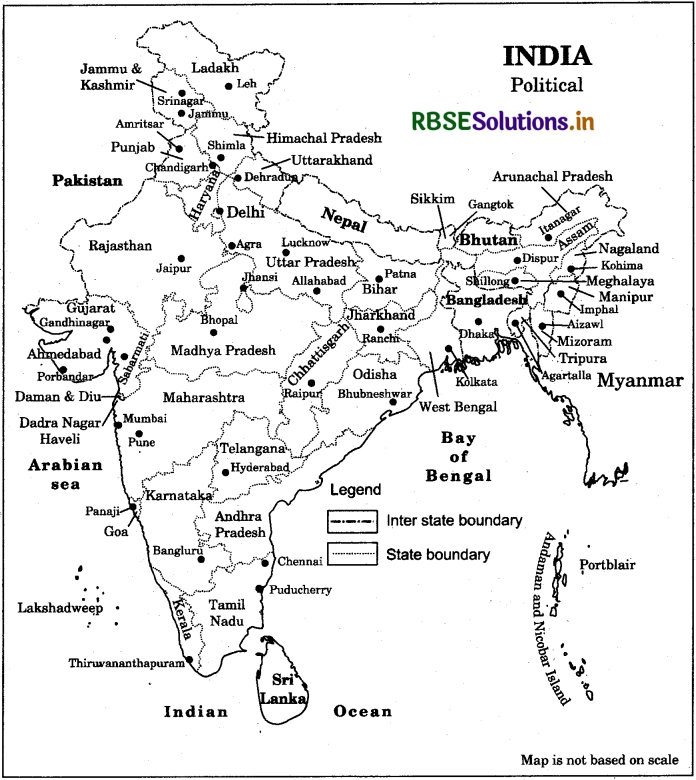
Show the following in Map of India—
(1) Allahabad (2) Hyderabad (3) Chennai (4) Delhi (5) Pune (6) Jhansi (7) Srinagar (8) Shimla (9) Chandigarh (10) Jaipur (11) Lucknow (12) Bhopal (13) Gandhinagar (14) Mumbai (15) Goa (16) Bangluru (17) Puducherry (18) Thiruvananthapuram (19) Patna (20) Kolkata (21) Bhubneshwar (22) Gangtok (23) Imphal (24) Aizawl (25) Agartalla (26) Port Blair (27) Dadra Nagar Haveli . (28) Dispur (29) Shillong (30) Kohima (31) Itanagar (32) Daman & Diu (33) Amritsar (34) Ahmedabad (35) Sabarmati (36) Porbandar (37) Agra (38) Panji-.
Answer:
Look at following Map—
Class 7 Hamara Rajasthan Map Related Questions in English 2

Question 3.
Show the following places in Map of India—
(1) Panipat (2) Delhi (3) Jaisalmer (4) Nagour (5) Mathura (6) Bijnaur (7) Ajmer (8) Chittorgarh (9) Agra (10) Badayun (11) Lucknow (12) Gujarat (13) Surat (14) Patna (15) Varanasi (16) Mumbai (17) Choi (18) Goa (19) Gaya (20) Jabalpur (21) Chennai (22) Puducherry (23) Ujjain (24) Madurai (25) Mangalore (26) Nasik (27) Elora (28) Ajanta.
Answer:
Look at following Map—
Class 7 Hamara Rajasthan Map Related Questions in English 3

Question 4.
Show major seas, lakes and rivers in the world map—
(1) Great Bear Lake (2) Great Slave Lake (3) North America (4) Salt Lake City (5) Pacific Ocean (6) Tropic of capricorn (7) Winnipeg Lake (8) Lake Superior (9) Muron Lake (10) Mississippi River (11) Caribbear Sea (12) Amazon River (13) South America (14) Antarctica (15) Aarcatic Ocean (16) Danube River (17) North Atlantic Ocean (18) Niger River (19) Black Sea (20) Mediterranean Sea (21) Nile River (22) Red Sea (23) Africa (24) Congo River (25) Victoria Lake (26) Orange River (27) Southern Atlantic Ocean (28) Southern Ocean (29) Indian Ocean (30) Caspian Sea (31) Asia (32) Huang He River (33) Brahmaputra River (34) Ganga River (35) East China Sea (36) Bay of Bengal (37) Darling River (38) Australia (39) Coral Sea (40) Trapic of Caner (41) Arabian Sea.
Answer:
Look at the following map—
Class 7 Hamara Rajasthan Map Related Questions in English 4

Question 5.
In world map show ocean currents.
Answer:
Look at the following map—
Class 7 Hamara Rajasthan Map Related Questions in English 5

Question 6.
In map of world show major sea port and airport.
Answer:
Look at the following map—
Class 7 Hamara Rajasthan Map Related Questions in English 6

Question 7.
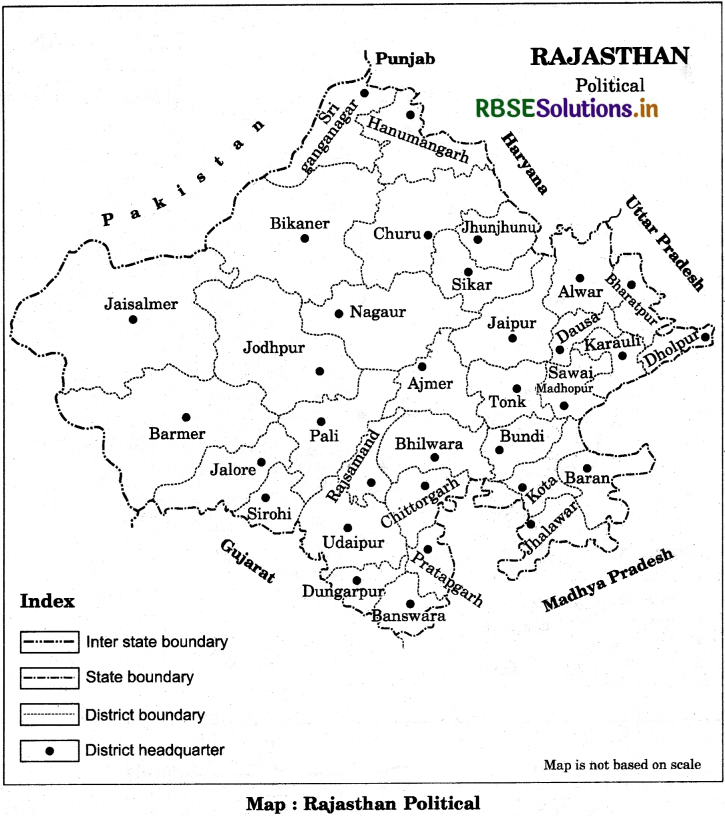
Show the political location in map of Rajasthan.
Answer:
Look at the following map—
Class 7 Hamara Rajasthan Map Related Questions in English 7

Question 8.
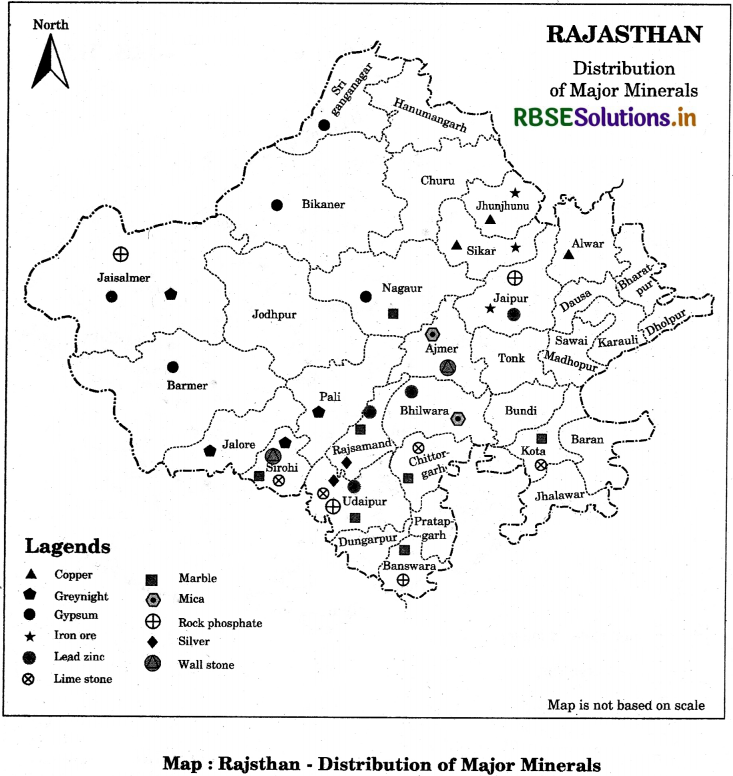
Show the distribution of major minerals in map of Rajasthan.
Answer:
Look at the following map—
Class 7 Hamara Rajasthan Map Related Questions in English 8

Class 7 Hamara Rajasthan Chapter 9 Question Answer in English The Contribution of Rajasthan in the Making of the Constitution

Engaging with these Hamara Rajasthan Book Class 7 Solutions and Class 7 Hamara Rajasthan Chapter 9 Question Answer The Contribution of Rajasthan in the Making of the Constitution will strengthen your knowledge and prepare you for assessments.

Class 7 Our Rajasthan Chapter 9 Question Answer The Contribution of Rajasthan in the Making of the Constitution

Our Rajasthan Class 7 Chapter 9 The Contribution of Rajasthan in the Making of the Constitution Question Answer

I. Write the correct option of the following questions in given bracket:

1. Collection of necessary laws on the basis of which a country or an institution is governed is called:
(a) Museum
(b) Constitution
(c) School
(d) None of the above
Answer:
(b) Constitution

2. We remember 26 January 1950 as an important day because on this day :
(a) The constitution was formed
(b) The constituent assembly was formed
(c) The costitution came into force
(d) Our country got freedom
Answer:
(c) The costitution came into force

II. Match the following :

Column A Column B
(A) Jai Narayan Vyas (i) Jaipur
(B) Gokul Lai Asawa (ii) Udaipur
(C) Hira Lai Shastri (iii) Jodhpur
(D) Balwant Singh Mehta (iv) Shahpura (Bhilwara)

Answer:

Column A Column B
(A) Jai Narayan Vyas (iii) Jodhpur
(B) Gokul Lai Asawa (iv) Shahpura (Bhilwara)
(C) Hira Lai Shastri (i) Jaipur
(D) Balwant Singh Mehta (ii) Udaipur

III. Fill in the blanks:

1. …………… was the permanent president of the Indian constituent assembly.
Answer:
Dr Rajendra Prasad

2. The constitution day is celebrated on …………… .
Answer:
26 November.

IV. Very Short Answer Type Questions

Question 1.
What was the cabinet mission?
Answer:
On seeing the intensity of the National Movement in India the British government sent a team of three of its ministers to India, which we know as the Cabinet Mission.

Class 7 Hamara Rajasthan Chapter 8 Question Answer in English Social and Educational Reforms in Rajasthan before Independence

Question 2.
Who was the publisher of “Akhand Bharat”?
Answer:
Jai Narayan Vyas was the publisher of “Akhand Bharat” in 1936.

V. Short Answer Type Questions

Question 1.
Write the names of the members of the constituent assembly who were the natives of Rajasthan.
Answer:
Members of the constituent assembly (inhabitants of Rajasthan)

Name of Member Princely State
1. Mukut Bihari Lal Bhargava Ajmer-Merwara
2. Manikya Lai Verma Udaipur
3. Jai Narayan Vyas Jodhpur
4. Balwant Singh Mehta Udaipur
5. Ramchandra Upadhyay Alwar
6. Dalel Singh Kota
7. Gokul Lai Asawa Shahpura (Bhilwara)
8. Jaswant Singh Bikaner
9. Rsg Bahadur Bharatpur
10. Hira Lai Shastri Jaipur
11. Sardar Singh Khetri

Question 2.
Give a short introduction of the life of Hira Lai Shastri.
Answer:
Hira Lai Shastri was borm on 24th November 1899 in Jobner town of Jaipur. He resigned from the government service after coming in contact with Arjun Lai Sethi. He advocated equal rights for all citizens in teh legislative assembly. Shastriji established an association by the name of “Jeevan kutir” in the Vanasthali village in Niwai tehsil of Tonk district. Salient social services were done through it. Then he remained connected with Jaipur Praja Mandal. He was the Prime Minister of all India native state public council (Akhil Bhartiya desi rajya Lok Parishad) and also the first chief minister of Rajasthan.

Question 3.
Give a short introduction of Balwant Singh Mehta.
Answer:
Balwant Singh Mehta was born on 8 February 1900 in Udaipur. He became the first chairman of the Praja Mandal in 1938 Balwant Singh Mehta established the tribal hostel in Udaipur in 1943. He was the first Rajasthani to sign on the manuscript of the constitution as a member of the Constituent Assembly.

Class 7 Hamara Rajasthan Chapter 9 Important Question Answer

Multiple Choice Questions

1. When did the Indian National Congress, first time officially put a demand for making a constituent assembly?
(a) In 1935 AD
(b) In 1936 AD
(c) In 1937 AD
(d) In 1949 AD
Answer:
(a) In 1935 AD

2. When was the constituent assembly set up according to the Cabinet Mission Plan?
(a) In 1935 AD
(b) In 1945 AD
(c) In 1946 AD
(d) In 1949 AD
Answer:
(c) In 1946 AD

Class 7 Hamara Rajasthan Chapter 8 Question Answer in English Social and Educational Reforms in Rajasthan before Independence

3. Sardar Sing, a member of the Constituent Assembly, was associated with which princely state?
(a) Udaipur
(b) Khetri
(c) Bharatpur
(d) Kota
Answer:
(b) Khetri

4. C.S. Vankatacharya, a member of the Constituent Assembly, was an administrative officer of which princely state?
(a) Jaipur
(b) Jodhpur
(c) Bikaner
(d) Udaipur
Answer:
(b) Jodhpur

Fill in the blanks

1. Rajasthan was divided into many ……………… at the time of the formulation of constituent assembly.
Answer:
princely states

2. The song, “………………”, written by Manikya Lai Verma, became very famous.
Answer:
Panchida

3. Ramchandra Upadhyay was a member of the constituent assembly as a representative from the princely state of ……………… .
Answer:
Alwar

4. Gokul Lai Asawa got his primary education at ……………… .
Answer:
Shahpura.

Very Short Answer Type Questions

Question 1.
What is constitution?
Answer:
Constitution is a collection of rules and laws on the basis of which a country or an organisation is operated.

Question 2.
When did the Indian constitution come into force?
Answer:
The Indian constitution came into force, on 26 January 1950.

Question 3.
Which Rajasthan native migrants were elected as the members of the constituent assembly?
Answer:
The native migrants of Rajasthan, Rajasthani Prabhu Dayal Himmat Singh from West Bengal, Banarsi Das Jhunjhun wala from Bihar, Padampat Singhania from Uttar Pradesh were elected as the members of the constituent assembly.

Class 7 Hamara Rajasthan Chapter 8 Question Answer in English Social and Educational Reforms in Rajasthan before Independence

Question 4.
Who was the representative of Udaipur in the constituent assembly?
Answer:
Manikya Lai Verma was given the responsibility of representating Udaipur in the constituent assembly.

Short Answer Type Questions

Question 1.
What does the Constituent Assembly mean? Explain.
Answer:
Constituent Assembly—
Constituent assembly means, an assembly of public representatives which makes the constitution. Elected representatives of the prouinces under British rule, and nominated representatives of the princely states were included in the constituent assembly. Members of the princely states and British provinces of Rajasthan were also included in the constituent assembly.

The first meeting of the constituent assembly was held on 9 December 1946, under the chairmanship of interim president Sachchidanand Sinha. Later on Dr. Rajendra Prasad was elected the permanent president of the Constituent Assembly.

Question 2.
Briefly describe the ‘Constitution of India’.
Answer:
The Constituent Assembly of India was set up in 1946, according to the Cabinet Mission Plan, whose permanent president Dr. Rajendra Prasad was elected. The constituent assembly made a drafting committee whose chairman was Dr. Bhimrao Ambedkar. On 13 December 1946; Jawaharlal Nehru presented the “Objective Resolution” in the constituent assembly. The members of the consituent assembly kept in mind the ideals emerged from independence struggle, while drafting the constitution. It took 2 years 11 months and 18 days to make the constitution. The constituent assembly adopted the constitution on 26 November 1949. The Indian constitution came into force, on 26 January 1950.

Question 3.
List the names of the members of the constituent assembly who were administrative officers in the princely states of Rajasthan.
Answer:
Members of the constituent assembly who were administrative officers in the princely states of Rajasthan—

Name of member Princely state
1. Sir V.T. Krishnamachari Jaipur
2. C.S. Venkatachari Jodhpur
3. Sardar K.M.Panniker Bikaner
4. Sir T Vijayaraghavachariya Udaipur

Long Answer Type Questions

Question 1.
Introduce the resident members of Rajasthan in the Constituent Assembly.
Answer:
Rajasthan was divided into many princely states at the time of the fourmulation of constituent assembly. The Ajmer-Merwara prouince was directly under the British rule. The resident/inhabitants of Rajasthan in the constituent assembly are as follows—
1. Mukut Bihari Lai Bhargava—
Mukut Bihari Lai Bhargava was born on 30 January 1903 in princely state of Udaipur in Rajasthan. He was a lawyer and advocated the cases of prisoners of state. He even went to jail for “Personal Satyagraha” and “Quit India Movement.” He represented the province of Ajmer-Merwara in the constituent Assembly.

2. Manikya Lai Verma—
Manikya Lai Verma was born on 4th December, 1897 in Bijoliya, Bhilwara. He organised the Satyagraha movement in Ajmer and presided over the first session of Mewar Prajamandal in 1941. He was the Chief Minister of greater Rajasthan in 1948 and the chairman of Rajasthan khadi Gram Udyog Board in 1963. He was also given the responsibility of representating Udaipur in the constituent assembly.
3. Jai Narayan Vyas—
Jay Narayan Vyas was born on 18 February in 1899 in Jodhpur. Jai Narayan Vyas was the chief editor of “Tarun Rajasthan” in 1927 and publisher of “Akand Bharat” in 1936. He was the chief minister of Rajasthan during the period of 1951 to 1956. He was a member of the constituent assembly from Jodhpur.

4. Balwant Singh Mehta— Balwant Singh Mehta was born on 8 February 1900 in Udaipur. He became the first chairman of the Praja Mandal in 1938. He was the first Rajasthani to sign on the manuscript of the constitution as a member of the Constituent Assembly.

5. Ramchandra Upadhyay—
Ramchandra Upadhyay was a member of the Constituent Assembly as a representative from the princely state of Alwar. He was a leading freedom fighter and a lawyer by profession.

6. Dalel Singh—
The lieutenant Colonel of Kota, Dalel Singh was born on 18th march, 1909. He was the presonal secretary of the Maharao Bhimrao Singh of Kota. He had knowledge of the laws. He worked in constitunet assembly from 1946 to 1950.

7. Gokul Lai Asawa—
Gokul Lai Asawa got his primary education at Shahpura. He started teaching at Harvard College in Kota. But he came to Ajmer from Kota and had to go to jail for four times during 1930 to 1932. Asawa was the representative from Shahpura (Bhilwara) in the constituent assembly.

8. Jaswant Singh—
He was the Chief Minister of Maharaja Sardool Singh of the princely state of Bikaner. He represented Bikaner when the constitution was formed. Later he was also nominated a member of the Rajya Sabha.

9. Raj Bahadur—
He was a lawyer by profession. He worked for the upliftment of the backward classes and protested against the custom of forced labour (begar) in the princely state of Bharatpur. He was also a minister in the Central Cabinet. He worked as an Indian ambassador in Nepal. ‘

10. Hira Lai Shastri—
Hira Lai Shastri was born on 24th November 1899 in Jobner town of Jaipur. He established an association by the name of “Jeevan Kutir” in the Vanasthali village in Niwai tehsil of Tonk district. Then he remained connected with Jaipur Prqja Mandal. He was the Prime Minister of all India native state public council.(Akhil Bhartiya desi Rajya Lok Parishad).and also the first Chief Minister of Rajasthan. He advocated equal rights for all citizens in the legislative assembly.

11. Sardar Singh—
Raja Sardar Singh of Khetri was a member of the constituent assembly. Sardar Singh was also a member of the interim parliament during 1950 to 1952. He bechme the member of Rajya Sabha during 1952 to 1956. He was sent to Laos, as an ambassador of India during 1958 to 1961.

Class 7 Hamara Rajasthan Chapter 8 Question Answer in English Social and Educational Reforms in Rajasthan before Independence

Activity

Question 1.
Find out the names of the three members of the Cabinet Mission with the help of a teacher.
Answer:
The names of the members of the Cabinet Mission sent to India by the British Government are—

  1. Lord Penthick—Lawrence (Secretary of State for India)
  2. Sir Stafford Cripps (President of the Board of Trade)
  3. A.V.Alexander (First Lord of Admiralty)

Question 2.
Under the directions of the teacher, know about the constitution of student’s parliament of your school.
Answer:
The student parliament has been drafted in the school, the constitution has also been written. The representatives of each of the departments will be called in the Student Parliament, in the Senate, there will be a discussion on what name should be given to the highest position. The name of the General Secretary, Speaker, Speaker, Chairperson or Prime Minister will be named in the Senate. With the formation of the student, parliament, the students will also interfere in the administrative work of the school. In special circumstances, in the Senate, students will make the representatives aware of their problems instead of demonstrating about their demands.

The structure of the student parliament will be like this
The structure of the student parliament will be similar to that of the Indian parliament. Students from all departments of the school will together elect 60 MPs. About 12 to 15 committees will be formed in these 60 people. The elected students will choose the highest post of MP. The committee will monitor the work related to the students. The term of the Parliament will be 1 year. The school will supervise the principal parliament.

‘Qualification—Only meritorious students will be able to contest elections. To contest elections, a student must be a 7-year-old student. The objective is that the students’ studies should not be affected for the elections.

Class 7 Hamara Rajasthan Chapter 8 Question Answer in English Social and Educational Reforms in Rajasthan before Independence

Question 3.
Make a chart of the names of the members of the constituent assembly and display in the class. Also attach photes if possible.
Answer:
Members of the constituent assembly (Inhabitants of Rajasthan)

Name of Member Princely State
1. Mukut Bihari Lai Bhargava Ajmer-Merwara
2. Manikya Lai Verma Udaipur
3. Jai Narayan Vyas Jodhpur
4. Balwant Singh Mehta Udaipur
5. Ramchandra Upadhyay Alwar
6. Dalel Singh Kota
7. Gokul Lai Asawa Shahpura (Bhilwara)
8. Jaswant Singh Bikaner
9. Raj Bahadur Bharatpur
10. HiraLal Shastri Jaipur
11. Sardar Singh Khetri

Class 7 Hamara Rajasthan Chapter 8 Question Answer in English Social and Educational Reforms in Rajasthan before Independence

Engaging with these Hamara Rajasthan Book Class 7 Solutions and Class 7 Hamara Rajasthan Chapter 8 Question Answer Social and Educational Reforms in Rajasthan before Independence will strengthen your knowledge and prepare you for assessments.

Class 7 Our Rajasthan Chapter 8 Question Answer Social and Educational Reforms in Rajasthan before Independence

Our Rajasthan Class 7 Chapter 8 Social and Educational Reforms in Rajasthan before Independence Question Answer

I. Write the correct option of the following question in given bracket:

1. Which social evils were prevalent in Rajasthan before independence:
(a) Satipratha
(b) Witch practice
(c) Child marriage
(d) All of the above
Answer:
(d) All of the above

2. Where was the first school for modem education opened in 1819?
(a) Jaipur
(b) Ajmer
(c) Udaipur
(d) Jodhpur
Answer:
(b) Ajmer

II. Match the following:

Column A Column B
1. Slavery (a) Udaipur
2. AnuitaDevi (b) Ajmer
3. Mayo college (c) Evil practice
4. Vidya Bhawan

Answer:

Column A Column B
1. Slavery (c) Evil practice
2. AnuitaDevi (d) Khejarli movement
3. Mayo college (b) Ajmer
4. Vidya Bhawan (a) Udaipur

III. Very Short Answer Type Questions

Question 1.
For what purpose was the Vanasthali Vidyapeeth established?
Answer:
The Purpose of establishing Vanasthali Vidyapeeth has been to develop a personality that expresses the spiritual of East and West and the coordination of scientific achievement.

Class 7 Hamara Rajasthan Chapter 8 Question Answer in English Social and Educational Reforms in Rajasthan before Independence

Question 2.
Tell the reason behind the closing down of schools opened in the name of modern education.
Answer:
Christianity was being propagated in schools opened in the name of modem education, so these was opposition to the teaching of Christianity. As a result, these schools were closed.

IV. Short Answer Type Questions

Question 1.
Write about the biography of Nana Bhai, Senga Bhai and Kalibai.
Answer:
Nana Bhai Khat was the director of the school in Dungarpur, Sanga Bhai was a teacher in the same school, while Kalibai was a 13-year-old Bhil girl from Dungarpur village. Public awareness work was being done by the school, which Maharawal did not like. Therefore, he sent magistrate and police to dose the school. The police asked Nana Bhai to dose the school, he was shot at his refusal, while Senga Bhai was beaten and tied behind the car with a Daantli (sharp edged weapon). Nobody resisted but the girl Kalibai who was coming from the field to cute grass, she showed courage and toothed the rope of Senga Bhai. Seeing this, the police fired indiscriminate bullets on the young girl. Kalibai became a martyre while protecting her master. Thus, Naha Bhai’s courage, Senga Bhai’s’ tolerance and Kalibai’s renuntiation set an example of dedication and played an important role in strengthening the education.

Question 2.
What is child marriage? Explain.
Answer:
Child Marriage : Marriage of under age girls and boys and the practice of marrying immature girls to men of older age and were two evil practices prevalent in the society. This had an adverse effect on the physical and mental health of girls ariifboys, which was not appropriate for a developing society.

Swami Dayanand Saraswati raised his voice to stop evil practices like child marriage and misalliance. The princely state of Alwar made the child marriage and misalliance prohibition law on 10th December, 1903. At the Indian level, the law relating to the prohibition of child marriage was first passed in 1929. It was amended in 1949,1978 and 2006. Currently, the minimum age of girls for marriage is 18 years and that of boys is 21 years. .

Class 7 Hamara Rajasthan Chapter 8 Important Question Answer

Multiple Choice Questions

1. The effect of British rule in Rajasthan was from:
(a) 1818 to 1947
(b) 1857 to 1947
(c) 1915 to 1947
(d) 1935 to 1943
Answer:
(a) 1818 to 1947

2. When did Lord William Bentinck made a law to declare the Satipratha illegal?
(a) In 1818 AD
(b) In 1829 AD
(c) In 1832 AD
(d) None of the above
Answer:
(b) In 1829 AD

Class 7 Hamara Rajasthan Chapter 8 Question Answer in English Social and Educational Reforms in Rajasthan before Independence

3. In which state of Rajasthan did the female infanticide declare illegal for the first time?
(a) Kota
(b) Bikaner
(c) Jodhpur
(d) Alwar
Answer:
(c) Jodhpur

4. Which act did the British try to put an end in 1833 AD?
(a) Female Infanticide
(b) Satipratha
(c) Charter Act
(d) Witch Practice
Answer:
(c) Charter Act

Fill in the blanks

1. From …………, there has been importance of education in the Indian society.
Answer:
ancient times

2. In ………… English was declared the state language.
Answer:
1835 AD

3. ………… were opened, for public awareness, by the Seva Sanga in Dungarpur state.
Answer:
Schools

4. Bom on 10 March 1905, ………… was famous as a social worker.
Answer:
Mama Baleshwar Dayal

Very Short Answer Type Questions

Question 1.
What kind of caste pattern existed in ancient times?
Answer:
In ancient times, the caste system was based on class system (vama vyavastha) existed in the society, which was a positive system based on divisions of work and labour.

Question 2.
Why could the British govern¬ment not interfere in the social and religious matters of the Indian public?
Answer:
The British government could not interfere with the religious and social matters of the people due to its policy of non-interference.

Question 3.
Which Muslim rulers also tried to stop the practice of Sati?
Answer:
Muhammad Bin Tughlaq and Akbar also tried to stop the practice of Sati Pratha during the medieval period.

Class 7 Hamara Rajasthan Chapter 8 Question Answer in English Social and Educational Reforms in Rajasthan before Independence

Question 4.
Where was the witch practice more prevalent?
Answer:
This practive was more prevalent in the states of Mewar and Kota.

Short Answer Type Questions

Question 1.
Review the status of education in Rajsathan and the steps taken towards improvement.
Answer:
Education passed through various phases in Rajasthan. The British Empire addressed education as indigenous education before the 19th century. After this, education was addressed as English education, Western Education or Modern Education. In this way, in 19 century, on the one hand, we see the traditional aspect of education while on the other hand we see the influence of English education.

A school for modern education was opened in Ajmer in 1819. Following this, schools were opened in Bhinay and Kekri.

In 1835 AD English was declared the state language. Hence, the influence of English education system increased. As a result, English educational system adopted schools, began to open in the princely state.

In the year 1872, Mayo College was established in Ajmer by the name of Viceroy Lord Mayo, for the purpose of making separate arrangements for English education of Rajput rulers, rulers of the princely states, princes and sons of the feudal lords. Its first session started in 1875-76. Pandit Janardan Rai Nagar established the Rajasthan Vidyapeeth Institution, on 21st August 1937, for the purpose of, “education for all”.

Question 2.
Explain the efforts made for Women education in Rajasthan.
Answer:
The missionary institution and women’s vernacular school started in 1861 AD. The government opened the first government girls school, in 1866 AD, in the union territories of Pushkar, Ajmer and Merwara. Efforts were made to encourage women’s education; as a result, girls school were opened in the princely states of Udaipur, Jaipur, Bharatpur, Alwar, Kota, Jhalawar, Tonk, Bikaner etc. princely states.

Hiralal Shastri established the Vanasthali Vidyapeeth with his wife for the promotion of women education. Ratan Shastri is known for her notable contribution for women education. She was given a number of awards for doing praiseworthy work in the field of education for women and children. Main awards are; The Padmashree, Padma Bhushan and Jamnalal Bajaj award.

Long Answer Type Questions

Question 1.
Mention the social evils prevailing in Rajasthan before independence.
Answer:
The social evils prevailing in Rajasthan before independence are sati pratha, female infanticide, child marriage and marriage, slavery, witch practice etc. Following are the introduction of these evil practices:
1. Sati Pratha : Sati Pratha is a practice where a secently widoweed women immolates herself on her deceased husband’s pyre. During the British period, encouraged by the efforts of Raja Ram Mohan Roy, Lord William Bentinck, made a law in 1829 AD to declare the Satipratha illegal. After this, laws to abolish the Satipratha, were also made in Kota, Jaipur and Mewar.

2. Female Infanticide : The practice of female infanticide was also in full swing, people used to kill girls as soon as they were bom. Female infanticide was declared illegal for the first time in the state of Kota in Rajasthan. After this, the states of Bikaner, Jodhpur, Jaipur, Udaipur and Alwar also declared this practice illegal.

3. Child Marriage and Misalliance Prohibition Law: Marriage of under age girls and boys and the practice of marrying immature girls to men of older age and were two evil practices prevalent in the society. This had an adverse effect on the physical and mental health of girls and boys, which was not appropriate for a developing society. Swami Dayanand Saraswati raised his voice to stop evil practices like child marriage and misalliance. The princely state of Alwar made the child marriage and misalliance prohibition law on 10th December, 1903.

4. Abolition of Slavery : Slavery has existed in India since ancient times. Rajasthan too was not unaffected by this. This practice got an impetus on the arrival of the Mughal. The prestige and pride of a family or clan was assessed on the basis of the number of slaves. These slaves lived with the rulers feudal lords and wealthy for their service “and attendance. Their social condition was not good. This custom could be understood as the servant or agricultural labour. The British tried to put an end to this through the Charter Act of 1833 AD.

5. Witch Practice : In some Castes of Rajasthan, there was the evil practice of alleging women as witch and killing them. This was based on superstition This practice was more prevalent in the States of Mewar and Kota. In the year 1853, when A.G.G. Rajputana heard about this, he pressurized the riders of the princely states to make a law to ban it. Some princely states declared this practice illegal.

Class 7 Hamara Rajasthan Chapter 8 Question Answer in English Social and Educational Reforms in Rajasthan before Independence

Question 2.
Before independence, introduce chief public leaders who have done social and education reforms in Rajasthan.
Answer:
There have been such public leaders in the land of Rajasthan who, not only contributed in the freedom struggle, but also, worked for the eradication of evils prevailed in the society along with making special efforts for women education.

Some of them are as follows :
1. Bhogilal Pandya: Bhogilal Pandya is known by the name of “Maseeha of the tribals” and “Gandhi of Bagar”. He was bom in Dungarpur in 1904. He established schools for the children and adults. The schools later became popular as ‘Bagadseva Mandir’.

2. Name Bhai Khat (Bhil), Senga Bhai, Kalibai: Nana Bhai Khat was the director of the school in Dungarpur; Sanga Bhai was a teacher in the same school, while Kalibai was a 13-year-old Bhil girl from Dungarpur village. Public awareness work was being done by the school, which Maharawal did not like. Therefore, he sent magistrate and police to close the school. The police asked Nana Bhai to close the school, he was shot at his refusal while Senga Bhai was beaten and tied behind the car with a Daantli (sharp edged weapon). Nobody resisted but the girl Kalibai who was coming from the field to cut grass, she showed courage and toothed the rope of Senga Bhai. Seeing this, the police fired indiscriminate bullets on the young girl. Kalibai became a martyre while protecting her master. Thus, NanaBhai’s courage, Senga Bhai’s tolerance and Kalibai’s renunciation set an example of dedication and played an important role in strengthening the education.

3. Kami Singh: Maharaja Kami Singh of the princely state of Bikaner, was bom in 1924. He did praiseworthy work for women education. He encouraged shooting and sports for the promotion of co-curricular activities and also started scholarship.

4. Hiralal Shastri: Hiralal Shastri was bom in a farmer family, on 24th November 1899, in Jobner (Jaipur). From the very beginning, the spirit of social service was in his mind, so he give up the service of Jaipur state. In 1929 he chose the backward and remote village of Banasthali as his work area. Here, he established an institution by the name of ‘Jeevan kutir’ where dedicated social rural workers were given employment and training for the upliftment of rural areas. Later oh he became active in the Praja Mandal. He was the first chief minister of Jaipur state in 1948 and of Rajasthan on 30 March, 1949. He established the Vanasthali Vidyapeeth with his wife for the promotion of women education.

5. Ratan Shastri: Ratan Shastri is known for her notable contribution for women education. She established the Banasthali Vidyapeeth. She was given a number of awards for doing praiseworthy work in the field of education for women and children. Main awards are; The Padmashree, Padma Bhushan and Jamnalal Bajaj award.

6. Kishori Devi: Kishori Devi was a freedom fighter and a social worker. She was born in Dularo ka Baas in Jhunjhunu district, in 1938, her husband Shri Sardar Harlal Singh was implicated in a false trial and put into prison by the jagirdar there. Kishori Devi started a movement against this. She started a Satyagraha in Jaipur by forming groups of women. She participated in the freedom movement and social reforms for the upliftment of women.

7. Mama Baleshwar Dayal: Born on 10 March, 1905, Mama Baleshwar Dayal was famous as a social worker. He worked for the Bhil tribe specially for the people of Rajasthan and Madhya Pradesh. For this he started the ‘Jal, Jungle & Jameen’ (water, forest and land) movement.

Class 7 Hamara Rajasthan Chapter 7 Question Answer in English Independence Movement and Rajasthan

Engaging with these Hamara Rajasthan Book Class 7 Solutions and Class 7 Hamara Rajasthan Chapter 7 Question Answer Independence Movement and Rajasthan will strengthen your knowledge and prepare you for assessments.

Class 7 Our Rajasthan Chapter 7 Question Answer Independence Movement and Rajasthan

Our Rajasthan Class 7 Chapter 7 Independence Movement and Rajasthan Question Answer

I. Write the correct option of the following question in given bracket

1. …………… wrote the famous Sorath by the name of “Chetavni ra Chungatya” :
(a) Kesari Singh Barhath
(b) Aijun lal Sethi
(c) Jorawar Singh Barhath
(d) Rao Gopal Singh Kharwa
Answer:
(a) Kesari Singh Barhath

2. The taxes collected from the people of Bijoliya in the times of Rao Sawai Krishna Singh were of:
(a) 48 types
(b) 84 types
(c) 88 types
(d) 44 types
Answer:
(b) 84 types

II. Match the following

Column ‘A’ Column ‘B’
1. Marwar Praja Mandal (a) ManikyaLal Verma
2. Mewar Praja Mandal (b) Pandit Abhinna Hari
3. Jaipur Praja Mandal (c) Jamnalal Bajaj
4. Bikaner Praja Mandal (d) Jay Narayan Vyas
5. Kota Praja Mandal (e) Madharam Vaid

Answer:

Column ‘A’ Column ‘B’
1. Marwar Praja Mandal (d) Jay Narayan Vyas
2. Mewar Praja Mandal (a) ManikyaLal Verma
3. Jaipur Praja Mandal (c) Jamnalal Bajaj
4. Bikaner Praja Mandal (e) Madharam Vaid
5. Kota Praja Mandal (b) Pandit Abhinna Hari

III. Fill in the blanks

1. The Bhagat Andolan was started by …………… .
Answer:
Govind Guru

2. …………… established the Rajasthan seva Sangh in Wardha in 1919.
Answer:
Vijay Singh Pathik.

IV. Very Short Answer Type Questions

Question 1.
Write names of any three peasant movements.
Answer:
Three peasant movements are: (i) Bijolia movement, (ii) Begue Peasant Movement, (iii) Bundi Peasant Movement.

Class 7 Hamara Rajasthan Chapter 7 Question Answer in English Independence Movement and Rajasthan

Question 2.
By whose ideology Govind Guru was influenced?
Answer:
He was greatly influenced by the ideas of Dayanand Saraswati.

V. Short Answer Type Questions

Question 1.
Write a brief note on theBijolia Peasant movement.
Answer:
Bijolia Peasant Movement :
This movement was started by the farmers of the Dhakad caste. It was carried on for 44 years and was campletely non-violent. This movement was divided into three stage: First stage (1897 to 1914), second stage (1914 to 1923) and the third stage.

During the rule of Rao Krishna Singh, 84 types of taxes were collected from the people of Bijoliya. After that the “Chanwari tax” was imposed on the public. After the protest of the farmers the chanwari tax was waived and exemption was given in the revenue. Further, Prithvi Singh, levied the sword typing (Talwar Bandi) tax on the poeple. The farmers continued the movement under the leadership of Pathik and got the support of Manikya Lai Verma. Jamna lal Bajaj led the third phase of the movement. The movement ended after a long struggle and settled down things with the farmers and returned their land.

Question 2.
What do you understand by Praja Mandal? Write their names.
Answer:
The meaning of Praja Mandal is the board of the people or association of people. The Praja Mandal played a vital role in Rajasthan. The public was given the responsibility of conducting the mass movement and Praja Mandals were formed in the different princely states of Rajasthan:

  • Marwar Praja Mandal
  • Jaipur Praja Mandal
  • Mewar Praja Mandal
  • Bikaner Praja Mandal
  • Kota Praja Mandal

Class 7 Hamara Rajasthan Chapter 7 Important Question Answer

Multiple Choice Questions

1. For how many years did the Bijolia Farmer Movement last?
(a) 11
(b) 22
(c) 33
(d) 44
Answer:
(d) 44

2. Who led the Begue Peasant Movement?
(a) Jamnalal Bajaj
(b) Vijay Singh Pathik
(c) Ramnarayan Chaudhari
(d) Pandit Nenu Ram
Answer:
(c) Ramnarayan Chaudhari

3. When was the Marwar Praja Mandal established?
(a) In 1934
(b) In 1936
(c) In 1938
(d) In 1939
Answer:
(a) In 1934

4. When did Seth Damodar Das Rathi lay the foundation of Arya Samaj in Beawar?
(a) In 1920
(b) In 1921
(c) In 1935
(d) In 1947
Answer:
(a) In 1920

Fill in the blanks

1. When the independence movement was going on in the country, …………… was not left unaffected to it.
Answer:
Rajasthan

2. In medieval period, relations between the …………… and …………… were good in Rajasthan.
Answer:
Jagiradar, farmers

Class 7 Hamara Rajasthan Chapter 7 Question Answer in English Independence Movement and Rajasthan

3. In the state of Alwar, …………… caused damage to the crops of the farmers.
Answer:
wild boars

4. Thakur Kalyan Singh increased the …………… for the expenditure incurred on the death of the former Thakur.
Answer:
revenue

Very Short Answer Type Questions

Question 1.
Explain the role of Praja Mandal.
Answer:
Praja Mandals awakened the political consciousness of the people and later played an important role in the integration of Rajasthan.

Question 2.
In how many stages was the Bijolia Peasant Movement started?
Answer:
This movement was divided into three stages : First stage (1897 to 1914), second stage (1914 to 1923) and the third stage (1923 to 1941).

Question 3.
Where was Govind Guru born?
Answer:
Govind guru was born in Dungarpur state in an ordinary Gypsy family.

Question 4.
How many languages did Arjun Lai Sethi know?
Answer:
He was a scholor of English, Persian, Sanskrit, Arabic and Pali.

Short Answer Type Questions

Question 1.
How did the freedom movement start in Rajasthan?
Answer:
When the independence movement was going on in the country, Rajasthan was not left unaffected to it. The British had direct suzerainty over Ajmer in Rajasthan. The rest of Rajasthan was ruled by kings and emperors. So the form of struggle was a little different here. The British had started interfering in the work of local states, which changed the social warp and weft there. The farmers and tribes here raised their voice and struggled against this. Subsequently Praja Mandals (people’s board) were established in various princely states. Praja Mandals awakened the political consciousness of the people and later played an important role in the integration of Rajasthan.

Question 2.
Why did the peasant movements happen in Rajasthan?
Answer:
In medieval period, relations between the Jagirdar (feudal lords) and farmers were good in Rajasthan. The jagirdar used to encourage the farmers to settle in their jagir (estate). But after the Subsidiary Alliance between the British and the kings the British started collecting taxes from the kings in cash. The kings collected this amount from the Jagirdar and in turn the Jagirdar collected it from the farmers. Along with the British, the king and the Jagirdars also fell into a life of luxury and put this burden on the farmers. To protest, distressed farmers started several movements.

Class 7 Hamara Rajasthan Chapter 7 Question Answer in English Independence Movement and Rajasthan

Question 3.
Which great personalities gave their support during the Bjjolia Farmer movement?
Answer:
This movement was started by the farmers of the Dhakad caste. The farmers’ representations, Naanji and Thakri Patel, complained about this, to the Maharana of Mewar and Sadhu Sitaram Das, Fateh Karan Charan and Brahmadev led the first phase. Vijay Singh Pathik led the second phase got the support of Manikya Lai Verma. Jamnalal Bajaj led the third phase of the movement. Women leaders like Anjana Devi Choudhary, Rama Devi and Narayani Devi Verma also contributed to this movement. After a long struggle of 44 years, the movement ended successfully.

Question 4.
What do you know about Samp Sabha? Explain.
Answer:
Govind Guru established the Samp Sabha in 1883 to organize the tribals, whose first session was held in 1903. The followers of Govind Guru came to be called Bhagat, hence it is called Bhagat movement. Samp means solidarity, love and brotherhood. Trie main purpose of the assembly was social reform. His teachings were -Take bath daily, do yagya and havan, do not drink alcohol, do not eat meat, do not steal/robbery, raise families with farm labor, teach children, open •Schools for this, decide in panchayats, do not visit courts, do not force the Jagirdars or government officials, do not tolerate them unjustly, fight injustice, use Swadeshi etc.

Long Answer Type Questions

Question 1.
Explain the Major peasant movements of Rajasthan.
Answer:
In the past, the relations of farmers with the kings and Jagirdars of Rajasthan were better. But after the Subsidiary Alliance between the British and the kings, the British started collecting taxes from the kings in cash. The kings collected this amount from the Jagirdar and in turn the Jagirdar collected it from the farmers. They were forced for bonded labour. To protest distressed farmer started movements, of which the following are the leading movements:

The Bijolia Movement : This organised Peasant Movement was started by the farmers of the Dhakad caste in Bijolia of Bhilwara. district. This movement was divided into three stages. First stage (1897 to 1914), 2nd stage (1914 to 1923) and the thirdstage (1923 to 1941).

Social leaders like Naanji, Thakri Patel, Sadhu Sitaram Das, Fateh Karan Char an, Brahmadev, Vijay Singh Pathik, Manikya Lai pathik, Seth Jamnalal Bajaj etc. played a strong role in this movement. Women leaders like Anj ana Devi Choudhary, Rama Devi and Narayani Devi Verma also contributed to this movement.

The Begue Peasant Movement Motivated by the success of Bijoliya movement, the farmers of the Begue Thikana (vassal territory) of Mewar also raised their voice against the atrocities of the Jagirdar. Ramnarayan Chaudhari led the fa mers on the order of Pathik. Leader like Rapa ji and Kripa ji Dhakad made thier movement successful by sacrificing themselves. In the end the government had to bow and 34 out of 53 taxes were abolished and forced labour (Begar) was banned.

Bundi Peasant Movement : In the year 1926 the farmers of Bundi, also started a protest movement against Laag-Baag and forced labour under the leadership of Pandit Nenu Ram, Ramnarayan Choudhary and Hari Bhai Kinkar. The peasants protested against the Laag Baag and forced labour. The police started firing at the gathered farmers, which led to the death of Nanak Bhil on the site. The movement ended when the state government of Bundi accepted the demands of the farmers in 1943.

Alwar Peasant Movement : The movement went on two stages for two reasons. Firstly, in the state of Alwar, Wild boars caused damage to the crops of the farmers. But they were forbidden to kill, so in 1921 the farmers started a movement, secondly, in 1925, the farmers organised a meeting in Neemuchana village against the increased revenue imposed by Alwar Maharaja Jai Singh. This house was shot indiscriminately like Jalianwala Bagh.

Sikar Peasant Movement: Sikar was the biggest Thikana of Jaipur state where the farmers opposed the increase in revenue. Sardar Harlal Singh, Netaram Singh and Prithvi Singh Gothra were prominent leaders associated with this movement. The peaceful demonstrations of the farmers led to the firing, which was discussed in the House of Commons in London. Finally, the Jagirdar had to convince the farmers and the revenue was also reduced.

The Shekhawati Peasant Movement: The Sekhawati farmers also protested against the arbitrary increase in the revenue. Master Kalicharan of Chirawa formed the Service committee (seva samiti). The farmers of Nawalgarh, Mandawa Dhundhlod, and Malasar clearly refused to pay the revenue. Thikanedar of Malasar, caused the brutal, beating of the farmers. A permanent solution was occured only after the independence.

Other Peasant Movement: In 1945, Thakur Chandrawal tried to crush the peasant movement with assault of sticks and spears. In the same way, in 1947, in Dabra, when around 600 farmers went to the Jagirdar to protest against revenue, laag-baag, and forced labour, he used rifles, Swords and spears causing many casualties.

Class 7 Hamara Rajasthan Chapter 7 Question Answer in English Independence Movement and Rajasthan

Question 2.
What do you know about the tribal movement in Rajasthan?
Answer:
Tribes like the Bhil, Meena and Garasiya have been living in Rajasthan since ancient time There is Bhil majority in South Rajasthan. While the Meena tribe is predominant in Jaipur. They were badly exploited during the British rule. Some social reformers and workers made aware them, in that period. They started movements for their rights, which are as follows:

The Bhil Movement : Govind Guru played an important role in spreading the ideology of awareness among the Bhils. He established the “Samp Sabha” and awakened the Bhils, against paying unfair taxes and forced labour. In the year 1913, when there was a session of Samp Sabha being held on Mangadh hills, on full moon in the month of Ashwini, the British army surrounded the hill and started firing. Thousands of tribals died and were injured at the spot. Guru Gobind Singh was shot in the leg. The incident was widely condemned and considered to be equivalent to the Jallianwala Bagh massacre. Because the followers of Govind Guru were called Bhagat, therefore this movement was also called Bhagat movement.

Motilal Tejawat was the second Maseeha of the tribal castes. Tejawat called the farmers Andy tribes for struggle against begar (forced labour), lagaan (taxes) and other atrocities at matrikundiya in Chittorgarh. Unity was emphasized to give impetus to the movement, hence it is also called Eki Aandolan. Thousands of trible peoples gathered at Udaipur to impart speed to the movement. They gave the Maharana a letter containing 21 demanding point. This letter of demand is called the ‘Call of Me war’ (Mewar ki pukar). The Maharana instantly accepted 18 demands.

The credit of organising the Bhil tribe of Dewal, Dungarpur and Banswara also goes to Bhogilal Pandya and Haridev Joshi.

Meena Tribal Movement: One section of the Meena tribe was given the responsibility of maintaining peace by the British rule. This section of Meena used to guard and in return collected chauth (a kind of tax) from the village. These Meenas are called “Chaukidar Meena”. They were often held responsible for all the theft and robbery taking place in the state and when the stolen goods were not found, then the cost of the goods was recovered from the Meenas. In 1924 the government bound the people of Meena tribe, above the age of 12, to give daily attendance in the nearby police station (Thana), under the Criminal Tribes Act. Discontentment spread among the Meena due to these reasons. Movements were launched to remove the prevalent evils in Meena society and to remove harsh laws like “Jarayam Pesha”. As a result of constant efforts the ‘Jarayam Pesha’ law ended after independence in 1952.

Question 3.
Throw light ojn the establishment of Praja Mandals in theMajor princely states of Rajasthan.
Answer:
Accordring to Pandit Jawahar lal Nehru, a movement can start in any place only when the people there are ready. Hence, the public was given the reposnsibility of conducting the mass movement and Praja Mandals were formed in the different princely states of Rajasthan as follows :

Marwar Praja Man dal: Jai Narayan Vyas established the Marwar Praja Mandal in Jodhpur in 1934. Bhanwar Lal Saraf was its chairman. In order to give impetus to the Praja Mandal Movement, the Marwar Lok Parishad was formed in 1938 under the chairmanship of Ranchhod Das Gattari.

Jaipur Praja Mandal : The Jaipur Praja Mandal was established in 1931 by the efforts of Kapoor Chand Pargi and Janxna Lai Bajaj. This was the first Praja Mandal of Rajasthan. The Jaipur Praja Mandal was reconstituted in 1936. The Praja Mandal in Jaipur started working under the leadership of Chiranji Lai Mishra. The first session was held in 1938 under the chairmanship of Jamna Lai Bajaj. Later Heera Lai Shastri became its chairman. The Praja Mandal demanded the establishment of a responsible government in the princely state.

Me war Praja Mandal : The Mewar Praja Mandal was established on 24 April, 1938 under the chairmanship of Balwant Singh Mehta. Manikya Lai Verma had a leading role in this. The Praja Mandal consistently pressurized the Maharana to break his ties with the British. The Praja Mandal played active role in the freedom struggle.

Bikaner Praja Mandal : Magharam Vaidya and Lakshman Das Swami established the Bikaner Praja Mandal in 1936. An open session of the Praja Mandal was organised in Raisinghnagar on 30th June 1946.

Kota Praja Mandal : Nayanu Rdm established the Hadoti Praja Mandal with the support of Abhinna Hari, Tansukh Lai etc. A Praja Mandal session was held in Kota under the chairmanship of Pandit Npyanu Ram on May 1939. Like other Phaja Mandals, the workers of the Kota Praja Mandal participated in the Quit India Movement.

Other Prsya Mandal : The activities of Praja Mandal were parallelly conducted in the States of East Rajasthan, along with these states. In these princely states tfye Praja Mandal acted as a link between the British rule to a responsible rule.

Class 7 Hamara Rajasthan Chapter 7 Question Answer in English Independence Movement and Rajasthan

Question 4.
Introduce the prominent people leaders of Rajasthan and explain their role.
Answer:
The prominent people leaders of Rajasthan are as followes :
1. Govind Guru : Govind Guru was born in Dungarpur state in an ordinary Gypsy family. He was greatly influenced by Dayanand Saraswati. He established the Samp Sabha for the social upliftment. Through Samp Sabha, he made tribal development and social upliftment of the tribals. He tried to keep the tribals away from alcohol, meat, robbery, theft etc. He made the efforts of unifying the tribals living in the middle of the hills of Dungarpur, Banswara, South Mewar, Sirohi Gujarat and Malwa.

2. Arjun Lai Sethi : He was born in Jaipur. He was a scholar of English, Persian, Sanskrit, Arabic and Pali. He established the Vardhman School in Jaipur. In his school, there were arrangements to provide training to the revolutionaries, around the country. Along with religious education, Sri Sethi used to teach the lesson of country service and revolution to the students. The responsibility of organising an armed revolution, in Rajasthan, was entrusted to Sri Sethi.

3. Kesari Singh Barhath : He was born on 21 November, 1872. Kesari Singh Barhath was associated with the armed revolution in Rajasthan. Kesari Singh worked to get the active support of Jagirdars and the rich peoples, against British, in the independence struggle. He had deep influence over the royal house of Udaipur, Jodhpur and Bikaner. In order to warn the Maharana of Mewar, against the British rule, Kesari Singh Barhath wrote a famous Soratha (couplets in special metre) called “Chetawani ra Chungatya”.

4. Vjjay Singh Pathik : He was born in Bulandshahar district of Uttar Pradesh. The real name of Vijay Singh Pathik was Bhoop Singh Gurjar. He led the Bijoliya peasant movement with the name of Vijay Singh Pathik and also established the Rajasthan Seva Sangh in Wardha in 1919.

5. Seth Damodar Das Rathi: Damodar Das Rathi was born in Pokaran Marwar. He was inclined towards the “national issues, right from his childhood. He was an intimate friend of Rao Gopal Singh of Kharva. During the First World War Ras Bihari Bose and Raja Mahendra Pratap made plans for revolution all over the country and decided the date 21 February 1915 for the purpose. The responsibility of capturing the cantonment of Nasirabad, in Ajmer in Rajasthan, was given to Rao Gopal Singh of Kharwa and Bhoop Singh. The financial arrangements for this plan, were made Rathi. Rathi ji laid the foundation of Arya Samaj in Beawar in 1921.

6. Thakur Jorawar Singh Barhath :
He was born on 12 September, 1883 in Udaipur. Thakur Jorawar Singh was also present with Ras Bihari Bose, who threw bomb on Lord Hardinge in Chandni Chowk.Thakur Zorawar Singh was the younger brother of Thakur Kesari Singh Barhath and paternal uncle of Amar Shahid Kunwar Pratap Singh. The Kota government and the Bihar government announced heavy rewards to capture him. After the incident of throwing of the bomb on Lord Hardinge, he remained underground for 27 years and died in 1939.

7. Kunwar Pratap Singh : He was born on 24 May, in Udaipur. He was the son of Kesari Singh Barhath. He participated in the revolutionary activities with Ras Bihar Bose. He was arrested by the police and was sent to the the Bareilly jail and tortured brutally. He was given temptations for giving information about his companions. But he did not tell about his friends. He became a victim of the inhuman torture of the British government and was martyred in the Bareilly jail.

8. Rao Gopal Singh Kharwa:Hewas born on 19 October, 1872 near Ajmer in Rajasthan. He was the administrator of kharwa state. He fully supported Vijay Singh Pathik during the armed revolution in Rajasthan. The plan failed because the British came to know about it. Vijay Singh Pathik and Rao Gopal Singh were house arrested in Targarh. They both went absconding from there after a few days. Gopal Singh was caught in Salimabad and sent to Tihar jail. After being released in 1920 he got involved with creative activities.

Class 7 Hamara Rajasthan Chapter 6 Question Answer in English The Prominent Rulers of Rajasthan

Engaging with these Hamara Rajasthan Book Class 7 Solutions and Class 7 Hamara Rajasthan Chapter 6 Question Answer The Prominent Rulers of Rajasthan will strengthen your knowledge and prepare you for assessments.

Class 7 Our Rajasthan Chapter 6 Question Answer The Prominent Rulers of Rajasthan

Our Rajasthan Class 7 Chapter 6 The Prominent Rulers of Rajasthan Question Answer

I. Write the correct option of the following questions in given bracket—

1. The ‘Kama of Rajputana’ is called :
(a) Maharaja Rai Singh
(b) Maharana Sanga
(c) Mirza raja Jaisingh
(d) Maharana Pratap
Answer:
(a) Maharaja Rai Singh

2. The Victory Tower is built by :
(a) Maharana Pratap
(b) Sawai Jai Singh
(c) Maharaja Surajmal
(d) Maharana Kumbha
Answer:
(d) Maharana Kumbha

II. Fill in the blanks

1. Jantar-Mantar (observatory) was built by ………………. for the study of astrology.
Answer:
Sawai Jai Singh

2. Famous poet Chandra Bardai composed ………………. .
Answer:
Prithvi raj Raso.

III. Very Short Answer Type Questions

Question 1.
Maharaja Surajmal was the ruler of which place?
Answer:
Maharaja Surajmal was the ruler of Bharatpur.

Class 7 Hamara Rajasthan Chapter 6 Question Answer in English The Prominent Rulers of Rajasthan

Question 2.
Write names of any two books written by Maharaja Jaswant Singh.
Answer:
(1) Anand Prakash,
(2) Bhasha Bhushan.

IV. Short Answer Type Questions

Question 1.
Mention the works done by Sawai Jai Singh.
Answer:
Work done by Sawai Jai Singh:
Sawai Jai Singh has spent most of his time outside the kingdom in military campaigns, mughal politics and in stopping the expansion of Maratha in Malwa.

In the history of Rajasthan, Sawai Jai Singh is known as a great ruler, army chief, scholar, shelter provider, and an expert of mathematics as well as movements of stars & planets (astrology). Sawai Jai Singh had got an accurate table d’eveloped for the counting of the speed of planets and stars.

Many books were written during his period such as Jai Singh Karika’ book was based on astrology and ‘Siddhant Samrat’, ‘Yantra Raj’ were based on astrological instruments.

Sawai Jai Singh got built five observatories for the study of astrology, these are situated in Jaipur, Delhi, Mathura, Banaras and Ujjain. ‘

Question 2.
Mention the cultural achievements of Rana Kumbha.
Answer:
Aesthete Kumbha of Sisodiya dynasty was bom at Chittorgarh in 1417 A.D. Maharana Kumbha ascended the throne of Mewar in 1433. There was a confluence of dagger, pen and art in the personality of Maharana Kumbha. Culturally, this period was the golden era of Mewar’s history. He also acquired the wisdom denoting titles of‘Maharajadhiraj’, Ttairayan’, ‘Maharana’, ‘Chapguru’, ‘Rqjguru’, Daanguru’, ‘Halaguru’, ‘Paramguru’. Out of 84 forts located in Mewar, 32 are built by Kumbha. Kumbha built the Achalgarh fort, Basantgarh fort, Bhomat fort, Machan fort, Kumbhalgarh fort and the Victory Tower situated in Chittorgarh fort. Kumbha was also a great musician. “Sangeet Raj”, “Sangeet Mimansa”, “Sood Prabandh”, are his great compositions, written on music. Kumbha wrote Rasik Priya Tika on “Geet Govinda” composed by Jaidev and also wrote Chandishatak ki Tika.

Class 7 Hamara Rajasthan Chapter 6 Important Question Answer

Multiple Choice Questions

1. Who had built Jantar-Mantar in Jaipur?
(a) Sawai Jai Singh
(b) Sawai Man Singh
(c) Aurangzeb
(d) Mohammad Shah
Answer:
(a) Sawai Jai Singh

2. Was a writer in Prithviraj Chauhan’s court:
(a) Chandbardai
(b) Vidyapati Gaud
(c) Prithvi Bhatt
(d) All of the above
Answer:
(a) Chandbardai

3. When did Maharana Kumbha sit on the throne of Mewar?
(a) In 1417 AD
(b) In 1433 AD
(c) In 1468 AD
(d) In 1488 AD
Answer:
(b) In 1433 AD

Class 7 Hamara Rajasthan Chapter 6 Question Answer in English The Prominent Rulers of Rajasthan

4. Which areas did Maharaja Surajmal win to expand the state of Bharatpur on his own merit?
(a) Farooq Nagar
(b) Dhaulpur
(c) Rohtak
(d) All of the above
Answer:
(d) All of the above

Fill in the blanks

1. There have been many …………….. in Rajasthan whom we can call brave and great.
Answer:
riders

2. Rana Sanga is famous for his …………….. and …………….. .
Answer:
bravery, generosity

3. The period of Rao Maldev is called the …………….. in the history of Marwar.
Answer:
gallentry era

4. MaharanaPratap endeavored to develop agriculture and forest even in the times of …………….. .
Answer:
crisis.

Very Short Answer Type Questions

Question 1.
When did Jaisingh, the ruler of the Kushwaha dynasty, receive the title of ‘Mirza Raja’?
Answer:
Mughal ruler Shah Jahan adorned Jaisingh with the title Of‘Mirza Rqja’ in 1639.

Question 2.
At what age did Sawai Jaisingh take over the throne?
Answer:
Sawai Jai Singh ascended the throne in 1699 at the age of just 12 years after the death of his father.

Class 7 Hamara Rajasthan Chapter 6 Question Answer in English The Prominent Rulers of Rajasthan

Question 3.
In which places is Jantar- Mantar located in India?
Answer:
Sawai Jai Singh got built five observatories for the study of astrology, these are located in Jaipur, Delhi, Mathura, Banaras and Ujjain.

Question 4.
Display the spirit of art and literature of Maharaj Suraj Mai.
Answer:
Asanartdiscemerhegotfortsand palaces built in the areas of his dominion. He gave patronage to poets and writers.

Short Answer Type Questions

Question 1.
Describe the achievements of Maldev.
Answer:
Maldev was the eldest son of Rao Ganga of Rathore dynasty. Maldev was a freedom lover and ambitious ruler. Maldev extended the boundaries of the kingdom by diplomacy and victories. The period of Rao Maldev is called the “gallantry era” in the history of Marwar. He fought total 52 battles during his reign and also had hegemony over 58 small and big subdivisions (pargana). First of all, he won Bhadrajun and then acquired victories over Nagaur, Merta, Siwana, and Bikaner. Maldev built Sojat fort, Malkot fort (Merta) and Pokhran fort. Maldev died in 1562 AD. The Persian historians called him “Hashmat wala Shasak” (powerful).

Question 2.
Underline the struggles of Maharana Pratap.
Answer:
Maharana Pratap was the eldest son of Uday Singh. He was born on 9 May, 1540 in Kumbhalgarh. His mother’s name was Jaivantabai. Rana Pratap was crowned on 28 February, 1572 AD. He had to face many difficulties as soon as ascending the throne, such as, Mughal ruler Akbar’s wish to rule over Mewar; strengthening economic and military power of Mewar; brother Jagmal who was offended and had taken Akbar’s refuge etc. Maharana Pratap did not accept the subjection of Mughal ruler, Akbar.

Maharana Pratap endeavored to develop agriculture and forest even in the times of crisis. He got books written like “Vishva Vallabh” written on these subjects. He always nurtured human rights. Maharana Pratap is known for his valour and war strategy. With his personality, he made every person of Mewar a great w7arrior, who would sacrifice everything for the freedom of motherland.

Question 3.
Introduce the religions goodwill of Maharaja Raj Singh.
Answer:
Raj Singh, son of Maharaja Jagat Singh, became the ruler of Mewar in 1652. Raj Singh favoured Aurangzeb in the battle of mughal succession, but the policies of Aurangzeb made Jaisingh his opponent. Raj Singh gave shelter to the “Goswami” devotees who brought the idol of Govardhannath (Shrinathji) from Brij because of Aurangzeb’s fear. The idol of Shrinathji and the idol of Dwarkadhish were installed in Singhaar (Nathdwara) and Kankroli (Rajsamand) respectively, and a temple was built there. In Udaipur, he bruit the temple of Amba Mata and many water sources. He got the Rajsamand Lake constructed in Kankroli which is famous for its artistic beauty.

Class 7 Hamara Rajasthan Chapter 6 Question Answer in English The Prominent Rulers of Rajasthan

Question 4.
Describe the bravery and courage of Prithviraj Chauhan.
Answer:
In the primitive era of Prithviraj Raso, the qualities of Prithviraj Chauhan are described. As a result of the penance of Maharaj Someshwar’s previous births, a son like Prithviraj was born to his home. The name of Prithviraj is important among the august rulers before the sultanate era, in India. Prithviraj Chauhan has been compared with the Paramara king Vikramaditya Parmar at that time. Undoubtedly Prithviraj was a great king embellished with 32 qualities. Right from childhood, this hero played the sting of his might among the mighty kingdoms. Around 1168 AD, Prithviraj Chauhan was crowned at the age of 15, his guardian mother was Karpoor devi. After becoming the ruler, Prithviraj Chauhan first paid attention towards his internal affairs. Philomath Prithviraj had the knowledge of six languages. All the qualities of a brave and valiant warrior and commandant were present in Prithviraj Chauhan.

Long Answer Type Questions

Question 1.
Describe about tbe main rulers of Rajasthan.
Answer:
There have been many rulers in Rajasthan whom we can call brave and. great because they made the state proud with their deeds. Some of them are as following:
Prithviraj Chauhan (1177-1192 AD)
The name of Prithviraj Chauhan is important among the august rulers, before the Sultanate era, in India. His father’s name was Someshwar and mother’s name was Karpoor Devi. Prithviraj was very young when his -father died. In such a situation his mother Karpoor Devi took over the charge of administration as a protector but the nearest relatives tried to take advantage.

After becoming the ruler, Prithviraj Chauhan, first paid attention towards his internal affairs. All the qualities of a brave and valiant warrior and commandant were present in Prithviraj Chauhan.

Maharana Kumbha (1433-1468 AD)
Aesthete Kumbha of Sisodiya dynasty was born at Chittorgarh in 1417 A.D. Maharana Kumbha ascended the throne of Mewar in 1433. The victory over Bundi, Gagron, Sirohi, and Vagad as well as Mewar- Marwar harmony were the main political achievements of Maharana Kumbha. There was a confluence of dagger pen and art in the personality of Maharana Kumbha. Culturally, this period was the golden era of Mewar’s history. Out of 84 forts located in Mewar, 32 are built by Kumbha. He also acquired the wisdom denoting titles of ‘Maharajadhiraj’, ‘Rairayan’, ‘Maharana’, ‘Chapguru’, ‘Rajguru’, ‘Daanguru’, ‘Halaguru’, ‘Paramguru’.

Maharana Sanga (1509-1528 AD)
The original name of Rana Sanga was Sangram Singh and he was born on 12 April, 1482 in Chittorgarh. Rana Sanga was the son of Rana Raima! Mewar reached the highest point of strength in his reign. He united all the Rajput kingdoms and brought them under one patronage.

Rana Sanga was a valiant warrior. He bravely defended his Kingdom from the attacks of Delhi, Gujarat, Malwa and Mughal emperors. There were 80 wounds on his body. Rana Sanga is famous for his bravery and generosity.

Maldev (1532-1562 AD)
Maldev was the eldest son of Rao Ganga of Rathore dynasty. He was born on 5 December, 1511 AD. Maldev was a freedom lover and ambitious ruler. Maldev extended the boundaries of the kingdom by diplomacy and victories. The period of Rao Maldev is called the “gallantry era” in the history of Marwar. He fought total 52 battles during his reign and also had hegemony over 58 small and big subdivisions (pargana). First of all, he won Bhadrajun and then acquired victories over Nagaur, Merta, Siwana, and Bikaner. Maldev built Sojat fort, Malkot fort (Merta) and Pokhran fort. Maldev died in 1562 AD. The Persian historians called him “Hashmat wala Shasak” (powerful).

Maharana Pratap (1572-1597 AD)
Maharana Pratap was the eldest son of Uday Singh. He was born, on 9 May, 1540 in Kumbhalgarh. His mother’s name was Jaivantabai. Rana Pratap was crowned on 28 February, 1572 AD. Maharana Pratap did not accept the subjection of Mughal ruler, Akbar.

Maharana Pratap endeavored to develop agriculture and forest even in the times of crisis. He got books written like “Vishva Vallabh” written on these subjects. He always nurtured human rights. Maharana Pratap is known for his valour and war strategy. With his personality, he made every person of Me war a great warrior, who would sacrifice everything for the freedom of motherland.

Maharaja Raisingh (1574-1612 AD)
Raisingh, the eldest son of Rao Kalyanmal of Bikaner, was born on 20 July, 1541 AD. Rai Singh was crowned in 1574 AD. Raisingh, with his battle skills, made successful campaigns to Gujarat, Kabul, Kandhar and South India. He was famous for his generosity. He is also called “the Karna of Rajputana”. Raisingh built the strong Junagarh fort. He got praise written inside the fort, which is called “Raisingh Prashasti”. Philomath Maharaja Raisingh composed sagas like” Raisingh mahotsav”, and “Jyotish Ratnamala.” ‘

Mirza Raja Jaisingh (1621-1667 AD)
Jai Singh of the Kushwaha dynasty ascended the throne in 1621 AD. Jaisingh carried out responsibility in various military campaigns of Mughal emperor Jahangir, Shah Jahan and Aurangzeb. Jahangir first sent him on a campaign against Malik Ambar of Ahmednagar. As soon as he took over the rule of Amer, Shah Jahan adorned Jaisingh with the title of “Mirza Raja” in 1639. Mirza king Jaisingh, along with being a brave military leader and efficient politician, was also a lover of literature and art.

Maharaja J as want Singh (1638-1678 AD)
Jaswant Singh was bom in December 1626 in Burhanpur. Jaswant Singh was crowned after the death of his father, Gaj Singh. Mughal emperor Shahjahan gave Jaswant Singh the title of “Maharaja”. Previously he was with the royal army (Shahjahan) in the Mughal war of succession but later at the advice of Amer ruler Jaisingh, he supported Aurangzeb in the battle of Daurai. Aurangzeb sent Jaswant Singh to different parts of his Kingdom. Jaswant Singh colonize the town of Jaswantpura near Aurangabad in South India.

Maharaja Raj Singh first (1652-1680 AD)
Raj Singh, son of Maharaja Jagat Singh, became the ruler of Mewar in 1652. Raj Singh favoured Aurangzeb in the battle of mughal succession, but the policies of Aurangzeb made Jaisingh his opponent. Raj Singh gave shelter to the “Goswami” devotees who brought the idol of Govardhannath (Shrinathji) from Brij because of Aurangzeb’s fear. The idol of Shrinathji and the idol of Dwarkadhish were installed in Singhaar (Nathdwara) and Kankroli (Rajsamand) respectively, and a temple was built there. In Udaipur, he built the temple of Amba Mata and many water sources. He got the Rajsamand Lake constructed in Kankroli which is famous for its artistic beauty.

Sawai Jai Singh (1699-1743 AD)
Jai Singh was bom on 3rd November, 1688 AD. After the death of his father, he sat on the throne at a very young age in 1699AD. Most of Sawai Jai Singh’s time was spent outside the kingdom in military campaigns, mughal politics and in stopping the expansion of Maratha in Malwa. Aurangzeb conferred on Jai Singh the title of “Sawai”.

Class 7 Hamara Rajasthan Chapter 6 Question Answer in English The Prominent Rulers of Rajasthan

In the history of Rajasthan, Sawai Jai Singh is known as a great ruler, army chief, scholar, shelter provider, and an expert of mathematics as well as movements of stars & planets (astrology). Sawai Jai Singh got built five observatories for the study of astrology, these are situated in Jaipur, Delhi, Mathura, Banaras and Ujjain.

Maharaja Surqjmal (1755-1763 AD)
Maharaja Surajmal was ruler of Bharatpur. His father, Badan Singh, bestowed his kingship to him, because of his own illness. While the mughal empire and other kingdoms were collapsing, Surajmal, without being a victim of alliance with the Mughal Marathas and Rajput, showed his capability by expending the kingdom of Bharatpur and winning the areas of Ghaziabad, Rohtak, Jhajjar, Agra, Dhaulpur, Mainpuri, Hathras, Banaras and Farooq Nagar. Surajmal along with being a brave army chief, wise diplomat and an art lover was also a ruler with human perspective.

Class 7 Hamara Rajasthan Chapter 5 Question Answer in English Trade in Rajasthan

Engaging with these Hamara Rajasthan Book Class 7 Solutions and Class 7 Hamara Rajasthan Chapter 5 Question Answer Trade in Rajasthan will strengthen your knowledge and prepare you for assessments.

Class 7 Our Rajasthan Chapter 5 Question Answer Trade in Rajasthan

Our Rajasthan Class 7 Chapter 5 Trade in Rajasthan Question Answer

I. Choose the correct option of the following questions and write the given brackets

1. Which of the industries is in the category of large scale industry in Rajasthan?
(a) Cold pressed oil
(b) Honey
(c) Cotton textile industry
(d) Khadi silk
Answer:
(c) Cotton textile industry

Class 7 Hamara Rajasthan Chapter 5 Question Answer in English Trade in Rajasthan

2. Which item is not exported from Rajasthan?
(a) Wool
(b) Precious stones
(c) Pertol
(d) Marble stones
Answer:
(c) Pertol

II. Fill in the blanks

1. In 1889 in Beawar ………………. was established.
Answer:
cotton textile industry

2. The Rajasthan government made The Agro processing; Agricultural business and Agricultural export promotion policy in the year ………………. .
Answer:
2019

III. Very Short Answer Type Questions

Question 1.
Write the names of the goods imported in Rajasthan.
Answer:
Rice, kerosene oil, mineral oil, electricity goods, machinery, transport equipments etc. are imported in Rajasthan.

Question 2.
Write names of two plans for encouragement of export in the state.
Answer:
1. State level Export Reward scheme.
2. Export promotion, process and documentation.

IV. Short Answer Type Questions

Question 1.
Write in brief about the agro based industries in Rajasthan.
Answer:
Most of the industries in the state are agro based.
These industires are divided into two categories:
1. Large scale industry,
2. Small scale or cottage.

1. Large Scale Industry : The agro based large scale industry in Rajasthan mainly includes the cotton textile industry and the sugar industry. The cotton textile industry is Rajasthan’s ancient, traditional, organised and the highest employment providing agro based indutry. In large industries, cotton textiles are widely produced by machines. Whereas in sugar industry, sugar is manufactured from sugarcane juice in large mills :

2. Small Scale and Cotttage Industry : The agro based small scale industries in the state are mainly edible oil, jaggery, unrefined sugar (Khandsari) and pulse industry. The Rajasthan Khadi and Village industries board manages khadi industries and other cottage industries in the state. Cotton khadi, khadi silk, cold pressed oil (ghani oil), jaggery and unrefined sugar, honey industry are agro based.

Class 7 Hamara Rajasthan Chapter 5 Question Answer in English Trade in Rajasthan

Question 2.
Define export and import and explain its importance.
Answer:
Import Export: In trade, when things bought from other country or state it is called import and when goods are sold to other country or state, it is,called export.

Import-export is very important for the development and improvement of national economies and local life because all states or countries have the necessary resources and skills to produce certain goods and services.

Every item is produced under a particular geographical and environmental condition. Special natural resources, other skills and sometimes special techniques are also required for the production of things, which is not necessarily available everywhere.

Therefore, the things which are produced in a particular place are exported and the things which are less produced are imported.

Class 7 Hamara Rajasthan Chapter 5 Important Question Answer

Multiple Choice Questions

1. The major agro-based industries in Rajasthan are:
(a) Cotton textile industry
(b) Sugar industry
(c) Khandsari udyog
(d) Both (a) and (b)
Answer:
(d) Both (a) and (b)

2. In which year was the first cotton textile mill established in Rajasthan?
(a) In 1880
(b)In 1888
(c) In 1889
(d) In 1988
Answer:
(c) In 1889

3. The exchange of goods is related to:
(a) Import
(b) Export
(c) Both (a) and (b)
(d) Production
Answer:
(c) Both (a) and (b)

Class 7 Hamara Rajasthan Chapter 5 Question Answer in English Trade in Rajasthan

4. The following are imported in Rajasthan:
(a) Kerosene
(b) Mineral oil
(c) Rice
(d) All of the above
Answer:
(a) Kerosene

Fill in the blanks

1. At present ………………. is also known as textile city.
Answer:
Bhiwara

2. Sugar mills are set up near ………………. growing areas.
Answer:
sugarcane

3. When one state trades with other state, then it is called ………………. trade.
Answer:
inter state

4. ………………. is the leading producer of mustard and cluster bean, carom seed (ajwain), corriander, fenugreek, isabgol and wool.
Answer:
Rajasthan.

Very Short Answer Type Questions

Question 1.
Which areas are important in the economic development of Rajasthan?
Answer:
Along with agriculture, industry and trade also have an important place in the economic development of Rajasthan.

Question 2.
Where was the first cotton textile mill established in Rajasthan?
Answer:
The first textile mill in Rajasthan, “The Krishna Mills Limited”, was established in Beawar in the year 1889.

Class 7 Hamara Rajasthan Chapter 5 Question Answer in English Trade in Rajasthan

Question 3.
Who manages the cottage industries in Rajasthan?
Answer:
The Rajasthan Khadi and Village Industries Board manages Khadi industries and other cottage industries in the state.

Question 4.
Rajasthan is the sole supplier of which items?
Answer:
Rajasthan is a sole supplier of sorghum and pearl millet, oilseeds, deoiled seed cake, raw yarn, marble and stone, bamboo, mustard oil and fabricated yam etc.

Short Answer Type Questions

Question 1.
Highlight the cotton textile industry of Rajasthan.
Answer:
Cotton Textile Industry : It is one of the major agro-based industries in Rajasthan. The cotton texile industry in Rajasthan’s ancient, traditional, organised and the highest employment providing agro based industry. Cotton is cultivated for this industry. When cotton is ripe, its fibre is obtained after separating from the seeds. Small tufts of cotton are made and spun on the spinning wheel to obtain cotton yarn. This yarn is then dyed to make warps. These warps are mounted on warp beams to make cloth. These are produced in large quantity by machines in the large scale industries.

The first textile mill in Rajasthan, “The Krishna Mills Limited”, was established in Beawar in the year 1889. At present cotton textile mills are established in Beawar, Bhilwara, Jaipur, Kishangarh, Pali, Hanumangarh, Kota, Sri Ganganagar, Vijayanagar etc. Bhilwara is also known as the textile city.

Question 2.
What do you understand by processing and export promotion?
Answer:
Processing : A method by which agricultural prodcuts, especially those which are perishable, are transformed into such edible product which can be used for a longer period.

Export Promotion : The state of Rajasthan is a leader in the production of many commodities and there are many export possibilities, but not enough exports are being made. Therefore the government has implemented many schemes for the augmentation of export. A two days training is given to entrepreneurs to state their own export trade.

Rajasthan is very prosperous, but it is necessary to promote processing and export promotion in the state for economic development. For this, our government is constantly trying.

Long Answer Type Questions

Question 1.
What is Import Export? Highlight this in the context of Rajasthan.
Answer:
Meaning of Import-Export :
When things bought from country or state it is called import and when goods are sold to other country or state, it is called export.

Everythings is produced in a specific physical and environmental conditions. Special natural resources and sometimes special technique is needed for this, which may not be available in every state. So some goods which are produced in abundance at a particular place are sold to other places, and where these are produced in less quantity they are bought from other places. This kind of exchange of goods is called trade.

Situation of Import-Export in Rajasthan: The goods which are produced in our state, whether these are agricultural product, forest product or industrial produce, are sent from one place to another in the state. When one state trades with other state, then it is called inter state trade. Trade between one country with another country is called international trade.

Rajasthan is the leading producer of mustard and cluster beans (Gawar), carom seeds (ajwain), fenugreek, psyllium husk (isabgol), and wool. The state also has a major contribution in the production of cumin and cereal, soyabean, pulses and oilseeds, vegetables, garlic, oranges and milk. Some of the goods are sent out of the state in the natural form while some are sent out in processed form. Fruits, vegetables, dairy products are processed, which you use in the form of packed food and beverages.

In Rajasthan, sorghum (jawar) and pearl millet, oilseeds, raw yarn, deoiled seed cake (khal), marble and stone, bamboo, mustard oil and fabricated yam are exported mainly. Rajasthan is a sole supplier of these goods. Whereas rice, kerosene oil, mineral oil, electricity goods, machinery, transport equipments etc. are imported.

Many goods are also exported to other countries from Rajasthan. Cloth, precious stone and jewellery, marble stone, granite and mica, items, wool and woollen clothes, chemical and related products, handicarft, leather and leather goods, readymade clothes, engineering, agricultural and food products, mats and carpets, electronics and computer software etc are major itmes. Rajasthan is a leading producer of many itams and there are many possibilities for export, so the government has implemented many schemes for the augmentation of export. A two days training is given to entrepreneurs to start their own export trade.

Apart horn this the state government has formulated the Rajasthan agro processing, agri-business, and agricultural export promotion policy in 2019, which makes provisions for exploring export possibilities of agro-processing, agricult ure-products and taking advantage of those opportunities. This policy motivates businessmen for export of agricultural pruduce from the state.

Class 7 Hamara Rajasthan Chapter 5 Question Answer in English Trade in Rajasthan

Activity

Question.
Fruit-vegetable, dairy products are processed, which you use as packaged food, beverages.
Make a list of processed food itmes with the help of your teacher.
Answer:
List of Processed Food Items

S. No. Food Items
1. Dairy product (milk, curd, cream, Ghee, Paneer, Cheese etc.)
2. Frojen Fruit and Vegetables, meat
3. Butter, Peanut Butter
4. Canned Food Items, Vegetables
5. Fast Food (Pizza,. Burgar, Hamburgar, Sandwich etc.)
6. Packed drinking water/Packed Beverages (Soup, Juice)
7. Cold drink, Artificial juice, Artificial Lemon water
8. Pickle, Jam, Chutney, Vinegar, Sauce, Ketch-up, Mayonnaise etc.
9. Sweet, Kalakand, Confectionary
10. Candy, Toffee, Chocolate etc.
11. Sugar, Jaggery, Khandsari etc.
12. Buscuit, Bread, Toast
13. Dry fruit
14. Cake, Pastry, Pancake
15. Namkeen, Dhokla, French Fries, Chips etc.

Class 7 Hamara Rajasthan Chapter 4 Question Answer in English Agricultural Marketing in Rajasthan

Engaging with these Hamara Rajasthan Book Class 7 Solutions and Class 7 Hamara Rajasthan Chapter 4 Question Answer Agricultural Marketing in Rajasthan will strengthen your knowledge and prepare you for assessments.

Class 7 Our Rajasthan Chapter 4 Question Answer Agricultural Marketing in Rajasthan

Our Rajasthan Class 7 Chapter 4 Agricultural Marketing in Rajasthan Question Answer

Come Let’s do

Question 1.
Find out about the different facilities provided to the farmers in Krishi Upaj Mandi.
Answer:
Following facilities are provided to the farmers in Krishi Upaj Mandi:

  • Facilitate the sale and purchase of agricultural commodities.
  • The farmers can get fair price for their produce.
  • Protect the farmers from middle men.
  • Providing information on daily market prices.
  • Providing agriculture produce markets online.
  • Arranging Aaratiya in the market to help the farmers.
  • Buying farmer produce at the minimum support price set by the government.

Question 2.
Find out the selling price of various items in the fair price shop in your locaity.
Answer:
Price List (Fair Price Shop)

Material Value
1. Wheat ……………
2. Sugar ……………
3. Kerosene ……………
4. Rice/Coarse grain ……………
5. Others ……………

Textbook Questions

I. Write the correct option of the following questions in given bracket—

1. Agricutural marketing board helps:
(a) Farmer
(b) Teacher
(c) Student
(d) Animal keeper
Answer:
(a) Farmer

Class 7 Hamara Rajasthan Chapter 4 Question Answer in English Agricultural Marketing in Rajasthan

2. In Krishi Upaj Mandi fee collected from mediators is:
(a) Market fee
(b) Licence fee
(c) Service fee
(d) Examination fee .
Answer:
(b) Licence fee

II. Fill in the blanks

1. For the development and establishment of Agriculture Produce Market in Rajasthan, …………… was established in 1974.
Asnwer:
The Rajasthan State Agriculture Market Board

2. Food products are got at fair price to …………… through Public Distribution System.
Answer:
poor consumers.

Very Short Answer Type Questions

Question 1.
Which agricultural products have been notified for regulation in the state?
Answer:
Following agricultural products have been notified for regulation in the state : Cereal, oil crop, pulse crop, cotton, minor forest produce etc.

Question 2.
Name two agriculture produces market of the state which are world famous.
Answer:
In Rajasthan the Jodhpur mandi is famous for cumin seed and Ramganj Mandi of Kota district is famous for coriander and fenugreek.

IV. Short Answer Type Questions

Question 1.
What do you understand by Krishi Upaj Mandi? What is the need for such markets?

Class 7 Hamara Rajasthan Chapter 4 Important Question Answer

Very Short Answer Type Questions

Question 1.
Why did Nathu find difficulty in selling his green gram (moong) crop?
Answer:
Last year the price of green gram was very high. Thus all the farmers of that region cultivated green gram crop. The result is that due to excess of production of green grain, at present he is facing the problem of selling it.

Question 2.
Describe one of the ill effects of a good crop yield.
Answer:
They do not get the right price for their produce in spite of a good harvest.

Class 7 Hamara Rajasthan Chapter 4 Question Answer in English Agricultural Marketing in Rajasthan

Question 3.
What has been the main objective of setting up the Rajasthan State Agriculture Market Board?
Ansi In our state “The Rajasthan State Agriculture Market Board” was established in 1974 for the establishment and development of Krishi Upaj Mandis.

Question 4.
State the main source of income of agricultural produce markets.
Answer:
Market fee is collected from buyers and license fee is collected from the mediators in this market. This fee is the main source of income for the mandis.

Short Answer Type Questions

Question 1.
What do you understand by commission agents (aaratiya)? Explain their role.
Answer:
There are also commission agents (aaratiya) in the market to help the farmers. Some commission agents who are called “kachcha aaratiya” (local commission agent) sell the farmers produce in their shops in the market and make payment to the farmer for his crop, after deducting their commission. Some “pakka aaratiya” (high level commission agent) are also there, who buy products from the kaccha aaratiya for wholesalers or the mill owners.

Question 2.
What measures does the government directly take to get farmers the right price for their produce? Explain.
Answer:
The farmers do not need to worry if they do not find right buyers in the agricultural produce market. In this situation government directly buy the produce from the farmers at “minimum support price”. In this way the government tries to give fair price to the farmers for then- produce.

Long Answer Type Questions

Question 1.
Give a detailed description of agricultural marketing in Rajasthan.
Answer:
Agricultural Marketing in Rajasthan: Farmers had to face difficulty in selling their crop. A lot of effort had to be made to sell the crop locally. If anyone is ready to buy the crop, he offers very low price. Therefore, the farmers face many problems. They do not get the right price for their produce in spite of a good harvest. The government has established agricultural produce markets or Krishi Upsg Mandi or such situation.

Agricultural Produce Market: It is a market established by government where agricultural produce is bought and sold. Sale and purchase of agricultural commodities is provided here. Through these markets, an effort is made to get the farmers a fair price for their produce. These markets are operated under certain rules and are also known as regulated markets. The regulation of these, markets is done by Agricultural Produce Market Committee or Krishi Upaj Mandi samiti.

Agricultural Marketing : This includes all the activities and services which the farmer undergoes from taking crops from the field to the consumers such as, transport, processing, storage, grading etc.

In our state “The Rajasthan State Agriculture Market Board” was established in 1974 for the establishment and development of such markets (Mandis).

These markets protect the farmers from middle men and facilitate getting a fair price for their produce. The farmers take the crops to these markets for which bidding is done. Then the farmers are able to sell their crops at a fair price.

In big markets the price of the crops are announced. The government has made the agriculture produce markets online, so that the price of the produce can be known at anytime.

Role of Commission Agents (Aaratiya) : There are commission agents (aaratiya) in the market to help the farmers. These are of two types :
(i) Kachcha Aaratiya (Local Commission Agent): These are those local commission agents who sell the farmer’s produce in their shops in the market and make payment to the farmer for his crop, after deducting their commission.

(ii) Pakka Aaratiya (High Level Commission Agent): These are those high level commission agents who buy products from the Kachcha aaratiya for wholesalers or the mill owners.

Minimum Support Price : If the farmers do not find right buyers in the agricultural produce market, then the government directly buy the produce from the farmers at “minimum support price”. In this way the government tries to give fair price of the farmers for their produce.

The Pubic Distribution System: On the one hand, while the government tries to provide fair prices to the farmers through regular agricultural mandis. On the other hand, the government also tries to bring agricultural produce and other food items to the common consumer. For this, the government had arranged a public distribution system.

Fair Price Shop : Through this, the government tries to bring some of the produce purchased from farmers, especially grains, to the poor consumers. This helps everyone in achieving the goal of food security. This work is performed by the Department of Food, Civil Supplies and Consumer Affairs.

Class 7 Hamara Rajasthan Chapter 4 Question Answer in English Agricultural Marketing in Rajasthan

Activitiy

Question.
Visit any agricultural produce market in your area, watch all the activities there and discuss in the class.
Answer:
List of activities in the regional market:

  • There is movement around the market, everything is in motion.
  • The commission agents (aaratiya) sit on their even shop.
  • Shopkeepers engage in decorating their shops. Buyers are constantly coming to the market.
  • Some people are asking for the price of goods at the shops.
  • Food items are being removed from some trucks.
  • Some small vendors are selling greens and vegetables on hawkers and carts.
  • On one side there are shops of grain and groceries, on the other side there are shops of fruits and vegetables.
  • To maintain peace and security in the mandi, security personnel have been deployed on behalf of the Mandi committee.
  • An inquiry center has been arranged to help buyers.
  • Daily laborers are also ready for their work to bring the purchased materials outside the market.
  • There are also some snack shops near the gate of Mandi, where people are drinking tea and coffee.
  • Outside the market, small vehicles are standing for the passengers, who are transporting their purchased goods to the house.

Class 7 Hamara Rajasthan Chapter 3 Question Answer in English Agriculture and Irrigation

Engaging with these Hamara Rajasthan Book Class 7 Solutions and Class 7 Hamara Rajasthan Chapter 3 Question Answer Agriculture and Irrigation will strengthen your knowledge and prepare you for assessments.

Class 7 Our Rajasthan Chapter 3 Question Answer Agriculture and Irrigation

Our Rajasthan Class 7 Chapter 3 Agriculture and Irrigation Question Answer

I. Write the correct option of the following questions in given bracket:

1. Identify the group of Rabi crops :
(a) Pearl millet, mustard, rice
(b) Com, wheat, cluster bean
(c) Groundnut, sesame, cotton
(d) Wheat, chickpea gram, mustard
Answer:
(d) Wheat, chickpea gram, mustard

2. The best method of irrigation for water conservation is:
(a) Through canals
(b) Through open drains
(c) Open well
(d) Through fountain and Drip irrigation
Answer:
(c) Open well

II. Fill in the blanks

1. There are 1. ………….. 2. ………….. 3. ………….. crops in Rajasthan.
Answer:
Rabi, Kharif, Zaid

2. Asia’s largest agricultural farm is situated in ………….. Rajasthan.
Answer:
Suratgarh in Shri Ganganagar.

III. Very Short Answer Type Questions

Question 1.

What are the different sources of irrigation in Rajasthan?
Answer:
The main sources of irrigation in the state are wells, tube wells, canals, ponds etc.

Class 7 Hamara Rajasthan Chapter 3 Question Answer in English Agriculture and Irrigation

Question 2.
Write the names of the districts producing pearl millet in Rajasthan.
Answer:
Alwar, Jaipur, Sikar, Nagaur, Jodhpur districts are the leading producers of pearl millet in Rajasthan:

IV. Short Answer Type Questions

Question 1.
What are the food crops? Explain by giving an example.
Answer:
Food Crops: Crops grown for food are called food crops. For example—Wheat, Barley, Sorghum, Maize, Rice pulses etc.
Major crops grown in Rajasthan are as follows:
(i) Wheat : This is a rabi crop. It is generally grown in the winter season. The main wheat producing districts of Rajasthan are Sri Ganganagar, Hanumangarh, Kota, Bar an, Bharatpur etc.

(ii) Barley (jau) and sorghum (jawar): These are crops of dry and humid climate. Barley is produced in Jaipur, Sri Ganganagar, Sikar, Alwar, Bhilwada, Ajmer, Jhunjhunu and Nagaur districts. Sorghum is produced in Ajmer, Pali, Bhilwara, Bharatpur, Jaipur districts.

(iii) Maize/Corn (Makka) : Maize is main food of Rajasthan. The main corn producing districts of Rajasthan are Bhilwara, Udaipur, Banswara, Rajsamand etc.

(iv) Pearl Millet (Bajra) : Alwar, Jaipur, Sikar, Nagaur, Jodhpur districts are the leading producers of pearl millet in Rajasthan.

(v) Chick pea gram (Chana) : It is produced in Bikaner, Jaisalmer, Ajmer, Jaipur, Pah districts.

Question 2.
What do you understand by pulses and oilseeds?
Answer:
Pulses : The crop products from which pulses are obtained are called pulse crops e.g. green gram, chickpea, dew gram etc.

Oilseeds : The crops from which oil is extracted are called oilseeds crops e.g. groundnut, mustard sesame etc.

Class 7 Hamara Rajasthan Chapter 3 Important Question Answer

Multiple Choice Questions

1. Which of the following is required by each crop:
(a) Definite temperature
(b) Amount of water
(c) Soil and climate
(d) All of the above
Answer:
(d) All of the above

Class 7 Hamara Rajasthan Chapter 3 Question Answer in English Agriculture and Irrigation

2. When is the Rabi crop sown (in Rajasthan)?
(a) October, November
(b) March, April
(c) June, July
(d) September, October
Answer:
(a) October, November

3. Which of the following is the kharif crop?
(a) Wheat
(b) Pearl millet
(c) Muskmelon
(d) Watermelon
Answer:
(b) Pearl millet

4. Which of the following is the commercial crop?
(a) Maize
(b) Rice
(c) Cotton
(d) Barley
Answer:
(c) Cotton

Fill in the blanks

1. Majority of the people in villages do farming. They are called ……………… .
Answer:
farmers/peasants

2. Many times Rajasthan experiences ……………… due to less rain.
Answer:
famine

3. Rajasthan is the ……………… leading producer of pearl millet in India.
Answer:
first

4. Rajasthan is the highest producer of ……………… in India.
Answer:
mustard.

Very Short Answer Type Questions

Question 1.
Define agriculture.
Answer:
Agriculture: The growing of crops and obtaining food grains and other products is called agriculture. Agriculture is a basic occupation in Rajasthan.

Question 2.
What do you understand by commercial crop?
Answer:
The crops which are grown for sale in the market are called cash crops e.g., sugarcane cotton.

Class 7 Hamara Rajasthan Chapter 3 Question Answer in English Agriculture and Irrigation

Question 3.
What is the special contribution of Rajasthan’s Sri Ganganagar district to agriculture?
Answer:
Asia’s largest agricultural farm is situated in Suratgarh in Shri Ganganagar district of Rajasthan.

Short Answer Type Questions

Question 1.
List the major crops of Rajasthan based on weather.
Answer:
Crops based on Weather

Rabi Kharif Zaid
Wheat, Mustard (Sarso) beat, chickpea (Chana) Barley (Jau) etc. Pearl millet (bajra), Maize (makka), green gram (moong), dew gram (moth), sesame (til), sorghum (j awar) groundnut, cotton, sugarcane etc. Fruits, muskmelon, watermelon, vegetables, cucumber etc.
Sowing: October-N ovember Sowing: July Sowing: April
Harvesting: March-April Harvesting: October-Novermber Harvesting: June

Question 2.
Classify the gross irrigated land in Rajasthan according to the means of irrigation.
Answer:
The division of the total irrigated land in Rajasthan according to the means of irrigation (During 2016-2017).
Class 7 Hamara Rajasthan Chapter 3 Question Answer in English Agriculture and Irrigation 1

Question 3.
What do you know about waterman Rajendra Singh?
Answer:
Rajendra Singh, who is renowned by the name of WATERMAN, was born oh 6th August, 1956 at village Daula in Bagpat district in Uttar Pradesh. He is India’s famous environmental activist. He is famous in the field of water conservation. It was only one and a half years after their marriage in 1981, that they left the job, sold all the household goods and took a total of twenty-three thousand rupees capital and came into their workplace. He was determined to find a total solution to the water problem.

Therefore, he created an organization called Tarun Bharat Sangh’ which was given the shape of an NGO. With his untiring efforts, Rajendra Singh worked to get a state like Rajasthan out of the water crisis. He won the Stockholm Water Prize in 2015, which is the Nobel Prize for water. Additionally, he was honored by Raman Magsaysay award in 2011. His biography has also been written on the journey of Rajendra Singh by the name of ‘Johad’.

Long Answer Type Questions

Question 1.
Underline the major crops in Rajasthan and their growing districts.
Answer:
Major crops grown in Rajasthan and the Districts produce it are :
1. Wheat : This is a rabi crop. It is generally grown in the winter season. The main wheat producing districts of Rajasthan are Sri Ganganagar, Hanumangarh, Kota, Baran, Bharatpur etc.

2. Barley (jau): This is a rabi crop of dry and humid climate. Barley is produced in Jaipur, Sri Ganganagar, Sikar, Alwar, Bhilwada, Ajmer, Jhunjhunu and Nagaur districts.

3. Sorghum (Jawar): This is a kharif crop of dry and humid climate. Sorghum is produced in Ajmer, Pali, Bhilwara, Jaipur Bharatpur districts.

4. Maize/Corn (Makka) : Maize is a kharif crop and is the main food of Rajasthan, specially of Mewar.The main com producing districts of Rajasthan are Bhilwara, Udaipur, Banswara, Rajsamand etc.

5. Pearl Millet (Bajra): This is also a kharif crop and the climate ofRajasthan is suitable for the cultivation of pearl millet. This is cultivated in fertile sandy soil with less rainfall and high temperature. This is the main food grain ofRajasthan. Rajasthan is the leading producer of pearl millet in India. Alwar, Jaipur, Sikar, Nagaur, Jodhpur districts are the leading producers of pearl milet in Rajasthan.

6. Chick pea gram (Ghana): This is a major rabi crop. It is produced in Bikaner, Jaisalmer, Ajmer, Jaipur, Pali districts.

7. Mustard (Sarso): This is a rabi crop. Rajasthan is the highest producer of mustard in India. The leading mustard produc ng districts are Tonk, Alwar, Bharatpur, Shri Ganganagar, Sawai Madhopur, Hanumangarh, Jaipur, Jodhpur and Baran.

Besides the above crops, chickpea, green gram (moong), dew gram (moth), black gram (urad), pigeon peas (arhar) pulse crop are also produced in the state. The major crops, rice, cotton, Psyllium husk, (isabgol) mustard seed (Rai), flaxseed, sugarcane etc. are also cultivated in Rajasthan. Rajasthan is the top producer of psyllium husk, mustard, cluster bean (gawar), dew gram and cumin (jeera) in the country. Asia’s largest agricultural farm is situated in Suratgarh in Shri Ganganagar district of Rajasthan.

Question 2.
Suggest the ways to save water by mentioning the means/sources of irrigation.
Answer:
Sources of Irrigation : Water is required for the cultivation of any crop. The production of crops through irrigation is called irrigated agriculture. Different types of irrigation methods are used in different areas. The main sources of irrigation in the state are wells, tube wells, canals, ponds etc. The most commonly used source of irrigation in Rajasthan is tube well. This source is used for irrigation in the districts of Jaipur, Bharatpur, Alwar, Dausa, Dhaulpur, Karauli, Sawai Madhopur, Ajmer etc. Canal irrigation is used through the Indira Gandhi canal in the districts of Sri Ganganagar, Hanumangarh, Bikaner and Jaisalmer in Rajasthan. Canal irrigation is also used in districts Bhilwara, Bundi, Kota, Alwar, Tonk, Chittorgarh, Banswara, Dungarpur, Udaipur, Ajmer, Jodhpur, Pah, Jalore.

Save Water : The excessive use of groundwater has resulted in the lowering of the water level. There is a need for conservation of rain water and revival of natural water resources. Water of tube well and well can be saved if fountain method or the drip method of irrigation is used. If drains and canals are paved then we can also save water.

Class 7 Hamara Rajasthan Chapter 3 Question Answer in English Agriculture and Irrigation

Let’s Practice

Question.
Each student of the class should name a crop and classify it into food grains, oilseeds, pulses crops. Examples of fertilizers made from each crop should also be mentioned.
Answer:

Crop Classification Food
1. Wheat Food grains Chapati, Bread, Oatmeal
2. Mustard Oilseeds Paratha, Pakori
3. Rice Food grains Khichdi, Sweet Rice
4. Chickpea (Chana) Pulses Dhokla, Gatte ki Sabji
5. Barley (Jau) Food grains Chapati, Sattu
6. Pearl Millet (Bajra) Food grains Chapati, Khichdi
7. Maize Food grains Chapati, Popcorn, Corn flakes
8. Green gram (moong) Pulses Pulse (Dal) Khichdi, Papad
9. Dew gram (moth) Pulses Pulse (Dal)
10. Sesame (Til) Oilseeds Fry
11. Sorghum (Jawar) Food grains Chapati
12. Groundnut Oilseeds Fry Butter
13. Mustard seed (Rai) Oilseeds Fry
14. Flax seed Oilseeds Fry
15. Urad Pulses Pulse (Dal), Pakari, Dahi-Bada
16. Lentil (Masoor) Pulses Pulse (Dal), Papad
17. Soyabean Oilseeds Fry, Soyabean Chunks
18. Peas Pulse Pulse (Dal), Vegetable
19. Arhar Pulses Pulse (Dal)
20. Mahua Oilseeds Fry, Oil

Class 7 Hamara Rajasthan Chapter 2 Question Answer in English Minerals and Power Resources

Engaging with these Hamara Rajasthan Book Class 7 Solutions and Class 7 Hamara Rajasthan Chapter 2 Question Answer Minerals and Power Resources will strengthen your knowledge and prepare you for assessments.

Class 7 Our Rajasthan Chapter 2 Question Answer Minerals and Power Resources

Our Rajasthan Class 7 Chapter 2 Minerals and Power Resources Question Answer

I. Write the correct option of the following questions in given bracket:

1. Identify the group of metallic minerals:
(a) lead, copper, iron
(b) lead, marble, gypsum
(c) copper, manganese, limestone
(d) granite; copper, mica
Answer:
(a) lead, copper, iron

Class 7 Hamara Rajasthan Chapter 2 Question Answer in English Minerals and Power Resources

2. Where is Chanderia Lead Zinc Refinery Plant situated:
(a) Chittorgarh
(b) Jaipur
(c) Jaisalmer
(d) Nagaur
Answer:
(a) Chittorgarh

II. Fill in the blanks

1. ……………… type of coal is the best.
Answer:
Anthracite

2. Conventional sources of energy are ………………, ………………, ……………… and ……………… .
Answer:
Coal, mineral oil and natural gas.

III. Very Short Answer Type Questions

Question 1.
Write names of non-conventional sources of energy.
Answer:
Non-conventional sources of energy are nuclear power, wind energy, biogas energy, solar energy etc.

Question 2.
Write names of two metallic minerals and associating districts.
Answer:
1. Iron ore: Jaipur, Sikar, Jhunjhunu.
2. Copper : Jhunjhunu, Alwar, Sikar.

IV. Short Answer Type Questions

Question 1.
What are minerals? Write their importance.
Answer:
Mineral : A naturally occurring substance that has a definite organization is called as mineral.

Importance of Minerals : Mineral resources are important among natural resources. The availability of minerals is vital to industrial development. Different types of minerals are found in Rajasthan. A number of items of daily use are made from the products obtained from minerals. The Aravali mountain range is most significant for production and availability of minerals in Rajasthan.

Class 7 Hamara Rajasthan Chapter 2 Question Answer in English Minerals and Power Resources

Question 2.
Write a comment on solar energy.
Answer:
Solar energy s Rajasthan is a hot region so maximum use of solar power is possible. The possibilities of producing solar energy increase due to this reason. Solar energy is used in power plants, street light, solar cooker, water heater etc. The state government gives financial aid to give impetus to use solar power on roof, power plants and household equipments. India’s largest solar park is established in Bhadla Jodhpur.

Class 7 Hamara Rajasthan Chapter 2 Important Question Answer

1. It can be seen in the museum :
(a) Weapon
(b) Clothes
(c) Daily use of kings
(d) All of the above
Answer:
(d) All of the above

2. Identify the metallic mineral from the following:
(a) Limestone
(b) Iron ore
(c) Marble
(d) Coal
Answer:
(b) Iron ore

3. Which of the following is non-metallic mineral?
(a) Gypsum
(b) Silver
(c) Manganese
(d) Copper
Answer:
(a) Gypsum

4. Which is not included in non- conventional means of energy?
(a) Nuclear Power
(b) Coal
(c) Wind energy
(d) Biogas
Answer:
(b) Coal

Fill in the blanks

1. Different types of ……………… are found in Rajasthan.
Answer:
minerals

2. Rajasthari is the largest producer of ……………… in India.
Answer:
lead-zinc

3. There is ……………… based thermal electric plant in Giral, Banner.
Answer:
lignite

4. Minerals are formed through a ……………… process of thousands of years.
Answer:
geological.

Very Short Answer Type Questions

Question 1.
Rajasthan is called the museum of minerals. Why?
Answer:
Different types of minerals are found in Rajasthan. So, it is called as the museum of minerals.

Class 7 Hamara Rajasthan Chapter 2 Question Answer in English Minerals and Power Resources

Question 2.
What do you mean by conventional energy resources?
Answer:
Coal, mineral oil and natural gas are conventional sources of energy. They get exhausted on single usage.

Question 3.
What do you mean by non- conventional energy resources?
Answer:
Atomic energy, wind energy, solar energy, biogas energy etc. are non conventional sources of energy. They are reusable.

Question 4.
How can mineral and energy resources be protected?
Answer:
1. We should stop the infinite exploitation of the minerals.
2. We should be careful while using energy and should prevent its wastage.

Short Answer Type Questions

Question 1.
How many types of minerals are there? Explain.
Answer:
Types of minerals are as follows :
Metallic Mineral: The mineral which contains metals are called metallic mineral. New products can be obtained by melting these minerals. These are hard and shiny.

Non-Metallic Mineral: The minerals which do not contain metals are called non metallic minerals. These are used in the original form, means no change is possible in non-matellic minerals.

Energy Mineral : The minerals from which energy can be obtained are called energy minerals, e.g., coal, petroleum, natural gas etc.

Question 2.
What is the status of Rajasthan in the field of minerals? Explain.
Answer:
Different types of minerals are found in Rajasthan. Rajasthan is also called as the museum of minerals. Rajasthan holds monopoly, in minerals such as wollastonite, Jasper, Lead-zinc etc. It is a leading producer of marble, granite, Kota stone, sandstone, silver, gypsum, rock phosphate, calcite, ball clay and copper. The Aravali mountain range is most significant for production and availability of minerals in Rajasthan.

Rajasthan is the largest producer of lead- zinc in India. Silver and cadmium is obtained as its by product. A Zinc refinery plant has been established in Debari (Udaipur) and a lead-zinc refinery plant has been established in Chanderiya, Chittorgarh.

Class 7 Hamara Rajasthan Chapter 2 Question Answer in English Minerals and Power Resources

Long Answer Type Questions

Question 1.
What do you mean by energy resources? Classify them.
Answer:
The resources that are used to generate energy are called energy resources. For example: coal, petroleum, wind, water, solar, energy, geothermal energy etc.
Energy resources can be divided into two types:

  1. Conventional energy resources
  2. Nori-conventional energy resources

Conventional Sources of Energy
1. Coal: Coal is of four types-anthracite, bituminous, lignite and peat. Anthracite is coal of the best quality. Lignite variety of coal is found in Rajasthan. It is found in Palana, Barsingsar (Bikaner), Kapurdi (Banner), Merta Road (Nagaur) and Jaisalmer area. There is lignite based thermal electric plant in Giral, Banner.

2. Mineral Oil and Natural Gas: The oil extracted from the natural reserves of the mineral hidden within the ground for fuel is called mineral oil. Mineral oil is found in the Jaisalmer basin, Banner Sanchore basin and Bikaner Nagaur basin whereas Natural gas reserves are found in Ghotaru, Kamlital, Tanot, Manihari Tibba, Ramgarh, Rajeshwari, Dandewala etc. This natural gas is a mixture of many gases and is the main source of fuel. There is natural gas based power house in Ramgarh in Jaisalmer, Anta in Bar an and Dhaulpur.

3. Hydel Power : Hydroelectricity power has a significant position among power resources. In Rajasthan hydroelectric power is generated and obtained from Gandhi sagar, Rana Pratap Sagar, Mahi Bajaj Sagar, Bhakra-Nangal andBeasalpur projects.

Non-Conventional Sources of Energy
1. Nuclear Power : Rawatbhata Nuclear Power Plant is the second nuclear power plant of the country. It is situated in the Chittorgarh district. This is the first heavy pressurised water plant made with ultra modern art and technology.

2. Wind Energy: The physical location and climate of Rajasthan is most suitable for wind energy. At present, wind based power houses are established in Jaisalmer, Pratapgarh, Jodhpur and Banner districts.

3. Biogas energy : Biogas plants have been set up in Rajasthan, because raising livestock is the primary occupation here. Many small biogas plants have been set up in Udaipur, Jaipur along with many other districts. Grants are given by the government of Rajasthan for setting up biogas plants. It is used as a source of household energy.

4. Solar energy : Converting the energy received from the sun into electrical energy is called solar energy. In general, solar energy is created by converting the rays received from the sun. Solar energy is also known as solar power. Rajasthan is a hot region so maximum use of solar power is possible. India’s largest solar park is established in Bhadla Jodhpur.

Class 7 Hamara Rajasthan Chapter 1 Question Answer in English Forest, Wildlife and its Conservation

Engaging with these Hamara Rajasthan Book Class 7 Solutions and Class 7 Hamara Rajasthan Chapter 1 Question Answer Forest, Wildlife and its Conservation will strengthen your knowledge and prepare you for assessments.

Class 7 Our Rajasthan Chapter 1 Question Answer Forest, Wildlife and its Conservation

Our Rajasthan Class 7 Chapter 1 Forest, Wildlife and its Conservation Question Answer

I. Write the correct option of the following questions in given bracket:

(i) The state bird of Rajasthan is :
(a) Peacock
(b) Great Indian bustard
(c) Parrot
(d) Pigeon
Answer:
(b) Great Indian bustard

(ii) Evergreen forests are found in :
(a) Karauli
(b) Udaipur
(c) Sri Ganganagar
(d) Mount Abu
Answer:
(d) Mount Abu

II. Match the following :

Column A Column B
1. Sita Mata Wildlife Sanctuary (a) Siberian crane
2. National Desert Park and Wildlife Sanctuary (b) Flying squirrel
3. Ranthambore National Park (c) Great Indian bustard
4. Keoladeo National Park (d) Tiger

Answer:

Column A Column B
1. Sita Mata Wildlife Sanctuary (b) Flying squirrel
2. National Desert Park and Wildlife Sanctuary (c) Great Indian bustard
3. Ranthambore National Park (d) Tiger
4. Keoladeo National Park (a) Siberian crane

III. Very Short Answer Type Questions

Question 1.
Write names of the national parks of Rajasthan.
Answer:

  1. Keoladeo National Park,
  2. Ranthambore National Park,
  3. Mukundra Hills National Park.

Class 7 Hamara Rajasthan Chapter 1 Question Answer in English Forest, Wildlife and its Conservation

Question 2.
Write names of any four wildlife sanctuaries of Rqjasthan.
Answer:

  1. Kesar Bagh wildlife sanctuary,
  2. Jaisamand wildlife sanctuary,
  3. Nahargarh wildlife sanctuary,
  4. Shergarh wildlife sanctuary.

IV. Short Answer Type Questions

Question 1.
Write the benefits of forest.
Answer:
Forests are valuable gifts provided by nature. Trees and plants give us pure air and also help in rainfall. They provide shelter to wildlife. Forests along with natural beauty make the climate equable. Forests are a good source of livelihood.
The economic importance of forest is derived from its products. We get timber, fuel wood, bamboo, Tendu leaf, khus and different types of medicine from the forests of Rajasthan.

Question 2.
Write the characteristics of the tropical thorny forest of Rajasthan.
Answer:
The characteristics of the tropical thorny forest of Rajasthan are :

  • Here temperature is high and rainfall is low.
  • In this area there is less evaporation, as the leaves of the trees are small.
  • The roots penetrate deep under the ground to get water.
  • State tree-Khejdi (kalpvriksh), state flower-Rohida and extremely nutritions Sewan grass etc. are found in this area.

Class 7 Hamara Rajasthan Chapter 1 Important Question Answer

Multiple Choice Questions

1. About how much of the total area of Rajasthan is covered with the forest?
(a) Half part
(b) Tenth part
(c) Twentieth part
(d) Thirtieth part
Answer:
(b) Tenth part

2. Which district has the largest forest coverage in Rajasthan?
(a) Udaipur
(b) Churu
(c) Jaipur
(d) Bharatpur
Answer:
(a) Udaipur

Class 7 Hamara Rajasthan Chapter 1 Question Answer in English Forest, Wildlife and its Conservation

3. Which tree is also called “Kalpvriksh” of Rajasthan?
(a) Rohida
(b) Khejdi
(c) Dhaukra
(d) Kair
Answer:
(b) Khejdi

4. How many protected areas are there in Rajasthan state?
(a) 7
(b) 11
(c) 13
(d) 17
Answer:
(c) 13

Fill in the blanks

1. Birds like Siberian crane, heron, stork, quail, koyal, weaver bird etc. are found in the …………… .
Asnwer:
bird santuary

2. The Aravalli range divides the state of ……………, into two parts.
Answer:
Rajasthan

3. Ramthambore National Park is famous for the …………… .
Answer:
Indian Tiger

4. Arid Forest Research Institute (AFRI) has been set up in …………… .
Answer:
Jodhpur.

Very Short Answer Type Questions

Question 1.
Where was Ishan’s father working in the forest department?
Answer:
Ishan’s father was working in the Keoladeo Ghana National Park in Bharatpur.

Question 2.
In which districts is the highest and least forest area found in the state of Rajasthan?
Answer:
Udaipur district has the largest forest coverage, while the least coverage is found in the Churu district.

Question 3.
How many wildlife sanctuaries are there in Rajasthan?
Answer:
There are 26 wildlife sanctuaries in Rajasthan.

Class 7 Hamara Rajasthan Chapter 1 Question Answer in English Forest, Wildlife and its Conservation

Question 4.
Which is the state animal of Rajasthan?
Answer:
Chinkara is the state animal in the wild category whereas camel is the state animal in domestic category.

Short Answer Type Questions

Question 1.
Give a brief introduction to the national parks of Rajasthan.
Answer:
There are three National parks ih Rajasthan:
1. Keoladeo National Park : The Keoladeo Ghana bird sanctuary is situated in the Bharatpur District of Rajasthan. Birds like Siberian Crane, Heron, Stork, Quail, Koyal, weaver bird etc. are found here.

2. Ranthambore National Park: This Park is situated in the Sawai Madhopur District. Wild animals like tiger, cheetah sambar, blue buck, crocodile etc. are found here. This park is famous for the Indian tiger.

3. Mukundra Hills National Park : This park is located in the district of Kota and Chittorgarh, Wild animals like the Tiger, Sloth Bear, Hyena, Jackal, Wolf, Sambar, Blue buck, Indian gazelle are found here.

Question 2.
Throw light on Rajasthan Forest Protection.
Answer:
There are 13 protected areas in the state. In the state forest policy 2010, of Rajasthan, there was a target to cover 20% of the total land area with forest, to maintain ecological and environmetal balance along with the targets of achieving economical development of the citizens. But forest covered area in Rajasthan, is only 10% of the total land area. The area of reserved forest is decreased in Rajasthan with the passage of time due to lack of awareness and indiscriminate cutting of trees.

Arid Forest Research Institute (AFRI) has been set up in Jodhpur. The purpose of this institute is to make researches for the development of forest and wildlife in the arid and semi-arid areas. The state government and other organisations have initiated various projects and campaigns to protect forest and spread awareness among the masses. Cutting of trees in the forest area has been banned. A lot of work has been done for tree plantation, development of grazing grasslands and social forestry.

Long Answer Type Questions

Question 1.
How many types of forests are there in Rajasthan? Classify.
Answer:
About 10% of the total area of Rajasthan is covered with the forest. Its classification is as follows:
Classification of forests from legal point of view:
1. Reserve Forest: These forests are under government control. They are environmentally important hence cutting of trees and grazing of animals is strictly banned here. This type of forest occupies more than one third of the total forest area.

2. Protected Forest: These forests are also under government control, but under certain regulations permission is given for cutting trees and animal grazing here. These type of forests cover more than half of the total forest area.

3. Unclassified Forest : In these forests, no government restriction applies, for cutting of trees and animal grazing.

Geographical classification of forests:
1. Tropical Thorny Forest : These forests are found in the arid and semi-arid regions of Rajasthan. Thorny trees and shrubs are found in these forests. The main trees here are Rohida, Khejadi, Dhaukra, Ber, Babul, Kair, Neem etc. This desert vegetation is also called Xerophytes.

2. Tropical Dry Deciduous Forest: These forests are also called monsoon forests. Most of the wood is sturdy of these forests. The trees of these forests shed their leaves during summer season.

Trees like Teak, Banyan, Mango, Tendu, Saalar, Mahua, Guler, Dhonk, Dhaak, Sal, Custardapple, Bamboo, Indian gooseberry, Neem, Indian rosewood, etc. are found in these forests.

3. Semi Tropical Evergreen Forest: These forests are always green, hence they are called Evergreen Forest. They are found in the hilly regions of Abu. They are found only in the high hilly areas. Mainly Mango, Bamboo and Teak are found in these forests.

Class 7 Hamara Rajasthan Chapter 1 Question Answer in English Forest, Wildlife and its Conservation

Activity

Question 1.
Just think-what if there are no forests?
Answer:
Forest is the lifeline of our world, without them we cannot even imagine the wheel of life on earth. The list of trees served to our planet is very long-they absorb the carbon released by humans and other animals, they work to maintain the soil layer on the ground, they are also important in the regularization of the water cycle. Contribute, with this, trees provide food to nature and human species. Apart from this, they give shelter to countless creatures of the world. In the form of construction material i.e., wood, they also help humans to build their home.

Trees are of such use to us, yet we keep them cut down ruthlessly, as if they have no utility for this earth. If we cut off all-the trees present on the earth, then no situation can be imagined except from the Holocaust. We must be living on a land that will not support life. The world will be so terrible that even a living being cannot be imagined to five there. Along with trees, most of the life on the earth will end, creatures living in the forest will also die, which are dependent on trees. There will also be a big change in the Earth’s climate.