Class 6 Hamara Rajasthan Chapter 7 Question Answer in English Water Resources and Conservation

Engaging with these Hamara Rajasthan Book Class 6 Solutions and Class 6 Hamara Rajasthan Chapter 7 Question Answer Water Resources and Conservation will strengthen your knowledge and prepare you for assessments.

Class 6 Our Rajasthan Chapter 7 Question Answer Water Resources and Conservation

Our Rajasthan Class 6 Chapter 7 Water Resources and Conservation Question Answer

In-text Questions

Let’s Practice

Question 1.
Make a list of advantages of dams on rivers.
Answer:
Advantages of dams on rivers—
(1) Hydroelectricity generation, (2) Irrigation facility, (3) Drinking water, (4) Plantation plan, (5) Rise in gfound water level, (6) Flood Control, (7) Soil erosion Control, (8) Construction of tourist places, (9) Fishing etc.

Question 2.
Is there any river valley project in your district ? If yes, collect information about it.
Answer:
I live in Banswara district. There is a Mahi BEy’sg Sagar Project in our district. The project is located on the, Mahi river.
This is a joint venture of Rajasthan and Gujarat state. Irrigation and hydropower facilities are made available in these states through this project.

Textbook Questions

I. Write the correct option of the following questions in given bracket—

1. The Banas is the tributary of which river?
(a) The Chambal River
(b) The Luni River
(c) The Banganga River
(d) The Mahi River.
Answer:
(a) The Chambal River

2. Mahi Bajaj Sagar Project developed at—
(a) Banswara
(b) Dungarpur
(c) Udaipur
(d) Kota.
Answer:
(a) Banswara

II. Very Short Answer Type Questions

Question 1.
Write the names of major tributaries of the Chambal River.
Answer:
The major tributaries of the Chambal river are the Banas, the Berach, the Kothari, the Kalisindh, the Parvati etc.

Class 6 Hamara Rajasthan Chapter 7 Question Answer in English Water Resources and Conservation

Question 2.
Write the names of major river valley projects of Rajasthan.
Answer:
(1) The Chambal Project, (2) The Mahi Bajaj Sagar Project. (3) The Bisalpur Project (4) The Sardar Sarovar Project.

III. Short Answer Type Questions

Question 1.
Write a short note on the Chambal River Project.
Answer:
The Chambal Project—It is a common project between Rajasthan and Madhya Pradesh. Four dams have been constructed under this project. Out of these dams the Gandhi Sagar Dam is located at Mandsaur district in Madhya Pradesh. Iii Rajasthan the Rana Pratap Sagar Dam is located in Chittorgarh, the Jawahar Sagar and the Kota Barrage are located in Kota district. Both these states get benefits of hydropower and irrigation through this project.

Question 2.
Explain briefly about traditional water harvesting techniques of Rajasthan.
Answer:
Water harvesting in Rajasthan has been very important since ancient times. Traditional water harvesting techniques have been adopted in almost every region of Rajasthan. Traditional sources of water like wells, Baori, Johad, Tanka, Khadeen etc. are used as traditional water harvesting techniques of Rajasthan. King and rulers made many efforts for the construction of lakes to harvest and conserve water.

Class 6 Hamara Rajasthan Chapter 7 Important Question Answer

Multiple Choice Questions

1. The river of drainage system of Arabaian Sea—
(a) Parvati
(b) Kalisindh
(c) Banas
(d) Luni
Answer:
(d) Luni

2. Som and Jakham rivers are the tributaries of which river?
(a) Mahi
(b) Chambal
(c) Ghaggar
(d) Banas
Answer:
(a) Mahi

Class 6 Hamara Rajasthan Chapter 7 Question Answer in English Water Resources and Conservation

3. Which river is known as The Ganga of Arjun’?
(a) Ghaggaar
(b) Banganga
(c) Mahi
(d) Luni
Answer:
(b) Banganga

4. In which state is the Rana Pratap Sagar dam situated?
(a) Udaipur
(b) Kota
(c) Chittorgarh
(d) Jaipur
Answer:
(c) Chittorgarh

5. Which is considered to be the largest fresh water man-made lake of the world?
(a) Jaisamand
(b) Pokaran
(c) Rajsamand
(d) Kaylana lake.
Answer:
(a) Jaisamand

Fill in the blanks

1. River drainage system of Rajasthan is divided into …………….. categories.
Answer:
three

2. The Ghaggar river is an example of …………….. drainage system.
Answer:
inland

3. Garisar lake is in …………….. .
Answer:
Jaisalmer

4. We should not dump domestic and industrial waste in …………….. .
Answer:
Water bodies.

Very Short Answer Type Questions

Question 1. What is water often used for?
Answer:
Water is used for drinking, daily domestic chores, irrigation and in industries.

Class 6 Hamara Rajasthan Chapter 7 Question Answer in English Water Resources and Conservation

Question 2.
What are the major water resources of Rajasthan?
Answer:
Major water resources of Rajasthan are lakes, rivers, dams made on rivers, canals, ponds, wells and tubewells.

Question 3.
What is a river system?
Answer:
A particular system of water flow created by a river or its tributaries, governed by topography of land and geological structure, is known as a river system or water system.’

Question 4.
What do you mean by ‘tributaries’?
Answer:
Small rivers which pour into a larger river later on, are known as ‘tributaries’.

Question 5.
Where does the Banganga river originate?
Answer:
The Banganga originates from Bairath hills of the Aravalli in Jaipur.

Question 6.
Name the nugor tributaries of Banas.
Answer:
Megor tributaries of Banas are the Menal, the kothari, the Berach and the Khari.

Question 7.
Which river is considered as the ancient Saraswati river or its tributary?
Answer:
The Ghagghar river.

Question 8.
Sardar Sarovar Project is a joint project of which states?
Answer:
This is a joint venture of Gujarat, Madhya Pradesh, Maharashtra and Rajasthan.

Question 9.
In how many categories is Rajasthan river drainage system divided?
Answer:
River drainage system (Apvaah. Tantra) of Rajasthan is divided into three categories—
(1) Bay of Bengal Drainage system,
(2) Arabian Sea Drainage System,
(3) Inland Drainage System.

Question 10.
Who is considered as the watershed of Rajasthan?
Answer:
The Aravalli mountain range.

Question 11.
Name the major rivers of Rajasthan included in the drainage system of Bay of Bengal.
Answer:
Chambal, the Kalisindh, Parvati, the Baiias and their tributaries.

Question 12.
Which are the main river of Rajasthan which falls in the Arabian sea?
Answer:
The Mahi, the Luni, the Sabarmati, the West Banas and their tributaries.

Question 13.
What is meant by ‘inland drainage system’?
Answer:
A river, which does not pour into the sea, and gets exinct on plains or drains into a lake, is known as an inland or underground drainage system.

Class 6 Hamara Rajasthan Chapter 7 Question Answer in English Water Resources and Conservation

Question 14.
Which rivers from inland river drainage system in Rqjasthan?
Answer:
The Ghaggar, the Banganga, the Kantali, the Sabi, the Ruparel, and the Mendfia river etc.

Question 15.
Name the dams built in Rajasthan under the Chambal project.
Answer:
(1) Rana Pratap Sagar Dam, (2) Jawahar Sagar Dam, (3) Kota Barrage.

Question 16.
Chambal project is a joint/ common project of which states?
Answer:
It is a common project between Rajasthan and Madhya Pradesh!

Question 17.
Which city is known as ‘the city of lakes’?
Answer:
Udaipur is known as the City of Lakes’.

Question 18.
Write the names of two saline water lakes.
Answer:
(1) Sambhar lake, (2) Lunka- ransar lake. .

Question 19.
What is a Tanka?
Answer:
A cylindrical under ground rain water storage in specially west Rajasthan is known as tanka.

Question 20.
Define Johad.
Answer:
Traditional harvested rain water storage tank is known as Johad.

Question 21.
What do you mean by Khadeen?
Answer:
In western Rajasthan, the structure built for water conservation for agriculture is called Khadeen.

Question 22.
Who called river valley projects as the temples of modern India, and why?
Answer:
Owing to the importance of the river valley projects, first Prime Minister of India Pandit Jawaharlal Nehru called them as ‘the temples of modem India’.

Question 23.
What do you understand by the Watershed?
Answer:
A highland between two water systems, which sheds rainwater in different directions, is known as watershed.

Short Answer Type Questions

Question 1.
Tell us about the Luni river.
Answer:
Luni river—River Luni orignates at the confluence of two streams Saraswati and Sagarmati near Gonvindgarh in Ajmer. After flowing through Ajmer, Nagaur, Pah, Jodhpur, Banner and Jalore, it drains into the Rana of Kutch. Its water remains fresh (sweet) till Balotra of Barmer district afterwards it becomes saline. Its tributaries include the Jojri, the Bandi, the Jawai, the Mithari, the Khari, the Sukri, the Sagi and the Guhiya etc.

Class 6 Hamara Rajasthan Chapter 7 Question Answer in English Water Resources and Conservation

Question 2.
Briefly describe the following rivers—
(1) Mahi, (2) Banganga.
Answer:
(1) Mahi—The Vindhya Range in Madhya Pradesh is the place of its origin. After flowing in Banswara and Pratapgarh districts of Rajasthan it pours into the Bay of Khambhat. Its main tributaries are the Som and the Jakham.

(2) Banganga—The Banganga originates from Bairath hills of the Aravalli in Jaipur. The water of this river creates wetland in Ghana National Park in Bharatpur. It is also known as ‘the Ganga of Arjun’.

Question 3.
What do you know about the Ghaggar river?
Answer:
The Ghaggar—This is the river of inland flow, which originates in the Shivalik Range in the Himalyas in Himachal Pradesh. This river enters Hanumangarh in Northern Rajasthan and goes underground in Shree Gangangar. This river is said to be either the ancient Saraswati river or its tributary.

Question 4.
Why are river valley projects called as multipurpose projects?
Answer:
Many objectives’ are fulfilled by making dams on rivers like production of hydropower, irrigation, drinking water, tree plantation, and increase in groundwater level, flood control and tourism. For these reasons dams are referred to as multipurpose projects.

Question 5.
Name the eight river valley projects of Rajasthan.
Answer:
The eight river valley projects of Rajasthan are—
(1) The Chambal Project, (2) The Sardar Sarovar Project, (3) The Mahi Bajaj Sagar Project, (4) The Bisalpur Project, (5) The Jawai Project (Pali), (6) The Som Kamla Amba Project (Dungarpur), (7) The Jakham project (Pratapgarh), (8) The Mansi Vakal Project (Udaipur).

Question 6.
Briefly describe Bisalpur project and Saratdar Sarvoar Project.
Answer:
(1) The Bisalpur Project—This project is built on the Banas river near Bisalpur village at Todaraisingh Nagar in Tonk district to fulfil the purpose of irrigation and drinking water. Through this project drinking water is supplied to the different areas of the state including Jaipur, Ajmer and Tonk.
(2) The Sardar Sarovar Project—
This is a joint venture of Gujarat, Madhya Pradesh, Maharashtra and Rajasthan. It was built on the Narmada river in Gujarat. Under this project irrigation and drinking water facilities are made available in Barmer and Jalore districts of south¬western Rajasthan.

Question 7.
Describe the classical water management systems of Udaipur.
Answer:
Classical water management system of Udaipur—Classical water management systems were developed for water conservation in Udaipur from the 14th to 19th century. Ranas of Udaipur constructed Pichhola, Uday Sagar, Fateh Sagar, Goverdhan Sagar, Rang Sagar, Swaroop Sagar and Jana Sagar lakes from time to time and connected them through canals. During the rainy season water gets transferred from one lake to another. Due to these lakes Udaipur is known as ‘the city of lakes’.

Question 8.
Describe saline water lakes in Rajasthan.
Answer:
There are many saline water lakes in Rajasthar Among them Sambhar lake in Jaipur, Ajmer and Nagaur, Pachpadra lake in Barmer, Deedwana lake in Nagaur, Lunkaransar lake in Bikaner, Pokaran lake in Jaisalmer and Falaudi lake in Jodhpur etc. are saline water lakes.

Class 6 Hamara Rajasthan Chapter 7 Question Answer in English Water Resources and Conservation

Question 9.
What do you know about Tooftop water harvesting’ and ‘Water harvesting’ techniques?
Answer:
At present ‘rooftop water harvesting’ and ‘water harvesting’ techniques are prevalent. In rooftop water harvesting technique rainwater is captured from the roof and collected in underground wells while in water harvesting technique ranoff rainwater is stored under the ground. There is an absolute necessity to adopt these techniques on a large scale.

Long Answer Type Questions

Question 1.
What do you understand by river drainage system? Describe the river drainage system of Rajasthan.
Answer:
River Flow System—A
particular system of water flow created by a river or its tributaries, governed by topography of land and geological structure, is known as a river system or water system. River Drainage System of Rajasthan River drainage system (Apvaah Tantra) of Rajasthan is divided into three categories—

(i) Bay of Bengal Drainage System—Rivers like the Banas, the Kalisindh, the Parvati etc. flow on the eastern part of the Aravali mountain range and drain into the Yamuna river. Later on the Yamuna river drains into the bay of Bengal. So these rivers form the drainage system of the Bay of Bengal.

(ii) Arabian Sea Drainage System— Rivers like the Mahi, the Luni, the Sabarmati, the West Banas and their tributaries, which flow on the western side of the Aravalli mountain range and drain into Arabian Sea form Arabian Sea drainage System.

(iii) Inland Drainage System—A River, which does not pour into the sea, and gets extinct on plains or drains into a lake, is known as an inland or underground drainage system. The Ghaggar, the Banganga, the Kantali, the Sabi, the Ruparel and the Mendha rivers form inland river drainage system in Rajasthan.

Question 2.
Describe the Chambal and Banas river.
Answer:
(1) The Chambal— It originates from the Vindhya Mountain Range in Madhya Pradesh. It is the longest and only river of Rajasthan which flows throughout the year. This river enters Rajasthan from Bhainsrorgrah in Chittorgarh district. It flows through Kota, Bundi, Sawai Madhopur, Karauli and Dholpur then it joins the Yamuna river in Uttar Pradesh. The major tributaries of the Chambal are the Banas, the Berach, the Kothari, the Kalisindh and the Parvati etc. Kota, the industrial city of Rajasthan, is located on the banks of the Chambal.

(2) The Banas—River Banas originates from the hills of Khamnor in Rajsamand district. It flows through Rajasmand, Chittorgarh, Bhilwara and Tonk districts and drains into the Chambal river at Rameshwar in Sawai Madhopur. It is a seasonal river. It is the longest river that flows completely within Rajasthan. It is approximately 480 kilometres long. Tonk and Sawai Madhopur are located on the banks of the Banas. Major tributaries of the Banas are the Menal, the Kothari, the Berach and the Khari.

Question 3.
Describe the lakes of Rajasthan as a water resource.
Answer:
Lakes of Rajasthan—Lakes are also a major form of water resources in Rajasthan. Many lakes are found here. They can be divided into two parts—
(1) Fresh water Lake—Udaipur has many freshwater lakes, due to which it is also called ‘the city of lakes’.
Ranas of Udaipur constructed Pichhola, Uday Sagar, Fateh Sagar, Goverdhan Sagar, Rang Sagar, Swaroop Sagar and Jana Sagar lakes from time to time and connected them through canals. During the rainy season water gets transferred from one lake to another. Due to these lakes Udaipur is known as ‘the city of lakes’.

Maharana Jaisingh of Mewar constructed Jaisamand lake on the Gomati river from 1687 to 1691 AD. It is the largest freshwater man-made lake of the world. Pushkar in Ajmer is a natural lake of religious importance. Aana Sagar is also a famous lake of Ajmer. Nakki Lake at Mount Abu in Sirohi is the natural lake, which is situated at the highest level in the state. Rajsamand lake on Rajsamand is well- known. Its northern part is known as Nau Chowki.

Besides these lakes Bal Samand, Kaylana and Ummed Sagar in Jodhpur, Garisar in Jaisalmer, Gepsagar in Dungarpur, Kolayat in Bikaner, Silisedh in Alwar are important sources of water in the state.

(2) Sambhar lake among Jaipur, Ajmer and Nagaur, Pachpadra lake in Banner, Deedwana lake in Nagaur, Lunkarnasar lake in Bikaner, Pokran lake in Jaisalmer and Falaudi lake in Jodhpur etc. are saline water lakes.

Class 6 Hamara Rajasthan Chapter 7 Question Answer in English Water Resources and Conservation

Question 4.
What measures should he taken to conserve water?
Answer:
Measures to conserve water—

  1. Every citizen should cooperate with the administration for the conservation of water.
  2. We should not dump domestic and industrial waste in water bodies.
  3. We should not bathe aroiind the sources of drinking water.
  4. It is possible by water harvesting, population control, use of advanced ‘ techniques of irrigation, afforestation, rational exploitation of groundwater and reuse of water.
  5. The government is providing favourable conditions to people and industries by transferring water through canals from the areas of heavy rainfall to the areas of low rainfall.

Class 6 Hamara Rajasthan Chapter 6 Question Answer in English Physical Formation of Rajasthan

Engaging with these Hamara Rajasthan Book Class 6 Solutions and Class 6 Hamara Rajasthan Chapter 6 Question Answer Physical Formation of Rajasthan will strengthen your knowledge and prepare you for assessments.

Class 6 Our Rajasthan Chapter 6 Question Answer Physical Formation of Rajasthan

Our Rajasthan Class 6 Chapter 6 Physical Formation of Rajasthan Question Answer

In-text Questions
(Activity)

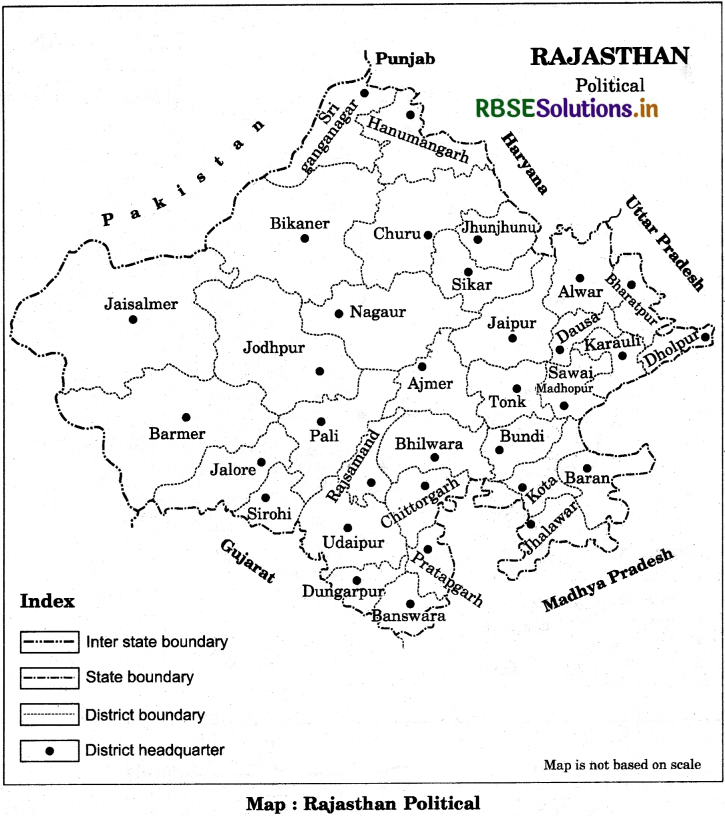
Looking at the map of Rajasthan with the help of teacher name the physical regions and their districts.

Name of physical region Name of Districts
1. Thar Desert Sri Ganganagar, Hanumangarh, Bikaner, Nagaur, Churu, Jhunjhunu, Jodhpur, Barmer, Jaisalmer, Pali, Jalore and Sikar.
2. Aravalli Mountain Sirohi, Udaipur, Raj samand, Ajmer, Dausa, Jaipur and Alwar.
3. Eastern Plains Bharatpur, Alwar, Dholpur, Karauli, Sawai madhopur, Jaipur, Dausa, Tonk, Bhil-wara, Dungarpur, Banswara, Chittorgarh and Prat.apgarb.
4. Southem- Eastern Plateau Kota, Bundi, Bar an, Jhalawar and Chittorgarh.

Textbook Questions

I. Write the correct option of the following questions in given bracket—

1. Which physical region is not situated in Rajasthan—
(a) Aravalli Mountain
(b) Eastern Plains
(c) Thar desert
(d) Mount Himalaya
Answer:
(d) Mount Himalaya

Class 6 Hamara Rajasthan Chapter 6 Question Answer in English Physical Formation of Rajasthan

2. The highest peak of Aravalli range is—
(a) Guru Shikhar
(b) Everest
(c) Jargaji
(d) Kanchenjunga
Answer:
(a) Guru Shikhar

II. Fill up the blanks—

1. ……………… region close to Chambal river has become extremely rugged because of erosion.
Answer:
Dang

2. The transformation of fertile land into barren and sandy is called ……………… .
Answer:
desertification.

III: Very Short Answer Type Questions

Question 1.
Which place in Rajasthan faces famine every year?
Answer:
Especially western Rajasthan faces famine every year.

Question 2.
What is Mavath?
Answer:
In India, the rain that occurs in winter is called ‘Mavath’.

IV. Short Answer Type Questions

Question 1.
Name the physical regions of Rajasthan and their chief characteristics.
Answer:
Physical regions of Rajasthan and their chief characteristics—
(1) Thar Desert or Western Desert— It is extended in the western part of Rajasthan in 12 districts of the state and covers nearly 61 percent of area, around 40 percent of Rajasthan’s population resides here, the richest desert of the world etc.

(2) Aravalli Mountain—It extends over almost 9 percent of mid Rajasthan running from south-west to north-east direction, among the most ancient mountains of the world, highest terrain of Rajasthan, Rajasthan’s lifeline etc.

(3) Eastern Plains—Formed from Chambal, Banas, Banganga and their tributaries, extends almost 23 percent of the state, most fertile and most densely populated region of state.

(4) Southern-Eastern Plateau—It extends nearly 7 percent of the state area, soil is made from lava, is fertile and medium black.

Class 6 Hamara Rajasthan Chapter 6 Question Answer in English Physical Formation of Rajasthan

Question 2.
Write about the seasons of Rajasthan.
Answer:
There are mainly three seasons in Rajasthan—
(1) Summer season—In Rajasthan, summer season lasts from March to June. In this season the temperature normally is higher than 30 to 40 degree centigrade in different regions. In some western districts of Rajasthan, temperature reaches upto 40 to 45 degree centigrade.

(2) Rainy season—In Rajasthan, rainy season lasts from July to September. Rajasthan has 90 to 95 perce: t of rains during this season. Jhalawar has highest rainfall and Jaisalmer has lowest rainfall. Rain decreases continously from south-eastern part to north-western part of Rajasthan.

(3) Winter season—In Rajasthan, winter season lasts from October to February. In western Rajasthan, sand gets extremely cold, and the temperature falls to 0° centigrade or less than it, at some places. Due to height, Mount Abu in Rajasthan, remains colder. In winter season, rain occurs due to ‘Mavath’ or Western Disturbance.

Class 6 Hamara Rajasthan Chapter 6 Important Question Answer

Multiple Choice Questions

1. Which is the most extensive physical part of Rajasthan?
(a) Thar Desert
(b) Aravalli Mountain
(c) Eastern Plains
(d) Southern-Eastern Plateau
Answer:
(a) Thar Desert

2. How many physical regions have Rajasthan been divided into?
(a) Two
(b) Three
(c) Four
(d) Five
Answer:
(c) Four

3. What is the height of Guru Shikhar?
(a) 1472 metre
(b) 1576 metre
(c) 1772 metre
(d) 1722 metre
Answer:
(d) 1722 metre

4. Lasadiya plateau is located at—
(a) Sirohi
(b) Udaipur and Pratapgarh
(c) Bhilwara
(d) Chittorgarh
Answer:
(b) Udaipur and Pratapgarh

Fill in the blanks

1. …………….. is among the most ancient mountains of the world.
Answer:
Aravalli mountain

2. Rajasthan is the only state of the country where …………….. types of climatic conditions prevails.
Answer:
five

3. Rajasthan is …………….. in comparison to other regions of India.
Answer:
drier

4. Soil erosion (Cutting) by water or wind is called …………….. .
Answer:
erosion.

Very Short Answer Type Questions

Question 1.
What is Great Indian Desert region called?
Answer:
The region of sandy desert situated at Barmer, Jaisalamer, and Bikaner is called Great Indian Desert.

Class 6 Hamara Rajasthan Chapter 6 Question Answer in English Physical Formation of Rajasthan

Question 2.
Which is the highest terrain of Rajasthan?
Answer:
Aravalli mountain is the highest terrain of Rajasthan.

Question 3.
How many seasons are found in Rajasthan? Write the names.
Answer:
There are mainly three seasons found in Rajasthan.
(1) Summer Season,
(2) Rainy Season,
(3) Winter Season.

Question 4.
Which crop benefits from Mavath?
Answer:
Mavath benefits the crop of wheat.

Question 5.
Where do Western Disturbances came from and rain?
Answer:
Western Disturbances come from Mediterranean sea and causes rain in Rajasthan along with northern-western India.

Question 6.
What is meant by an ‘Analogue line’?
Answer:
The imaginary lines on map that connects places of same rain is known as ‘ahalogue line’.

Question 7.
What are the monsoon winds?
Answer:
The winds, that change their direction according to the season are called as the monsoon winds.

Short Answer Type Questions

Question 1.
Into how many physical parts is Rajasthan divided?
Answer:
Rajasthan is divided into four physical parts on the basis of land structure. These are—
(1) Thar Desert, (2) Aravalli Mountain, (3) Eastern Plains, (4) Southern-Eastern Plateau.

Class 6 Hamara Rajasthan Chapter 6 Question Answer in English Physical Formation of Rajasthan

Question 2.
Why is the Thar desert called the world’s richest desert?
Answer:
The Thar desert is considered the world’s richest desert in comparison to other deserts of the world due to following reasons—
(1) Population density, (2) Animal density, (3) Rain, (4) Mineral diversity, (5) Vegetation, (6) Agriculture, (7) Sources of Irrigation, (8) Highest bio-diversity etc.

Question 3.
What are dunes or Dhora?
Answer:
The region of sandy desert situated at Barmer, Jaisalmer,.and Bikaner is called Great Indian Desert. Sand dunes and sandy soil is found in this region, which change their place with the force of winds. These are called dunes and in local language, ‘Dhora’.

Question 4.
Why is Aravalli called lifeline of Rajasthan?
Answer:
Aravalli is called the lifeline of Rajasthan because of the following reasons—

  1. Different types of mineral resources are found in this mountain range.
  2. The Aravalli mountain range stops, the spreading of desert towards east.
  3. This mountain range is the place of origin of most of the rivers.
  4. Various types of vegetation, wildlife and medicinal herbs are found in this region.
  5. Aravalli range stops the monsoon and causes rain in eastern and southern Rzgasthan.

Question 5.
What is called as ‘Chhappan ka Maidan’?
Answer:
There are some plains formed by Mahi and its tributaries in district of Banswara and Pratapgarh in southern part of Rajasthan, which are known as plains of Mahi. It is known as ‘Chhappan ka Maidan’ because this plain comprises of a group of 56 villages and is made by 56 river-drains.

Question 6.
Describe the southern-eastern plateau.
Answer:
It is situated in the southern- eastern part of Rajasthan. In ancient times Rajasthan’s southern-eastern part was the region of rulers of Hada dynasty so it is called Plateau of Hadauti. Most of the soil of this plateau made from lava, is fertile and medium black, that extends nearly 7 percent of the state area.

Question 7.
Tell us about the major plateaus in Rajasthan.
Answer:
In Rajasthan’s southern-eastern part the plateau- of Hadauti is situated. It is the largest plateau in the state. Other major plateaus of Rajasthan are Udiya and Abu Situated at Sirohi, Plateau of Bhorat located in Udaipur and Rajsamand, Mesa at Chittorgarh, Upermal at eastern part of Chittorgarh and Bhilwara and plateau of Lasadiya at Udaipur and Pratapgarh etc.

Question 8.
What is ‘Loo’? Explain.
Answer:
Loo—Extreme hot dusty winds moving in Rajasthan during summer is called ‘Loo’. Sometimes their speed is more than 100 km per hour.

Question 9.
What is desertification? What is being done in Rajasthan for this?
Answer:
Desertification—The process of degradation or transformation of fertile land into barren and sandy soil by physical conditions and human activities is called desertification. Desert is expanding persistently in western part of Rajasthan, though efforts are being made to reduce it. by tree plantation.

Long Answer Type Questions

Question 1.
Describe the salient features of Thar Desert.
Answer:
Features of Thar Desert—

  1. The Vast Thar desert is situated in the western part of Rajasthan extending from India’s western border to Aravalli in mid Rajasthan.
  2. It is extended in 12 districts of the state and covers nearly 61 percent of area.
  3. Around 40 percent of Rajasthan’s population resides here.
  4. This desert is considered the richest in comparison to other deserts of the world because of its population density, animal density, rain, mineral diversity, vegetation, agriculture, sources of irrigation, highest bio- diversity etc.
  5. Sand dimes and sandy soil is found in this region, which change their place . with the force of winds.
  6. Thar desert is divided into desert, the Plains of Ghaghar, Semi desert region, Naguar’s upper land, and in-flow regions on the basis of its surficial structure.

Class 6 Hamara Rajasthan Chapter 6 Question Answer in English Physical Formation of Rajasthan

Question 2.
Tell us about the Aravalli mountain, the physical part of Rajasthan.
Answer:
Aravalli Mountain—

  1. The Aravalli range extends over almost 9 percent mid Rajasthan running from south¬west to north-east direction.
  2. It is among the most ancient mountains of the world, extending over 692 km from Khedbrahma of Gujarat in the south to Raiseena Delhi in the north.
  3. The Aravalli range divides Rajasthan into two parts—(i) Eastern Rajasthan and (ii) Western Rajasthan.
  4. Aravalli Mountain is the highest terrain of Rajasthan. .
  5. Different types of mineral resources are found in this mountain range.
  6. The Aravalli mountain range stops the spreading of desert towards east.
  7. This mountain range is the place of origin of most of the rivers.
  8. Various type of vegetation, wildlife and medicinal herbs are found in this region.
  9. Aravalli range stops the monsoon and causes rain in eastern and southern Rajasthan.
  10. The highest peak of Aravalli mountain Range in Rajasthan is Guru Shikhar. This is situated at Mount Abu in Sirohi district. It’s height is 1722 metre.

Question 3.
Discuss the main features of the Eastern Plains.
Answer:
Main features of the Eastern Plains—

  1. The eastern plain is the main physical region of Rajasthan.
  2. Chambal, Banas, Banganga and their tributaries, forms Rajasthan’s eastern plain, which extensively is the flow of the Gangetic plain only.
  3. This plain extends almost 23 percent of the state.
  4. The region close to Chambal river from Kota to Dhaolpur has turned into rough bump because of river erosion which is known by the name of Chambal’s forest or ‘Dang’ or hilly area [bad land topography or utkhat bhoomi].
  5. Almost 40 percent of population of Rajasthan resides in this most fertile and most densely populated region of state.
  6. The plains of Mahi is located in its southern part.

Question 4.
What do you know about the climate of Rajasthan?
Answer:
Climate of Rajasthan—

  1. Monsoon has a clear effect on the climate of Rajasthan.
  2. Rajasthan is the only state of the country where five types of climatic conditions prevails due to state’s latitudinal position and north-western position in the
    Indian sub-continent, distance from sea, position of Aravalli mountain and the extension of state.
  3. Nearly 61 percent of the north of the state has dry and semi dry desert climatic conditions, in Jaipur and northern eastern districts east to Aravalli, is semi humid climate, from Sawai Madhopur to Udaipur there is humid climate and in south Banswara and south-east of Jhalawar district has extreme humid climate.
  4. On the basis of average conditions of climate, it can be said that Rajasthan is drier in comparison to other regions of India.

Question 5.
Describe in detail the conditions of summer season in Rajasthan.
Answer:
The conditions of summer season in Rajasthan—

  1. The summer season in Rajasthan is often uneven. This season lasts from March to June.
  2. In this season the temperature normally is higher than 30 to 40 degree centigrade in different regions.
  3. In western Rajasthan especially in Jaisalmer, Banner, Bikaner, Jodhpur, Shri Ganganagar, Churu etc. temperature reaches up to 40 to 45 degree centigrade.
  4. Thar Desert, being sandy is among one of the hottest places in India. Sand heats up fast and cools down fast hence in the day time, in this season, the temperture rises up and, in the night, it lowers down, so difference of daily temperature and annual temperature is much more.
  5. In this season, Mount Abu remains the coldest place of Rajasthan due to its height.

Question 6.
Describe the characteristics of rainy season in Rajasthan.
Answer:
Features/Characteristics of rainy season—

  1. In Rajasthan rainy season lasts from July to September.
  2. Rains occur due to monsoon winds.
  3. Rajasthan has 90 to 95 percent of rains during this season.
  4. It rains from the monsoon streams of both Arabian Sea and Bay of Bengal, here.
  5. Bay of Bengal monsoon causes more rain in Rajasthan, which mostly occurs in eastern Rajasthan. Arabian Sea causes most of the rain in southern Rajasthan.
  6. Jhalawar has highest rainfall approx, 100 cm.
  7. Jaisalmer has lowest rainfall approx. 10 cm.
  8. Mount Abu gets the highest rainfall of about average 150 cm.
  9. Rain decreases continuously from south-eastern part to north-western part of Rajasthan.
  10. In east of Aravalli it rains more than 50 cm and in west less than 50 cm.

Class 6 Hamara Rajasthan Chapter 6 Question Answer in English Physical Formation of Rajasthan

Question 7.
What is a Famine? What is the reason for this?
Or
Describe the Famine in Rajasthan.
Answer:
The condition of shortage of fodder, water for animals and for human beings, scarcity of drinking water and grains occur, it is called famine.

Rajasthan and especially western Rajasthan suffers famine (drought) repeatedly. The main cause behind this is the indefinite, insufficient, irregular, and periodic nature of rains here. Scanty rain is the natural character of the climate here. But because of the human-interest, forest are cut or destroyed in an unscrupulous way, exploitation of ground water, ignoring the traditional way of water resource management affects the economic and social life of this region badly.

Class 6 Hamara Rajasthan Chapter 5 Question Answer in English Pre-Independence form of Government

Engaging with these Hamara Rajasthan Book Class 6 Solutions and Class 6 Hamara Rajasthan Chapter 5 Question Answer Pre-Independence form of Government will strengthen your knowledge and prepare you for assessments.

Class 6 Our Rajasthan Chapter 5 Question Answer Pre-Independence form of Government

Our Rajasthan Class 6 Chapter 5 Pre-Independence form of Government Question Answer

I. Write the correct option of the following questions in given bracket—

1. To give wages to military and other army related responsibility was of—
(a) Treasurer
(b) King
(c) Bakshi
(d) Pradhan.
Answer:
(c) Bakshi

2. Rajasthan’s first elected chief miniter was—
(a) Mohan Lai Sukhadiya
(b) Teeka Ram Paliwal
(c) Jainarayan Vyas
(d) Haridev Joshi.
Answer:
(b) Teeka Ram Paliwal

II. Match the following

Column ‘A’ Column ‘B’
1. Village Administrative system of Mughal era.
2. Mansabdari A letter in which the estate given by ruler was mentioned.
3. Estate lease State’s smallest unit.

Answer:

Column ‘A’ Column ‘B’
1. Village State’s smallest unit.
2. Mansabdari Administrative system of Mughal era.
3. Estate lease A letter in which the estate given by ruler was mentioned.

III. Very Short Answer Type Questions

Question 1.
Write the duties of the sub- divisional (Pargana) Officer.
Answer:
The responsibility of the Sub- Divisional Officer (Pargana) was to maintain the peace in system.

Class 6 Hamara Rajasthan Chapter 5 Question Answer in English Pre-Independence form of Government

Question 2.
Descendants of which dynasties ruler the princely states of Rajasthan?
Answer:
Rulers of Sisodiya, Rathore, Kachwaha and Chauhan dynasty etc. ruled at several princely states of Rajasthan.

IV. Short Answer Type Questions

Question 1.
Explain the form of Jagirdari system.
Answer:
The form of Jagirdari system—

  1. In Rajasthan Jagirdari system was blood relation based Endogamous kin arrangement.
  2. King appointed feudal lords on important administrative posts.
  3. Relationship of kings and jagirdar was not of master or servant relationship rather it was based on brotherhood and harmony.

Question 2.
Name the administrative transformation happened in Rajasthan during British era.
Answer:
There were several administrative transformation happened in Rajasthan during British era—

  1. With the establishment of British rule, administratively India was divided into two parts first, British India, second, princely states India.
  2. India of British era was made of union territories and 11 provinces. Every province had different governors who were responsible to India’s governor general.
  3. Administration of India then came under the direct control of British Crown and parliament after 1857 revolution.
  4. British government governed India by passing many acts.
  5. India Government Act 1935 which was regulated on 1 April, 1937 brought the changes in Ajmer-Merwada administration and was brought under Indian government’s home department instead of foreign and political department. The main effect of its coming under home department was that the laws of this region were made by federal executive, not by the governor.

V. Long Answer Type Questions

Question 1.
Write an essay on pre-independence Jagirdari System of Rajasthan.
Answer:
Pre-Independence Jagirdari system of Rajasthan—
Rajasthan’s complete governance of medieval era was based on king and Jagirdari system. In Rajasthan Jagirdari system was administrative and military system (sainik system), based on blood relations and kinship.

The main element of Rajasthan’s Jagirdari system or feudal system was, that the eldest son of king became the king after his death. King allotted lands to his younger brothers for their livelihood. The owner of these lands were called feudal Lords or Jagirdars. The work of there Jagirdar S was to protect and conduct the governance of that place. Later the states were also allotted on the basis of some merit.

King appointed feudal lords on important administrative posts. Relationship of kings and Jagirdar was based on brotherhood and harmony.

The dependency of kings lessened on Jagirdaras during Mughal era.

Class 6 Hamara Rajasthan Chapter 5 Important Question Answer

Multiple Choice Questions

1. What did the minister in chief call during the royal rule in Rajasthan?
(a) Bakshi
(b) Deewan
(c) King
(d) Sub Divisional Officer
Answer:
(b) Deewan

Class 6 Hamara Rajasthan Chapter 5 Question Answer in English Pre-Independence form of Government

2. Who was the India’s first viceroy?
(a) Lord Canning
(b) Lord Dalhousie
(c) Lord Mountbatten
(d) Lord William Bentinck.
Answer:
(a) Lord Canning

3. When did the elections for the first legislative assembly of Rajasthan take place?
(a) 1947
(b) 1950
(c) 1951
(d) 1952
Answer:
(d) 1952

Fill in the Blanks

1. Kings appointed to help them in their government works.
Answer:
ministers

2. In rajasthan Jagirdari system was based Endogamous Kin arrangement.
Answer:
blood relation

3. Rule of East India Company ended after revolution.
Answer:
1857

4. The process of of Rajasthan started after independence of the country.
Answer:
unification.

Very Short Answer Type Questions

Question 1.
When did our Rajasthan come into its present form?
Answer:
After independence, Rajasthan came into its present form.

Question 2.
Define monarchy.
Answer:
The rule in which the king is the chief center of the entire power of the state is called monarchy.

Class 6 Hamara Rajasthan Chapter 5 Question Answer in English Pre-Independence form of Government

Question 3.
What was the work of Village Panchayat?
Answer:
Village was governed by Village Panchyat.

Question 4.
On which system is the Rajasthan’s complete governance of medieval era based on?
Answer:
Rajasthan’s complete governance of medieval era was based on King and Jagirdari system.

Question 5.
What were the reasons for introducing the Jagirdari system?
Answer:
Rulers initiated Jagirdari system for the protection and governance of princely states.

Question 6.
During British rule, into how many parts was India divided administratively? Write the names.
Answer:
In two parts—(1) British India, (2) Princely states India.

Short Answer Type Questions

Question 1.
State the main features of the rule of princely states.
Answer:

  1. Princely states conducted their rule as an indpenedent state.
  2. Rulers of princely states ruled their states with the help of ministers and Jagirdars.
  3. King was chief center of the power. The type of rule was called monarchy.
  4. There were officers of central system, king, ministers, paymasters (bakshi), treasurer, sub-divisional officers to conduct the governance in various princely states.

Question 2.
Tell about the beginning of Jagirdari system in Rajasthan.
Answer:
Beginning of Jagirdari system started in Rajasthan during the period of Rajput dynasty. Different branches of Rajputs established their states in Rajasthan, which were called their princely states or Riyasat. Rulers initiated Jagirdari system for the protection and governance of princely states.

Question 3.
What changes occurred in the administration of India after the 1857 period?
Answer:
Rule of East India Company ended after 1857 revolution. Administration of India then came under the direct control of British Crown and parliament. Lord Canning was appointed governor general along with India’s first viceroy. British government governed India by passing many acts.

Long Answer Type Questions

Question 1.
Describe the central govern¬ment system in princely states.
Answer:
Central government system in princely states—Before independence, there were several princely states in Rajasthan, Governance system was the same. There were following officers of central system to conduct the governance in various princely states—

  1. King—King was the top core to the absolute power of state. King usually governed with the help of advisors and members of council of ministers.
  2. Ministers—Kings appointed ministers to help them in their government works. Minister in chief was called Deewan. King used to consulted with the ministers about the regime affairs, to solve the problems of government.
  3. Pay Master (Bakshi)—To give wages to military and monitor variant works related to army was the responsibility of Bakshi.
  4. Treasurer—Treasure’s job was to keep the balance of income and expenses and keep safe the savings and to increase in the treasury of government.
  5. Sub Divisional Officer—State was divided into sub-divisions and the responsibility of the sub-divisional officer was to maintain the peace in system.

Class 6 Hamara Rajasthan Chapter 5 Question Answer in English Pre-Independence form of Government

Question 2.
Describe the transformation in the form of Medieval Jagirdari System.
Answer:
Transformation in the form of Medieval Jagirdari System—

  1. The dependency of kings lessened on Jagirdars during Mughal era because of the treaty with them.
  2. Mughals became Mansabdar and they got the patronage of Mughals. So rulers started behaving like masters with Jagirdars.
  3. In the beginning they used to give serivce to king during, peace and war but in medieval era, tax was also levied with these services’ which was mentioned in estate lease.
  4. Some arrangement of Mughal governance system effected Rajasthan too. Princely states divided their administration in divisions (parganas) and villages.

Class 6 Hamara Rajasthan Chapter 4 Question Answer in English Sites of Ancient Civilization in Rajasthan

Engaging with these Hamara Rajasthan Book Class 6 Solutions and Class 6 Hamara Rajasthan Chapter 4 Question Answer Sites of Ancient Civilization in Rajasthan will strengthen your knowledge and prepare you for assessments.

Class 6 Our Rajasthan Chapter 4 Question Answer Sites of Ancient Civilization in Rajasthan

Our Rajasthan Class 6 Chapter 4 Sites of Ancient Civilization in Rajasthan Question Answer

I. Write the correct option of the following questions in given bracket—

1. In which of the following district Kalibanga is situated?
(a) Jalore
(b) Hanumangarh
(c) Sikar
(d) Udaipur.
Answer:
(b) Hanumangarh

2. Ashoka’s Bhabhru inscription has been found from?
(a) Bairath
(b) Ganeshwar
(c) Ahad
(d) Balathal
Answer:
(a) Bairath

II. Fill in the blanks—

1. In ……………… in Neem Ka Thana tehsil of Sikar district, remains of a distinct culture are found.
Answer:
Ganeshwar

Class 6 Hamara Rajasthan Chapter 4 Question Answer in English Sites of Ancient Civilization in Rajasthan

2. Ahad township in ancient times was known by the name of ……………… town.
Answer:
Tambawati.

III. Very Short Answer Type Questions

Question 1.
Write any two sites of Copper Stone Era.
Answer:
(1) Ahad, (2) Ganeshwar.

Question 2.
From which district Remnants of Balathal civilization are found?
Answer:
Remnants of Balathal civilization are found from Udaipur district.

Question 3.
At the bank of which river Ahad civilization developed?
Answer:
Ahad civilization was developed on the bank of Ahad (Bedach) river.

IV. Short Answer Type Questions

Question 1.
Which are the ancient sites of civilization in Rajasthan? Give, des-cription of any two.
Answer:
There are many ancient sites of civilization in Rajasthan. The main are as follows—Kalibanga, Aghatpur or Ahad, Balathal, Ganeshwar, Bairath etc. A brief description of two of these is as follows—
(1) Kalibanga—Kalibanga is situated in Hanumangarh district on the banks of Ghagghar river. In the excavation a town of Sindu—Saraswati civilization period is found where bricks were used in houses. For the drainage of dirty water, drains were made and fire pits (agnikund) are also found. Remains of a fort are found in the excavation of another cliff.

(2) Ahad—Ahad is situated in the east of Udaipur, on the bank of Ahad (Bedach) river. The walls found in this place are made of stones and mud and the roofs are made of bamboo and kelu (terracotta tiles). The people of Ahad were deft in the art of making vessels. Several things are obtained during excavation. It was a copper stone civilization.

Question 2.
Mention the features of ancient site of Kalibanga.
Answer:
The main features of ancient site of Kalibanga are as follows—

  1. In the excavation a town of Sindhu- Saraswati civilization period is found where bricks were used in houses.
  2. There were Four-five large room and some small rooms in the houses.
  3. For the drainage of dirty water from the town, drains made of wood and bricks were there.
  4. Here platforms (chabutaras) are also found on which fire pits (agnikund) are made up. Probably these were used for religious activities,
  5. Remains of a fort are found in the excavation of another cliff.
  6. In this region evidence of tilled agricultural land outside the ramparts of the town are also found.
  7. During excavation, cow faced bowls, ox of copper, mirrors of bronze, ivory combs, earthen wares, glass beads, toys etc. are found.
  8. This prosperous town was ruined over the period of time due to the drying of the river water and extending of desert.

Class 6 Hamara Rajasthan Chapter 4 Important Question Answer

Multiple Choice Questions

1. The early age is—
(a) Iron age
(b) Copper-Bronze age
(c) Stone age
(d) Kalyug
Answer:
(c) Stone age

Class 6 Hamara Rajasthan Chapter 4 Question Answer in English Sites of Ancient Civilization in Rajasthan

2. Which metal did man start using first?
(a) Copper
(b) Gold
(c) Iron
(d) Aluminium.
Answer:
(a) Copper

3. Knitted cloth is found in which of the following place—
(a) Kalibanga
(b) Balathal
(c) Ahad
(d) Ganeshwar
Answer:
(b) Balathal

4. In which district is the ancient civilization site Bagore located?
(a) Jaipur
(b) Udaipur
(c) Hanumangarh
(d) Bhilwara
Answer:
(d) Bhilwara

Fill in the blanks

1. Gradually humans started making ……………. in place of stone.
Answer:
metal

2. The city planning of Kalibanga looks similar to that of ……………. .
Answer:
Sindhu Valley

3. The people of ……………. were deft in the art of making vessels.
Answer:
Ahad

4. ……………. tools are found in abundance at Ganeshwar.
Answer:
Copper.

Very Short Answer Type Questions

Question 1.
Why is the early age called ‘stone age’?
Answer:
In early age, majority of equipments discovered are mainly made up of stones, so the early age is called ‘stone age’.

Question 2.
From which regions are the remains of copper civilization found in Rajasthan?
Answer:
The remains of copper civilization in Rajasthan are found from Kalibanga, Ganeshwhar and Ahad regions.

Class 6 Hamara Rajasthan Chapter 4 Question Answer in English Sites of Ancient Civilization in Rajasthan

Question 3.
In which district is the ancient civilization centre Tilwara located?
Answer:
The ancient civilization centre Tilwara is located in Banner district.

Question 4.
What was the reason for the destruction of propsperous town of Kalihanga?
Answer:
The destruction of prosperous town of Kalibanga was due to the drying of the river water and extending of desert.

Question 5.
What is Dhoolkot?
Answer:
In the east of Udaipur, on the bank of Ahad (Bedach) river, two cliffs are seen, the native people call them Dhoolkot.

Question 6.
What is the culture of Ganeshwar called?
Answer:
The culture of Ganeshwar is called copper accumulated culture.

Question 7.
Which civilization sites descriptions are notable for knowing the history of iron age?
Answer:
Description of the sites of Bairath, Sambhar, Bagor, Redh etc. are important to know about the iron age civilization.

Question 8.
In which district is Bairath town located?
Answer:
Bairath town is located in Jaipur district.

Question 9.
From the point of view of archaeology, name two important areas of Bairath.
Answer:
(1) Hill of Beejak, (2) Bheem Dungari.

Question 10.
Which ancient cultural site is located in Jalore district?
Answer:
Bheenmal.

Short Answer Type Questions

Question 1.
Which were the oldest evidences obtained from excavation?
Answer:
Several chief ancient testimonies obtained from excavation. They are dwelling sites, wood, cereals, weapons and equipments made from bones and stones.

Question 2.
What kind of equipments did humans make in stone age and why?
Answer:
In stone age, humans made equipments like axe, knife and gandasa (pole axe). Because in stone age, humans hunted animals or gathered root vegetables from forests to fulfill their requirement and fill their stomach.

Question 3.
In which places are the tools of stone age found in Rajasthan in abundance?
Answer:
In Rajasthan, the equipments of stone age have been discovered in abundance mainly in Banas, Gambhiri, Bedach and Chambal river valleys and rock shelters.

Question 4.
Who discovered Kalibanga? Describe.
Answer:
Archaeologist Amlanand Ghosh, discovered Kalibanga. He discovered almost two dozen historic sites on the banks of Saraswati and Drishdwati river valley. Kalibanga in Hanumangarh district on the bank’s of Ghagghar river is prominent among them. Later the excavation was done here under the direction of Dr. B.B. Lai and B.K. Thapar.

Question 5.
Explain the history of naming ‘Aghatpur’.
Answer:
In the east of Udaipur, on the bank of Ahad (Bedach) river, two cliffs are seen, the native people call them Dhoolkot. This town was earlier known by the name of Tambawati. It was the centre of production of copper tools. This is probably why it got this name. It came to be known by the name of Aghatpur in the tenth or eleventh century.

Class 6 Hamara Rajasthan Chapter 4 Question Answer in English Sites of Ancient Civilization in Rajasthan

Question 6.
What type of earthenware are found in Ganeshwar?
Answer:
Two types of earthenware are found in Ganeshwar—

  1. Light red coloured thin vessels of Pre-Harrapan culture.
  2. Strong vessels of distinct painting in red smooth soil. Jar pitcher, bowls, pans, lids-vessels etc. are prominent among these vessels.

Question 7.
What are the major ancient centres of civilization in Rajasthan?
Answer:
There are several ancient centres of civilization in Rajasthan. Out of these Kalibanga in Hanumangarh district; Ahad and Balathal in Udaipur district; Ganeshwar in Sikar district; Bagore and Ojhiyana in Bhilwara district; Bairath, Sambhar, Jodhpura situated at Jaipur district; Nagar, Rendh situated in Tonk district; Nagari at Chittor; Nuh at Bharatpur; Bheenmal at Jalore; Rajsamand’s Pachmata, Gilund etc. are the major ancient sites of civilization in Rajasthan. These unveil cultures of stone, copper stone, and copper-iron period.

Long Answer Type Questions

Question 1.
Describe the characteristics of the ancient archaeological site Ahad.
Answer:
The characteristics of the ancient archaeological site Ahad are as follows—

  1. The walls found in this place are made of stones and mud. The roofs of which are made of bamboo and kelu (terracotta tiles). .
  2. A large room was divided into smaller rooms (overas) by applying the mud in between layers of bamboo.
  3. The four to six hearths found in houses are evidence of the system of joint family.
  4. Rice of superior quality was produced here.
  5. In Ahad a furnace kind of hearth is found. This is believed that copper was melted at this place.
  6. Red and brown earthenenware found here are excellent in terms of art and ornamentation.
  7. Dishes, lamps, incense holders, bowls, pots, pitchers, bangles, toys, 26 types of beads, 6 coins of copper and three seals are obtained during excavation carried out in 1951-52 at Dhoolkot.
  8. This civilization, was destroyed due to a natural outbreak, moved towards north-east and south-east and settled down in places like Gilund and Bhagwan pura.

Question 2.
Describe Balathal as an ancient site of civilization.
Answer:
Balathal—

  1. Balathal Civilization is related to Ahad culture of Copper Stone Age.
  2. The traces of a large building of eleven rooms and a fort are also found here.
  3. Knives of copper, axe, chisel and arrows like tools and flower earrings, pendant of necklace etc. ornaments are found in Balathal.
  4. Mixed economy was popular among the inhabitants here! Agricult lire, animal husbandry and hunting, all three, were the means of livelihood.
  5. The signs of iron melting furnaces are found here.
  6. Balathal is the only place, besides Bairath, where knitted cloth is found.

Class 6 Hamara Rajasthan Chapter 4 Question Answer in English Sites of Ancient Civilization in Rajasthan

Question 3.
What do you know about Ganeshwar? Describe.
Answer:
Ganeshwar—

  1. Ganeswar is the site in Neem Ka Thana Tehsil of Sikar district.
  2. The remains of a distinct culture are found at Ganeshwar.
  3. This culture flourished in the regions of eastern Rajasthan and Gangaghati.
  4. Copper tools are found in abundance at Ganeshwar. The reason behind this must have been the proximity to Khetri copper store.
  5. The main equipments are arrows, chisels, fishing hook, razor plates, and rings etc.
  6. It seems double helical venous copper pins were exported to western and Middle Asia from here.
  7. Earthenware are also found in Ganeswhar.

Question 4.
Explain the features of Bairath as a place of Worship.
Answer:
The features of Bairath as a place of worship are as follows—

  1. Bairath town situated in Jaipur district has remained a chief centre of culture and civilization in every epoch.
  2. The Hill of Bqejak and Bheem Dungari here are aracheologically important.
  3. This is mentioned as Viratnagar, the capital of Matsya Janapada in Maha- baharat, where Pandavs spent their last days of exile in anonymity.
  4. This centre was also important in Muryan-period. Two pillar edicts (Babharu or Birath inscription) of Ashoka and remains of Buddhist monastery are found here.
  5. 36 silver coins are found in one room here. Of these 8 are of ‘panchmark’ and 28 belong to Indian Greek rulers.
  6. In excavation pots adorned with swastika and three gem wheel mark, lamps, dancing bird, stone boxes, iron nails, and handmade cloth are found.

Class 6 Hamara Rajasthan Chapter 3 Question Answer in English Sources of History

Engaging with these Hamara Rajasthan Book Class 6 Solutions and Class 6 Hamara Rajasthan Chapter 3 Question Answer Sources of History will strengthen your knowledge and prepare you for assessments.

Class 6 Our Rajasthan Chapter 3 Question Answer Sources of History

Our Rajasthan Class 6 Chapter 3 Sources of History Question Answer

I. Write the correct answers of the following questions given in bracket—

1. Who is the writer of Vansh Bhaskar?
(a) Banki Das
(b) Shyamal Das
(c) Suryamall Misan
(d) Dayal Das
Answer:
(a) Banki Das

II. Fill in the blanks

1. A record written in praise is called …………… .
Answer:
Prashasasti

Class 6 Hamara Rajasthan Chapter 3 Question Answer in English Sources of History

2. Engraved in Sanskrit …………… Inscription gives the information till the period of Rawal Samar Singh.
Answer:
Cheerwa

III. Very Short Answer Type Questions

Question 1.
Write names of any three prominent forts of Rajasthan.
Answer:
(1) Chittor Fort (2) Ranthambhore Fort (3) Meharangarh.

Question 2.
What are archaeological sources?
Answer:
The relics of ancient times which help us to understand the context of places and incidents are called archaeological sources.

Question 3.
Explain the contribution of currencies in writing of History?
Answer:
Religious, political and economic condition of certain period is known through currencies which is helpful in writing history.

VI. Short Answer Type Questions

Question 1.
What are Tamra Patra’ and what information we get through these?
Answer:
Tamra Patra—Writings engraved on copper’s large-small plates are called Tamra Patra’. Related to charity and virtue (punya) these are also called ‘Dan Patras’. Through these we come to know about the kings, period, festivals, religion, lands, types of lands, measurements and charity etc.

Question 2.
Give the information about Rajasthan’s prominent historical texts.
Answer:
Literature plays an important role in knowing history.

  1. We get the help from Veda-Purana, Ramayana, Mahabarat, Buddhist and Jain texts to know the ancient history of Rajasthan.
  2. We get the description of achievements of Chauhans by epic, ‘Prathiviraj Vijay’ written by Jayanak in latter part of the 12th century.
  3. Through Nayan Chand Suri’s epic ‘Hammeer Mahakavya’ we get the information about history of Chauhans along with Allauddin Khilji’s Ranthambore victory as well as the social, religious, condition of that time.
  4. Prithvi Raj Raso, Vachnika of Achal Das Khinci, Padmnabh written Kanhad Dev Prabandh, Dalpat—Vilas written by Dalpat Singh of Bikaner, Vachnika written by Khidiya Jagga etc. are especially noteworthy.
  5. Nainsi’s Khyat, Dayal Das’s Khyat, Khyat of Jodhpur state, helps us to know the history.
  6. Persian—Urdu literary texts (Persian—Urdu Tvarikho) helps us to understand the history of medieval Rajasthan specially.
  7. The historical texts ‘Annals and Antiquities of Rajasthan’ and “A Journey of western Rajasthan” written by Colonel James Todd, “Vansh Bhaskar” written by the great writer of Bundi Suryamall Misan, ‘Veer Vinod’ written by poet laureate Shyamal Das, History of Marwar State (Marwar Rajya Ka Itihas) written by Vishweshar Nath Reu, History of Udaipur, Jodhpur, Sirohi, Dungarpur, Banswara and Pratapgarh written by Gauri Chand Ojha are notable.

Class 6 Hamara Rajasthan Chapter 3 Important Question Answer

Multiple Choice Questions

1. The means of knowing the history of Pratiharas—
(a) Inscription of Cheerwa
(b) Ghatiyala Abhilekh
(c) Bijoliya Inscription
(d) Kiradoo Abhilekh
Answer:
(b) Ghatiyala Abhilekh

Class 6 Hamara Rajasthan Chapter 3 Question Answer in English Sources of History

2. The text written by poet Shyamaldas—
(a) Kanhad Dev Prabandh
(b) Vansh Bhaskar
(c) Hammeer Mahakavya
(d) Veer Vinod
Answer:
(d) Veer Vinod

Fill in the blanks

1. The art and skill can be seen in the relics of ……………… (Neem Ka TTiana, Sikar) Copper Culture.
Answer:
Ganeshwar

2. ……………… inscriptions are important resources to know the history of Chauhans.
Answer:
Bijoliya

3. Writings engraved on copper’s large-small plates are called ……………… .
Answer:
Tamra Patra.

Very Short Answer Type Questions

Question 1.
Define Prashasti.
Answer:
Inscriptions written in praise are called Prashasti.

Question 2.
Write the names of any two archaeological sources.
Answer:
(1) Records (Abhilekh) (2) Currencies.

Question 3.
In which style are records found?
Answer:
These are found in various langauges in both the forms poetry and prose.

Question 4.
Name any two records found in Rajasthan.
Answer:
(1) Nagri record, (2) Ghatiyala abhilekh.

Class 6 Hamara Rajasthan Chapter 3 Question Answer in English Sources of History

Question 5.
What did we obtain from excavation?
Answer:
We obtained earthenware, bowls, dishes, incense pots, lamps from excavation.

Question 6.
From which places in Rajasthan did black and red earthen¬ware obtain from excavation?
Answer:
Black and red earthenware were obtained from Jodhpura (Jaipur) and Noh (Bharatpur).

Question 7.
Who is the author of Kanhad Dev Prabandh?
Answer:
The author of Kanhad Dev Prabandh is Padmnabh.

Question 8.
What things are described in the famous Khyat thematic literature?
Answer:
In Khyat thematic literature there is a description of establishment of famous Rajput dynasties, lineage of kings, state area, etc.

Question 9.
Write the names of any two famous Khyat.
Answer:
(1) Nainsi ri Khyat (2) Banki Dari Khyat.

Question 10.
Name the famous historical text composed by Colonel James Todd.
Answer:
‘Annals and Antiquities of Rajasthan’.

Short Answer Type Questions

Question 1.
Which material is included in archaeological sources?
Answer:
Following materials are included in archaeological sources—
(1) Records (Abhilekh), (2) Monuments, (3) Currencies, (4) Vessels and artworks from excavation, (5) Copper Plates.

Question 2.
What do you understand by ‘Records’ (Abhilekh)?
Answer:
Records—These are found engraved on inscriptions (plates of stones), stone edicts (big blocks of stone), pillars, buildings, walls of caves, idols-statues, stupas, monasteries, ponds, blocks erected in farms and copper plates.

Class 6 Hamara Rajasthan Chapter 3 Question Answer in English Sources of History

Question 3.
Describe the importance of records (abhilekh).
Answer:
Importance of records—
(1) On these records the names, and the dates of incidents, administrative duties, decrees and ordlers of kings, their dependents, queens, princes, feudal lords are mentioned. (2) We get the knowledge of contemporary political, religious, cultural life through these.

Question 4.
Tell us about the major records found in Rajasthan.
Answer:
Major records of Rajasthan—
The major records found in Rajasthan are Nagri record, Kanswa record, Ghatiyala record, Kiradoo record, Nandsa and Barnalayup (pillar) inscription, Samoli inscription etc. We get the information about religious arrangement, types of Yajnas, land and Dravyadaan (Material donations), political boundary etc., from these.

Question 5.
Describe the major monu¬ments of Rajasthan. What information does these provide?
Answer:
Forts of Chittor, Jalore, Gagron, Ranthambore, Amemr, Meharangarh, Taragarh, Kumbhalgarh etc. are important among Rajasthan. Except these buildings, Rajaprasad (palaces), public buildings, bathrooms, homes of the commons, Vihars, Monasteries, Chetya, Stupas, Temples, Stepwells, Tombs, Wells etc. are also monuments.

These also provides the knowledge of contemporary architecture, religious beliefs,worship methods, conscience of human and prosperity.

Question 6.
Who composed the epic ‘Hammeer Mahakavya’ ? What information does this provide?
Answer:
Nayan Chand Suri composed the epic ‘Hammeer Mahakavya’. Through ‘Hammeer Mahakavya’ we get the information about history of Chauhans along with Allauddin Khilji’s Ranthambhore victory as well as the social, religious condition of that time.

Long Answer Type Questions

Question 1.
Describe currencies as a source of knowing history.
Answer:

  1. Currency is the archaeological material for the source, of history.
  2. Religious, political and economic condition of certain period is known through currencies or coins, stamps or other symbols.
  3. Symbols, language, script, year, names with samvat and purity of metal, measurements etc. graved on the currencies, give us the knowledge about the prosperity of that period.
  4. Coins also indicate the power of king and state.
  5. Coins and currencies excavated from Ahad, Red, Bairtah, Rangmahal, Sambhar, Sukhaniya gives information about the period of dynasty, rule, kingdom, and occupied borders of chhatraps, Maalavas, Chauhans, Guhils etc.

Class 6 Hamara Rajasthan Chapter 3 Question Answer in English Sources of History

Question 2.
Describe vessels and artefacts as sources of history.
Answer:

  1. Vessels and artefacts have great importance as a source of history. We have obtained vessels and artefacts excavation.
  2. In the Artwork we see the drawings on vessels, engravings on pillars, and the workmanship on doors and windows (gokhars).
  3. The vessels obtained and their structure, polish, colour, etc. depicts the excellent art of that period.
  4. We can understand the art and skill of our ancestors from the earthenware, bowls dishes incense pots, lamps excavated from different places in Rajasthan.
  5. The art and skill can be seen in the relics of Ganeshwar (Neem ka Thana, Sikar) Copper Culture, black and red earthenware obtained from Jodhpura (Jaipur) and Noh (Bharatpur), Prastar (engraved stones/jewels), Falak (banners) etc. obtained from Ahad and Gilund.

Class 6 Hamara Rajasthan Chapter 2 Question Answer in English History of Rajasthan

Engaging with these Hamara Rajasthan Book Class 6 Solutions and Class 6 Hamara Rajasthan Chapter 2 Question Answer History of Rajasthan will strengthen your knowledge and prepare you for assessments.

Class 6 Our Rajasthan Chapter 2 Question Answer History of Rajasthan

Our Rajasthan Class 6 Chapter 2 History of Rajasthan Question Answer

I. Write the correct answer of the following questions in brackets—

1. What was the capital of Matsya Janapada?
(a) Mathura
(b) Ahichhatrapur
(c) Viratnagar
(d) Bagaur.
Answer:
(c) Viratnagar

2. Kota-Bundi region is called—
(a) Hadoti
(b) Jaangal
(c) Maru
(d) Mewat
Answer:
(a) Hadoti.

II. Fill in the blanks

1. Beawar-Ajmer region is known by the name of …………….. .
Answer:
Merwada

2. The language of Jaipur and region nearby is called …………….. .
Answer:
Dhundhad.

III. Very Short Answer Type Questions

Question 1.
Name any two Janapadas of Mahabharat time period.
Answer:
(1) Matsya (2) Jaangal

Class 6 Hamara Rajasthan Chapter 2 Question Answer in English History of Rajasthan

Question 2.
Which districts are part of Shekhawati area?
Answer:
Churu, Jhunjhunu and Sikar are part of Shekhawati Area.

Question 3.
Who was Hassan Khan Mewati?
Answer:
The famous hero of Mewaties was Hassan Khan Mewati who fought against Babar in the war of Khanwa in favour of Rana Sanga was killed.

IV. Short Answer Type Questions

Question 1.
Why did the republican janapada system of Rajasthan demolish after 5th century.
Answer:
After 5th century, Hun attacked the republican janapada system of Rajasthan. The Him invasions destroyed the order of republic janapadas of Rajsthan. The destruction of this place is mentioned in the text named ‘Brihadsamhita’.

Question 2.
Name any three Janapadas or regions?
Answer:
(1) Jaangal—Modern Bikaner, Nagaur and Jodhpur comes in this janapada. Its capital was Ahichhatrapur. We can perceive it from modern Nagaur. According to mythological sayings Balram and Krishna of Yadav dynasty passed this region, while they were going to Dwarika.

(2) Matsya—This janapada is mentioned in Rigveda. During Mahabharat the capital of Matsya Janapada was Viratnagar (Bairath). This janapada was located between Alwar and Jaipur. This place is also mentioned by Chinese traveller Yuvan Chwang.

(3) Marwar—Over the period ancient Maru region had been called Marwar. Guijar—Pratihars ruled in seventh century on its Mandor (Jodhpur) region. Later on Rathore dynasty established their hegemony oh this region.

Class 6 Hamara Rajasthan Chapter 2 Important Question Answer

Multiple Choice Questions

1. What was the name of the capital of Jaangal district?
(a) Ahichhatrapur
(b) Bairath
(c) Mathura
(d) Chawand
Answer:
(a) Ahichhatrapur

Class 6 Hamara Rajasthan Chapter 2 Question Answer in English History of Rajasthan

2. Where is the ‘Yupa’ inscription of conquests of the Malavas situated?
(a) Jaipur
(b) Nandasa (Bhilwara)
(c) Medpaat (Mewar)
(d) Mandor (Jodhpur)
Answer:
(b) Nandasa (Bhilwara)

3. By what name is the southern part of Jodhpur known?
(a) Mad
(b) Shekhawati
(c) Gujartra
(d) Mewat
Answer:
(c) Gujartra

4. Which district area was also called Medpaat (Mewar) and Pragvaat?
(a) Malav
(b) Shoorsen
(c) Yodhey
(d) Shivi
Answer:
(d) Shivi

Fill in the blanks

1. Matsya janapada was mentioned by Chinese traveller …………….. .
Answer:
Yuvan Chewang

2. The capital of Shoorsen janapada was …………….. .
Answer:
Mathura

3. Over the period ancient Maru region has been called …………….. .
Answer:
Marwar

4. Pratapgarh is also known by the name of …………….. .
Answer:
Kanthal.

Very Short Answer Type Questions

Question 1.
How did the creation of Janpadas started in ancient India?
Answer:
In ancient India Arayans merged small towns and built their respective states and Janapadas.

Question 2.
What was the name of the Capital of Shivi Janapada?
Answer:
The capital of Shivi Janapada was Majhmika or Madhyamika.

Class 6 Hamara Rajasthan Chapter 2 Question Answer in English History of Rajasthan

Question 3.
In which part of Rajasthan is Yodhey located?
Answer:
Yodhey is located in the northern part of Rajasthan.

Question 4.
Who destructed the Kushan power in northern Rajasthan?
Answer:
Yodhey destructed the Kushan power in northern Rajasthan.

Question 5.
For what period did the republic systems remain in their respective regions?
Answer:
The republic systems remained in their respective regions till Gupta period.

Question 6.
Which book discusses the destruction of republic systems?
Answer:
The destruction of republic systems is mentioned in the text named ‘Brihadsamhita’.

Question 7.
What was the terrain of ancient Shivi Janapada called?
Answer:
The terrain of ancient Shivi Janapada was called Mewar.

Question 8.
Which region is called Mewat?
Answer:
The region of Alwar—Bharatpur is called Mewat because of abundance of Mew caste.

Question 9.
What is Jaisalmer region called?
Answer:
Jaisalmer region is called Mad or Vail.

Question 10.
Write the names of any two regions of Rajasthan.
Answer:
(1) Hadoti, (2) Shekhawati.

Short Answer Type Questions

Question 1.
In ancient times, Rajasthan was divided into which political units?
Answer:
In ancient times Rajasthan was divided into different janapadas and territories. These janpadas and territories were known by the name of geographical place or by the name of the caste residing there, like Jaangal, Maru, Arjuhayan, Shivi, Mevat, Hadauti etc.

Question 2.
Which region was known as Shivi Janapada? Tell us about it.
Answer:
Shivi Janapada—Shivi caste established hegemony in east, west and north divisional region of modern Udaipur. Hence it is recognized by the name of Shivi Janapada. The capital of this janapda was Majhmika or Madhyamika.’ Its remains are found in village named Nagri near Chittorgarh. This terrain is also called Medvpaat (Mewar) and Pragvaat.

Class 6 Hamara Rajasthan Chapter 2 Question Answer in English History of Rajasthan

Question 3.
What do you know about Arjunayan?
Answer:
Arjunayan—Arjunayan of Bharatpur-Alwar region were famous for their victories. Arjunayans together with Malavas defeated foreign Chhatrap (Chief of Province) invaders.

Question 4.
Write about the Malav Janapada.
Answer:
Malav—The center of the power of Malavas was a town near Jaipur (in modern times it is in Tonk district). Over the period they extended to Ajmer, Tonk and Mewar region. The region of Tonk, Pratapgarh and Jhalawar comes under Malavdesh. The ‘Yupa’ inscription of conquests of the Malavas is situated at Nandasa (Bhilwara).

Question 5.
Which region of Rajasthan was known as Vagad ? Write about it.
Answer:
Vagad—In Rajasthan two regions are known by the name of Vagad-one Dungarpur, Banswara and second Narhad, Nohar, Bhadra and region of Kanana near Pilani. But mainly terrain of Dungarpur, Banswara of south Rajasthan is called Vaggat or Vagad. The dialect of this place is Vagadi.

Question 6.
Give a brief description of Hadauti Zone.
Answer:
Hadauti—Modern Bundi and Kota region is called Hadauti. In ancient times Meena tribe ruled this terrain. Bundi was named after the name Bunda of Meena dynasty. Over the period Hada branch of Chauhan dynasty established its hegemony on this region. Afterwards this terrain and its dialect is called Hadauti.

Question 7.
What do you know about Dhundhad?
Answer:
Dhundhad—Jaipur and its adjoining regions were famous by the name of Dhundhad. In 12th century Kachwaha Rajpoot defeated the local tribes of Meena and Badgurjar and established the foundation of their kingdom. The language of this place is called Dhundhadi.

Long Answer Type Questions

Question 1.
Write in detail about Maru region.
Answer:
Maru region—Maru region is mentioned in all our mythological books like Ramayan, Charak Samhita, Mahabharat, Vrihat Samhita including Rigveda. Maru region was early democracy of Arayans in which some parts of modern Bikaner, Nagaur, Churu, Gangangar, Jaisalmer and Barmer were included. Over the time, with few developments Kuru, Bhadra and Jangal named Janapadas were formed in this region.

Question 2.
Write the main things related to Shoorsen Janapada.
Answer:
Shoorsen—

  1. The largest part of Bharatpur, Dholpur and Karauli of Rajasthan was included in this janapada.
  2. The capital of this janapada was Mathura.
  3. In 4th century B.C. Greek writers had mentioned Shoorsen or Saursen during the period of Alexander.
  4. Shoorsen kingdom is also mentioned in ‘Bayana Prashasti’.
  5. After the attack of Alexander, some castes from Punjab and Takk eager to keep their freedom, came and settled in Rajasthan.
  6. Among these Malav, Shivi, Aijunayan etc. castes were famous for their courage and chivalry.

Class 6 Hamara Rajasthan Chapter 2 Question Answer in English History of Rajasthan

Question 3.
Which region was included in Mewar Zone? Describe.
Answer:
Mewar—Ancient region of Shivi janapada is called Mewar. Modem Udaipur, Chittorgarh, Rajsamand, Bhilwara districts were in the region of Mewar.

Guhil— Sisodiya dynasty ruled this region from seventh century to the formation of modem Rajasthan. Over the time Nagada, Ahar, Kalyanpur, Chittorgarh, Kumbhalgarh, Chavand, Udaipur etc. remained the capital of Mewar. The dialect of this place is Mewari.

Class 6 Hamara Rajasthan Chapter 1 Question Answer in English Rajasthan An Introduction

Engaging with these Hamara Rajasthan Book Class 6 Solutions and Class 6 Hamara Rajasthan Chapter 1 Question Answer Rajasthan An Introduction will strengthen your knowledge and prepare you for assessments.

Class 6 Our Rajasthan Chapter 1 Question Answer Rajasthan An Introduction

Our Rajasthan Class 6 Chapter 1 Rajasthan An Introduction Question Answer

Let’s Practice

(a) Examine India’s map and answer—

Question 1.
Which country is connected to international border of Rajasthan?
Answer:
Pakistan is connected to international border of Rajasthan.

Question 2.
Name the neighbouring states of Rajasthan.
(a) In North
(b) In East
(c) In South-east
(d) In South
Answer:
(a) In North—Punjab
(b) In East—Uttar Pradesh
(c) In South-east—Madhya Pradesh
(d) In South—Gujarat.

Let’s Practice

Answer the following questions examining the map (see Textbook.)—

Question 1.
Make a list of all the districts of Rajasthan.
Answer:
Districts of Rajasthan
Name of District
1. Jaipur
2. Jodhpur
3. Bikaner
4. Ajmer
5. Kota
6. Udaipur
7. Bharatpur
8. Dausa
9. Sikar
10. Alwar
11. Jhunjhunu
12. Pah
13. Jalore
14. Sirhoi
15. Banner
16. Jaisalmer
17. Churu
18. Sri Ganganagar
19. Hanumangarh
20. Bhilwara
21. Tonk
22. Nagaur
23 Bundi
24. Baran
25. Jhalawar
26. Rajsamand
27. Chittorgarh
28. Banswara
29. Dungarpur
30. Pratapgarh
31. Dholpur
32. Karauli
33. Sawai Madhopur

Class 6 Hamara Rajasthan Chapter 1 Question Answer in English Rajasthan An Introduction

Question 2.
Name the northern, southern, eastern and western most districts of Rsyasthan.
Answer:
Northern most district—Sri Ganganagar
Southern most district—Banswara
Eastern most district—Dholpur
Western most district—Jaisalmer

Question 3.
Which districts of Rajasthan are situated at the border of Pakistan?
Answer:
The districts of Rajasthan which are situated at the border of Pakistan are Sri Gapganagar, Bikaner, Jaisalmer and Banner.

Let’s Practice

Question 1.
In which division your district is included? Identify other districts of your division.
Answer:
[Note—Write the name of the division in which your district comes and the names of other districts that fall in it.]

Let’s Practice

Question 1.
Fill in the following blanks looking at map 1.2. [In Textbook].
Answer:

Name of the State Name of the districts sharing borders
1. Punjab — Sri Ganganagar, Hanumangarh
2. Haryana — Hanumangarh, Churu, Jhunjhunu, Sikar, Jaipur, Alwar, Bharatpur.
3. Uttar Pradesh — Bharatpur, Dholpur
4. Madhya Pradesh — Dholpur, Karauli, Sawai Madhopur, Kota, Baran, Jhala- war, Chittorgarh, Bhilwara, Pratapgarh, Banswara
5. Gujarat — Banswara, Dungarpur, Udaipur, Sirohi, Jalore, Banner.

Textbook Questions

I. Write the correct answer of the following questions given in the brackets—

1. Which is the largest district of Rajasthan in terms of area?
(a) Jaisalmer
(b) Dholpur
(c) Jaipur
(d) Pratapgarh.
Answer:
(a) Jaisalmer.

Class 6 Hamara Rajasthan Chapter 1 Question Answer in English Rajasthan An Introduction

2. How many districts are there in Rajasthan?
(a) 25
(b) 30
(c) 33
(d) 23
Answer:
(c) 33

II. Very Short Answer Type Questions

Question 1.
What is Radcliffe Line?
Answer:
The line dividing our state and country from Pakistan is called ‘Radcliffe Line’.

Question 2.
Name the neighbouring states of Rajasthan.
Answer:
Rajasthan has five neighbouring states—(1) Punjab, (2) Haryana, (3) Uttar Pradesh, (4) Madhya Pradesh, (5) Gujarat.

III. Short Answer Type Questions

Question 1.
Rajasthan is divided into how many divisions? Write their names.
Answer:
Rajasthan is divided into 7 divisions. Their names are as follows—
(1) Jaipur, (2) Jodhpur, (3) Bikaner, (4) Ajmer, (5) Kota, (6) Udaipur, (7) Bharatpur.

Question 2.
Describe in brief the expansion and location of Rajasthan.
Answer:
The expansion and location of Rajasthan—Geographically, Rajasthan is located at India’s northern-western part at 23°3’ to 30°23’ northern latitude and 69°30’ to 78°17’ eastern longitude. Total area of Rajasthan is 3,42,239 square kilometers. Expansion of Rajasthan is 826 kilometers from north to south and 869 kilometers from east to west.

Class 6 Hamara Rajasthan Chapter 1 Important Question Answer

Multiple Choice Questions

1. What is the name of our state?
(a) Delhi
(b) Haryana
(c) Uttar Pradesh
(d) Rajasthan
Answer:
(d) Rajasthan

Class 6 Hamara Rajasthan Chapter 1 Question Answer in English Rajasthan An Introduction

2. Which is the largest state of India in terms of area?
(a) Uttar Pradesh
(b) Madhya Pradesh
(c) Rajasthan
(d) Tamil Nadu
Answer:
(c) Rajasthan

3. Which is the smallest district of Rajasthan state?
(a) Jaisalmer
(b) Dholpur
(c) Karauli
(d) Churu
Answer:
(b) Dholpur

Very Short Answer Type Questions

Question 1.
In which part of India is Rajasthan located?
Answer:
Rajasthan is located at India’s northern-western part.

Question 2.
Over what percentage of India is Rajasthan extended?
Answer:
Rajasthan is extended almost in 10.41 percent of India.

Question 3.
How many districts are there in Rajasthan?
Answer:
There are 33 districts in Rajasthan.

Question 4.
Which state makes the longest border with Rajasthan?
Answer:
Madhya Pradesh.

Short Answer Type Questions

Question 1.
Describe two main features of Dholpur district of Rajasthan.
Answer:
(1) Dholpur is the smallest district of the state.
(2) Dholpur is the eastermost district of Rajasthan, so this district witnesses the first sunrise and sunset.

Question 2.
Tell about the international border of Rajasthan.
Answer:
Rajasthan’s western international border aligns with Pakistan which is nearly 1070 kilometers in length. The fine dividing our state and country from Pakistan is called ‘Radcliffe Line’. It was determined during independence and India-Pakistan partition in 1947.

Long Answer Type Questions

Question 1.
List all the divisions of Rajasthan and the districts falling in them.
Answer:
Divisions of Rajasthan and the districts related to them.

Division Districts
1. Jaipur Jaipur, Dausa, Sikar, Alwar and Jhunjhunu
2. Jodhpur Jodhpur, Pali, Jalore, Sirohi, Barmer and Jaisalmer
3. Bikaner Bikaner, Churu, Ganga- nagar and Hanumangarh
4. Ajmer Ajmer, Bhilwara, Tonk and Nagaur
5. Kota Kota, Bundi, Baran, and Jhalawar
6. Udaipur Udaipur, Rajsamand, Chittorgarh, Banswara, Dungarpur and Pratapgarh
7. Bharatpur Bharatpur, Dholpur, Karauli and Sawai Madhopur

Class 6 Hamara Rajasthan Chapter 1 Question Answer in English Rajasthan An Introduction

Question 2.
What is the total’ land boundary of Rajasthan? Tell us about its neighbouring states.
Answer:
Rajasthan has a total land boundary of nearly 5920 kilometers. Rajasthan has five neighbouring states— (1) Punjab, (2) Haryana, (3) Uttar Pradesh, (4) Madhya Pradesh, (5) Gujarat. Rajasthan shares the largest part of the state border with Madhya Pradesh and shares the shortest border with Punjab in north.

Class 7 Hamara Rajasthan Map Related Questions in English

Engaging with these Hamara Rajasthan Book Class 7 Solutions and Class 7 Hamara Rajasthan Map Related Questions will strengthen your knowledge and prepare you for assessments.

Class 7 Our Rajasthan Map Related Questions

Our Rajasthan Class 7 Map Related Questions

Question 1.
Show the following in World map—
(1) Tropic of capricorn (2) Indian Ocean (3) Asia (4) Africa (5) India (6) Nile river (7) South America (8) Australia (9) Europe (10) North America (11) Antarctica (12) Greeland (13) Pacific ocean (14) Atlantic sea (15) Arctic ocean (16) Tropic of cancer.
Answer:
Look at following Map—
Class 7 Hamara Rajasthan Map Related Questions in English 1

Question 2.
Show the following in Map of India—
(1) Allahabad (2) Hyderabad (3) Chennai (4) Delhi (5) Pune (6) Jhansi (7) Srinagar (8) Shimla (9) Chandigarh (10) Jaipur (11) Lucknow (12) Bhopal (13) Gandhinagar (14) Mumbai (15) Goa (16) Bangluru (17) Puducherry (18) Thiruvananthapuram (19) Patna (20) Kolkata (21) Bhubneshwar (22) Gangtok (23) Imphal (24) Aizawl (25) Agartalla (26) Port Blair (27) Dadra Nagar Haveli . (28) Dispur (29) Shillong (30) Kohima (31) Itanagar (32) Daman & Diu (33) Amritsar (34) Ahmedabad (35) Sabarmati (36) Porbandar (37) Agra (38) Panji-.
Answer:
Look at following Map—
Class 7 Hamara Rajasthan Map Related Questions in English 2

Question 3.
Show the following places in Map of India—
(1) Panipat (2) Delhi (3) Jaisalmer (4) Nagour (5) Mathura (6) Bijnaur (7) Ajmer (8) Chittorgarh (9) Agra (10) Badayun (11) Lucknow (12) Gujarat (13) Surat (14) Patna (15) Varanasi (16) Mumbai (17) Choi (18) Goa (19) Gaya (20) Jabalpur (21) Chennai (22) Puducherry (23) Ujjain (24) Madurai (25) Mangalore (26) Nasik (27) Elora (28) Ajanta.
Answer:
Look at following Map—
Class 7 Hamara Rajasthan Map Related Questions in English 3

Question 4.
Show major seas, lakes and rivers in the world map—
(1) Great Bear Lake (2) Great Slave Lake (3) North America (4) Salt Lake City (5) Pacific Ocean (6) Tropic of capricorn (7) Winnipeg Lake (8) Lake Superior (9) Muron Lake (10) Mississippi River (11) Caribbear Sea (12) Amazon River (13) South America (14) Antarctica (15) Aarcatic Ocean (16) Danube River (17) North Atlantic Ocean (18) Niger River (19) Black Sea (20) Mediterranean Sea (21) Nile River (22) Red Sea (23) Africa (24) Congo River (25) Victoria Lake (26) Orange River (27) Southern Atlantic Ocean (28) Southern Ocean (29) Indian Ocean (30) Caspian Sea (31) Asia (32) Huang He River (33) Brahmaputra River (34) Ganga River (35) East China Sea (36) Bay of Bengal (37) Darling River (38) Australia (39) Coral Sea (40) Trapic of Caner (41) Arabian Sea.
Answer:
Look at the following map—
Class 7 Hamara Rajasthan Map Related Questions in English 4

Question 5.
In world map show ocean currents.
Answer:
Look at the following map—
Class 7 Hamara Rajasthan Map Related Questions in English 5

Question 6.
In map of world show major sea port and airport.
Answer:
Look at the following map—
Class 7 Hamara Rajasthan Map Related Questions in English 6

Question 7.
Show the political location in map of Rajasthan.
Answer:
Look at the following map—
Class 7 Hamara Rajasthan Map Related Questions in English 7

Question 8.
Show the distribution of major minerals in map of Rajasthan.
Answer:
Look at the following map—
Class 7 Hamara Rajasthan Map Related Questions in English 8

Class 8 Hamara Rajasthan Map Related Questions in English

Engaging with these Our Rajasthan Book Class 8 Solutions and Class 8 Hamara Rajasthan Map Related Questions will strengthen your knowledge and prepare you for assessments.

Class 8 Our Rajasthan Map Related Questions

Our Rajasthan Class 8 Map Related Questions

Question 1.
Show any four of the following on the map of India :
(a) Bay of Bengal
(b) Indian Ocean
(c) Jaipur
(d) New Delhi
(e) Andaman-Nicobar Island-group
Or
Show any four of the following on the map of India :
(1) Rajasthan
(2) New Delhi
(3) Himalaya Mountain
(4) Bay of Bengal
(5) Jammu and Kashmir
(6) Gujarat
Answer:

Class 8 Hamara Rajasthan Map Related Questions in English 1

Question 2.
Show the following places on the political map of India :
(1) Hyderabad
(2) Patna
(3) Gandhinagar
(4) Panji
(5) Raipur
(6) Chandigarh.
Answer:
Class 8 Hamara Rajasthan Map Related Questions in English 1

RBSE Solutions
Question 3.
Show the following places on the map of India :
(1) Srinagar
(2) Ranchi
(3) Bengaluru
(4) Thiruvananthapuram
(5) Bhopal
(6) Mumbai.
Answer:
Class 8 Hamara Rajasthan Map Related Questions in English 1

Question 4.
Show the following places on the map of India :
(1) Bhubneshwar
(2) Jaipur
(3) Chennai
(4) Kolkata
(5) Delhi
(6) Lucknow.
Answer:
Class 8 Hamara Rajasthan Map Related Questions in English 1

Question 5.
Show the India Iron and Steel Plants on the map of India.
Answer:
Class 8 Hamara Rajasthan Map Related Questions in English 2

Question 6.
Mark the following minerals in the World map!
(1) Iron
(2) Copper
(3) Bauxite
Answer:
Class 8 Hamara Rajasthan Map Related Questions in English 3

RBSE Solutions

Question 7.
Mark the distribution of mineral oil and coal in the World map.
Answer:
Class 8 Hamara Rajasthan Map Related Questions in English 4

Question 8.
In the outline map of the World, mark the industrial belt and industrial regions.
Answer:
Class 8 Hamara Rajasthan Map Related Questions in English 5

Question 9.
Mark the areas of iron and steel production in the outline map of the world.
Answer:
Class 8 Hamara Rajasthan Map Related Questions in English 6

Question 10.
Mark the cotton textile manufacturing region in the outline map of the World.
Answer:
Class 8 Hamara Rajasthan Map Related Questions in English 7

RBSE Solutions

Question 11.
Mark different rates of population growth in the outline map of the World.
Answer:
Class 8 Hamara Rajasthan Map Related Questions in English 8

Question 12.
Show the following districts on the map of Rajasthan :
(1) Dhaulpur
(2) B aimer
(3) Dungarpur
(4) Bikaner
(5) Pali
(6) Kota
Answer:
Class 8 Hamara Rajasthan Map Related Questions in English 9

Question 13.
Show the following places on the map of Rajasthan :
(1) Ajmer
(2) Bundi
(3) Chittorgarh
(4) Dausa
(5) Tonk
(6) Udaipur
Answer:
Class 8 Hamara Rajasthan Map Related Questions in English 9

RBSE Solutions

Question 14.
Show the following districts on the map of Rajasthan :
(1) Alwar
(2) Bhilwara
(3) Churu
(4) Jaipur
(5) Karauli
(6) Sikar
Answer:
Class 8 Hamara Rajasthan Map Related Questions in English 9

Question 15.
Show the following districts on the map of Rajasthan :
(1) Banswara
(2) Jaisalmer
(3) Jalore
(4) Nagaur
(5) Rajsamand
(6) Sawai Madhopur
Answer:
Class 8 Hamara Rajasthan Map Related Questions in English 9

Question 16.
Show the following districts on the map of Rajasthan :
(1) Baran
(2) Jhunjhunu
(3) Hanumangarh
(4) Pratapgarh
(5) Sirohi
(6) Jodhpur
Answer:
Class 8 Hamara Rajasthan Map Related Questions in English 9

RBSE Solutions

Question 17.
Show the following districts on the map of Rajasthan :
(1) Bharatpur
(2) Jhalawar
(3) Sriganganagar
(4) Jaipur
(5) Ajmer
(6) Tonk
Answer:
Class 8 Hamara Rajasthan Map Related Questions in English 9

Question 18.
Mark the population density in the map of Rajasthan.
Answer:
Class 8 Hamara Rajasthan Map Related Questions in English 10

Question 19.
Mark the population growth rate in the outline map of Rajasthan.
Answer:
Class 8 Hamara Rajasthan Map Related Questions in English 11

Question 20.
In the map of Rajasthan, mark the sex ratio (2011).
Answer:
Class 8 Hamara Rajasthan Map Related Questions in English 12

Question 21.
Mark the literacy rate in the outline map of Rajasthan.
Answer:
Class 8 Hamara Rajasthan Map Related Questions in English 13

RBSE Solutions

Question 22.
Mark the major tourist places in the outline map of Rajasthan.
Answer:
Class 8 Hamara Rajasthan Map Related Questions in English 14

Class 7 Hamara Rajasthan Chapter 9 Question Answer in English The Contribution of Rajasthan in the Making of the Constitution

Engaging with these Hamara Rajasthan Book Class 7 Solutions and Class 7 Hamara Rajasthan Chapter 9 Question Answer The Contribution of Rajasthan in the Making of the Constitution will strengthen your knowledge and prepare you for assessments.

Class 7 Our Rajasthan Chapter 9 Question Answer The Contribution of Rajasthan in the Making of the Constitution

Our Rajasthan Class 7 Chapter 9 The Contribution of Rajasthan in the Making of the Constitution Question Answer

I. Write the correct option of the following questions in given bracket:

1. Collection of necessary laws on the basis of which a country or an institution is governed is called:
(a) Museum
(b) Constitution
(c) School
(d) None of the above
Answer:
(b) Constitution

2. We remember 26 January 1950 as an important day because on this day :
(a) The constitution was formed
(b) The constituent assembly was formed
(c) The costitution came into force
(d) Our country got freedom
Answer:
(c) The costitution came into force

II. Match the following :

Column A Column B
(A) Jai Narayan Vyas (i) Jaipur
(B) Gokul Lai Asawa (ii) Udaipur
(C) Hira Lai Shastri (iii) Jodhpur
(D) Balwant Singh Mehta (iv) Shahpura (Bhilwara)

Answer:

Column A Column B
(A) Jai Narayan Vyas (iii) Jodhpur
(B) Gokul Lai Asawa (iv) Shahpura (Bhilwara)
(C) Hira Lai Shastri (i) Jaipur
(D) Balwant Singh Mehta (ii) Udaipur

III. Fill in the blanks:

1. …………… was the permanent president of the Indian constituent assembly.
Answer:
Dr Rajendra Prasad

2. The constitution day is celebrated on …………… .
Answer:
26 November.

IV. Very Short Answer Type Questions

Question 1.
What was the cabinet mission?
Answer:
On seeing the intensity of the National Movement in India the British government sent a team of three of its ministers to India, which we know as the Cabinet Mission.

Class 7 Hamara Rajasthan Chapter 8 Question Answer in English Social and Educational Reforms in Rajasthan before Independence

Question 2.
Who was the publisher of “Akhand Bharat”?
Answer:
Jai Narayan Vyas was the publisher of “Akhand Bharat” in 1936.

V. Short Answer Type Questions

Question 1.
Write the names of the members of the constituent assembly who were the natives of Rajasthan.
Answer:
Members of the constituent assembly (inhabitants of Rajasthan)

Name of Member Princely State
1. Mukut Bihari Lal Bhargava Ajmer-Merwara
2. Manikya Lai Verma Udaipur
3. Jai Narayan Vyas Jodhpur
4. Balwant Singh Mehta Udaipur
5. Ramchandra Upadhyay Alwar
6. Dalel Singh Kota
7. Gokul Lai Asawa Shahpura (Bhilwara)
8. Jaswant Singh Bikaner
9. Rsg Bahadur Bharatpur
10. Hira Lai Shastri Jaipur
11. Sardar Singh Khetri

Question 2.
Give a short introduction of the life of Hira Lai Shastri.
Answer:
Hira Lai Shastri was borm on 24th November 1899 in Jobner town of Jaipur. He resigned from the government service after coming in contact with Arjun Lai Sethi. He advocated equal rights for all citizens in teh legislative assembly. Shastriji established an association by the name of “Jeevan kutir” in the Vanasthali village in Niwai tehsil of Tonk district. Salient social services were done through it. Then he remained connected with Jaipur Praja Mandal. He was the Prime Minister of all India native state public council (Akhil Bhartiya desi rajya Lok Parishad) and also the first chief minister of Rajasthan.

Question 3.
Give a short introduction of Balwant Singh Mehta.
Answer:
Balwant Singh Mehta was born on 8 February 1900 in Udaipur. He became the first chairman of the Praja Mandal in 1938 Balwant Singh Mehta established the tribal hostel in Udaipur in 1943. He was the first Rajasthani to sign on the manuscript of the constitution as a member of the Constituent Assembly.

Class 7 Hamara Rajasthan Chapter 9 Important Question Answer

Multiple Choice Questions

1. When did the Indian National Congress, first time officially put a demand for making a constituent assembly?
(a) In 1935 AD
(b) In 1936 AD
(c) In 1937 AD
(d) In 1949 AD
Answer:
(a) In 1935 AD

2. When was the constituent assembly set up according to the Cabinet Mission Plan?
(a) In 1935 AD
(b) In 1945 AD
(c) In 1946 AD
(d) In 1949 AD
Answer:
(c) In 1946 AD

Class 7 Hamara Rajasthan Chapter 8 Question Answer in English Social and Educational Reforms in Rajasthan before Independence

3. Sardar Sing, a member of the Constituent Assembly, was associated with which princely state?
(a) Udaipur
(b) Khetri
(c) Bharatpur
(d) Kota
Answer:
(b) Khetri

4. C.S. Vankatacharya, a member of the Constituent Assembly, was an administrative officer of which princely state?
(a) Jaipur
(b) Jodhpur
(c) Bikaner
(d) Udaipur
Answer:
(b) Jodhpur

Fill in the blanks

1. Rajasthan was divided into many ……………… at the time of the formulation of constituent assembly.
Answer:
princely states

2. The song, “………………”, written by Manikya Lai Verma, became very famous.
Answer:
Panchida

3. Ramchandra Upadhyay was a member of the constituent assembly as a representative from the princely state of ……………… .
Answer:
Alwar

4. Gokul Lai Asawa got his primary education at ……………… .
Answer:
Shahpura.

Very Short Answer Type Questions

Question 1.
What is constitution?
Answer:
Constitution is a collection of rules and laws on the basis of which a country or an organisation is operated.

Question 2.
When did the Indian constitution come into force?
Answer:
The Indian constitution came into force, on 26 January 1950.

Question 3.
Which Rajasthan native migrants were elected as the members of the constituent assembly?
Answer:
The native migrants of Rajasthan, Rajasthani Prabhu Dayal Himmat Singh from West Bengal, Banarsi Das Jhunjhun wala from Bihar, Padampat Singhania from Uttar Pradesh were elected as the members of the constituent assembly.

Class 7 Hamara Rajasthan Chapter 8 Question Answer in English Social and Educational Reforms in Rajasthan before Independence

Question 4.
Who was the representative of Udaipur in the constituent assembly?
Answer:
Manikya Lai Verma was given the responsibility of representating Udaipur in the constituent assembly.

Short Answer Type Questions

Question 1.
What does the Constituent Assembly mean? Explain.
Answer:
Constituent Assembly—
Constituent assembly means, an assembly of public representatives which makes the constitution. Elected representatives of the prouinces under British rule, and nominated representatives of the princely states were included in the constituent assembly. Members of the princely states and British provinces of Rajasthan were also included in the constituent assembly.

The first meeting of the constituent assembly was held on 9 December 1946, under the chairmanship of interim president Sachchidanand Sinha. Later on Dr. Rajendra Prasad was elected the permanent president of the Constituent Assembly.

Question 2.
Briefly describe the ‘Constitution of India’.
Answer:
The Constituent Assembly of India was set up in 1946, according to the Cabinet Mission Plan, whose permanent president Dr. Rajendra Prasad was elected. The constituent assembly made a drafting committee whose chairman was Dr. Bhimrao Ambedkar. On 13 December 1946; Jawaharlal Nehru presented the “Objective Resolution” in the constituent assembly. The members of the consituent assembly kept in mind the ideals emerged from independence struggle, while drafting the constitution. It took 2 years 11 months and 18 days to make the constitution. The constituent assembly adopted the constitution on 26 November 1949. The Indian constitution came into force, on 26 January 1950.

Question 3.
List the names of the members of the constituent assembly who were administrative officers in the princely states of Rajasthan.
Answer:
Members of the constituent assembly who were administrative officers in the princely states of Rajasthan—

Name of member Princely state
1. Sir V.T. Krishnamachari Jaipur
2. C.S. Venkatachari Jodhpur
3. Sardar K.M.Panniker Bikaner
4. Sir T Vijayaraghavachariya Udaipur

Long Answer Type Questions

Question 1.
Introduce the resident members of Rajasthan in the Constituent Assembly.
Answer:
Rajasthan was divided into many princely states at the time of the fourmulation of constituent assembly. The Ajmer-Merwara prouince was directly under the British rule. The resident/inhabitants of Rajasthan in the constituent assembly are as follows—
1. Mukut Bihari Lai Bhargava—
Mukut Bihari Lai Bhargava was born on 30 January 1903 in princely state of Udaipur in Rajasthan. He was a lawyer and advocated the cases of prisoners of state. He even went to jail for “Personal Satyagraha” and “Quit India Movement.” He represented the province of Ajmer-Merwara in the constituent Assembly.

2. Manikya Lai Verma—
Manikya Lai Verma was born on 4th December, 1897 in Bijoliya, Bhilwara. He organised the Satyagraha movement in Ajmer and presided over the first session of Mewar Prajamandal in 1941. He was the Chief Minister of greater Rajasthan in 1948 and the chairman of Rajasthan khadi Gram Udyog Board in 1963. He was also given the responsibility of representating Udaipur in the constituent assembly.
3. Jai Narayan Vyas—
Jay Narayan Vyas was born on 18 February in 1899 in Jodhpur. Jai Narayan Vyas was the chief editor of “Tarun Rajasthan” in 1927 and publisher of “Akand Bharat” in 1936. He was the chief minister of Rajasthan during the period of 1951 to 1956. He was a member of the constituent assembly from Jodhpur.

4. Balwant Singh Mehta— Balwant Singh Mehta was born on 8 February 1900 in Udaipur. He became the first chairman of the Praja Mandal in 1938. He was the first Rajasthani to sign on the manuscript of the constitution as a member of the Constituent Assembly.

5. Ramchandra Upadhyay—
Ramchandra Upadhyay was a member of the Constituent Assembly as a representative from the princely state of Alwar. He was a leading freedom fighter and a lawyer by profession.

6. Dalel Singh—
The lieutenant Colonel of Kota, Dalel Singh was born on 18th march, 1909. He was the presonal secretary of the Maharao Bhimrao Singh of Kota. He had knowledge of the laws. He worked in constitunet assembly from 1946 to 1950.

7. Gokul Lai Asawa—
Gokul Lai Asawa got his primary education at Shahpura. He started teaching at Harvard College in Kota. But he came to Ajmer from Kota and had to go to jail for four times during 1930 to 1932. Asawa was the representative from Shahpura (Bhilwara) in the constituent assembly.

8. Jaswant Singh—
He was the Chief Minister of Maharaja Sardool Singh of the princely state of Bikaner. He represented Bikaner when the constitution was formed. Later he was also nominated a member of the Rajya Sabha.

9. Raj Bahadur—
He was a lawyer by profession. He worked for the upliftment of the backward classes and protested against the custom of forced labour (begar) in the princely state of Bharatpur. He was also a minister in the Central Cabinet. He worked as an Indian ambassador in Nepal. ‘

10. Hira Lai Shastri—
Hira Lai Shastri was born on 24th November 1899 in Jobner town of Jaipur. He established an association by the name of “Jeevan Kutir” in the Vanasthali village in Niwai tehsil of Tonk district. Then he remained connected with Jaipur Prqja Mandal. He was the Prime Minister of all India native state public council.(Akhil Bhartiya desi Rajya Lok Parishad).and also the first Chief Minister of Rajasthan. He advocated equal rights for all citizens in the legislative assembly.

11. Sardar Singh—
Raja Sardar Singh of Khetri was a member of the constituent assembly. Sardar Singh was also a member of the interim parliament during 1950 to 1952. He bechme the member of Rajya Sabha during 1952 to 1956. He was sent to Laos, as an ambassador of India during 1958 to 1961.

Class 7 Hamara Rajasthan Chapter 8 Question Answer in English Social and Educational Reforms in Rajasthan before Independence

Activity

Question 1.
Find out the names of the three members of the Cabinet Mission with the help of a teacher.
Answer:
The names of the members of the Cabinet Mission sent to India by the British Government are—

  1. Lord Penthick—Lawrence (Secretary of State for India)
  2. Sir Stafford Cripps (President of the Board of Trade)
  3. A.V.Alexander (First Lord of Admiralty)

Question 2.
Under the directions of the teacher, know about the constitution of student’s parliament of your school.
Answer:
The student parliament has been drafted in the school, the constitution has also been written. The representatives of each of the departments will be called in the Student Parliament, in the Senate, there will be a discussion on what name should be given to the highest position. The name of the General Secretary, Speaker, Speaker, Chairperson or Prime Minister will be named in the Senate. With the formation of the student, parliament, the students will also interfere in the administrative work of the school. In special circumstances, in the Senate, students will make the representatives aware of their problems instead of demonstrating about their demands.

The structure of the student parliament will be like this
The structure of the student parliament will be similar to that of the Indian parliament. Students from all departments of the school will together elect 60 MPs. About 12 to 15 committees will be formed in these 60 people. The elected students will choose the highest post of MP. The committee will monitor the work related to the students. The term of the Parliament will be 1 year. The school will supervise the principal parliament.

‘Qualification—Only meritorious students will be able to contest elections. To contest elections, a student must be a 7-year-old student. The objective is that the students’ studies should not be affected for the elections.

Class 7 Hamara Rajasthan Chapter 8 Question Answer in English Social and Educational Reforms in Rajasthan before Independence

Question 3.
Make a chart of the names of the members of the constituent assembly and display in the class. Also attach photes if possible.
Answer:
Members of the constituent assembly (Inhabitants of Rajasthan)

Name of Member Princely State
1. Mukut Bihari Lai Bhargava Ajmer-Merwara
2. Manikya Lai Verma Udaipur
3. Jai Narayan Vyas Jodhpur
4. Balwant Singh Mehta Udaipur
5. Ramchandra Upadhyay Alwar
6. Dalel Singh Kota
7. Gokul Lai Asawa Shahpura (Bhilwara)
8. Jaswant Singh Bikaner
9. Raj Bahadur Bharatpur
10. HiraLal Shastri Jaipur
11. Sardar Singh Khetri