हमारा राजस्थान कक्षा 6 पाठ 1 के प्रश्न उत्तर राजस्थान एक परिचय

Engaging with these Hamara Rajasthan Book Class 6 Solutions and कक्षा 6 हमारा राजस्थान पाठ 1 के प्रश्न उत्तर राजस्थान एक परिचय will strengthen your knowledge and prepare you for assessments.

Class 6 Hamara Rajasthan Chapter 1 Question Answer in Hindi राजस्थान एक परिचय

हमारा राजस्थान कक्षा 6 पाठ 1 के प्रश्न उत्तर

पृष्ठ 2
आओ अभ्यास करें-
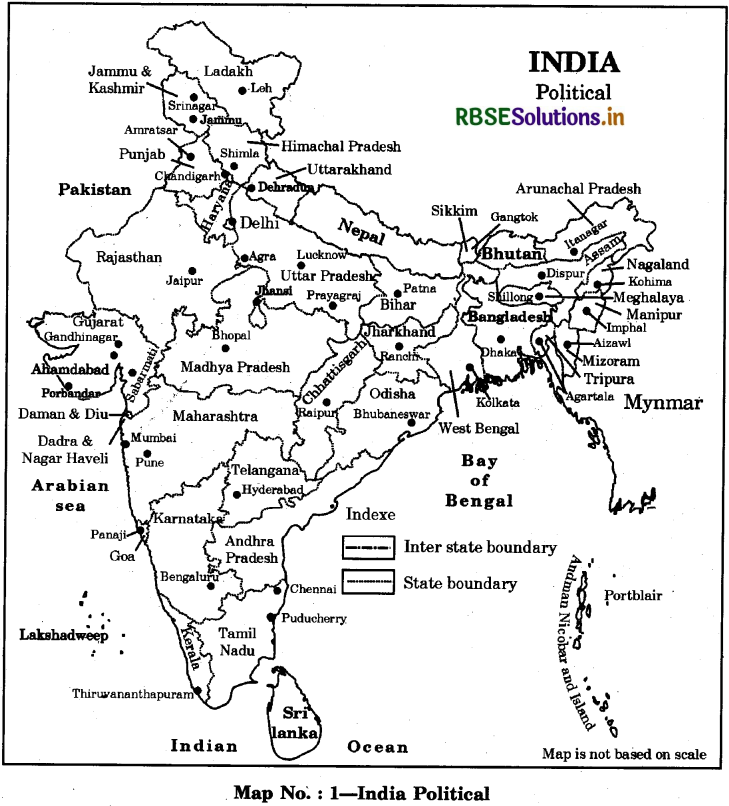
(क) भारत के मानचित्र को देखकर पता लगाइए कि-

प्रश्न 1.
राजस्थान की अन्तर्राष्ट्रीय सीमा किस देश से मिलती है?
उत्तर:
राजस्थान की अन्तर्राष्ट्रीय सीमा पाकिस्तान से मिलती है।

प्रन 2.
राजस्थान के पड़ोसी राज्यों के नाम बताइए-
(क) उत्तर में –
(ख) पूर्व में-
(ग) दक्षिण-पूर्व में-
(घ) दक्षिण में –
उत्तर:
(क) उत्तर में पंजाब
(ख) पूर्व में – उत्तर प्रदेश
(ग) दक्षिण-पूर्व में मध्य प्रदेश
(घ) दक्षिण में- गुजरात

पृष्ठ – 3
आओ अभ्यास करें-
उपर्युक्त मानचित्र (पाठ्यपुस्तक का पृष्ठ संख्या 2) को देखकर निम्नलिखित प्रश्नों के उत्तर दीजिए-

प्रश्न 1.
राजस्थान के सभी जिलों की सूची बनाइये।
उत्तर-
राजस्थान के जिले

जिले का नाम जिले का नाम
1. जयपुर 2. जोधपुर
3. बीकानेर 4. अजमेर
5. कोटा 6. उदयपुर
7. भरतपुर 8. दौसा
9. सीकर 10. अलवर
11. झुंझुनूं 12. पाली
13. जालोर 14. सिरोही
15. बाड़मेर 16. जैसलमेर
17. चुरू 18. श्रीगंगानगर
19. हनुमानगढ़ 20. भीलवाड़ा
21. टोंक 22. नागौर
23. बूंदी 24. बारां
25. झालावाड़ 26. राजसमंद
27. चित्तौड़गढ़ 28. बाँसवाड़ा
29. डूंगरपुर 30. प्रतापगढ़
31. धौलपुर 32. करौली
33. सवाई माधोपुर

प्रश्न 2.
राजस्थान के सबसे उत्तरी, दक्षिणी, पूर्वी व पश्चिमी जिलों के नाम लिखिए।
उत्तर:

सबसे उत्तरी जिला श्रीगंगानगर
सबसे, दक्षिणी जिला बाँसवाड़ा
सबसे पूर्वी जिला धौलपुर
सबसे पश्चिमी जिला जैसलमेर

हमारा राजस्थान कक्षा 6 पाठ 1 के प्रश्न उत्तर राजस्थान एक परिचय

प्रश्न 3.
राजस्थान के कौन-कौन से जिले पाकिस्तान की सीमा पर स्थित हैं?
उत्तर:
राजस्थान के श्रीगंगानगर, बीकानेर, जैसलमेर तथा बाड़मेर जिले पाकिस्तान की सीमा पर स्थित हैं।

पृष्ठ 4-I
आओ अभ्यास करें-

प्रश्न 1.
आपका जिला किस संभाग में सम्मिलित किया गया है? आपके संभाग के अन्य जिलों को पहचानिए।
उत्तर:
[नोट- आपका जिला जिस संभाग में आता है, उसका नाम तथा उसमें आने वाले अन्य जिलों के नाम लिखिए।]

पृष्ठ 4 – II
आओ अभ्यास करें-

प्रश्न 1.
मानचित्र 1.2 (पाठ्यपुस्तक में) को देखकर निम्नलिखित रिक्त स्थानों की पूर्ति कीजिए।
उत्तर:

राज्य का नाम सीमा बनाने वाले राजस्थान के जिलों का नाम
1. पंजाब श्रीगंगानगर, हनुमानगढ़
2. हरियाणा हनुमानगढ़ चुरू, झुंझुनूं, सीकर, जयपुर, अलवर भरतपुर
3. उत्तर प्रदेश भरतपुर, धौलपुर
4. मध्य प्रदेश धौलपुर, करौली, सवाई माधोपुर, कोटा, बारां, झालावाड़, चित्तौड़गढ़, भीलवाड़ा, प्रतापगढ़, बाँसवाड़ा
5. गुजरात बाँसवाड़ा, डूंगरपुर, उदयपुर, सिरोही, जालोर, बाड़मेर।

पाठ्यपुस्तक के प्रश्न

I. निम्नलिखित प्रश्नों के सही उत्तर के विकल्प को कोष्ठक में लिखिए-

1. क्षेत्रफल के अनुसार राजस्थान का सबसे बड़ा जिला कौनसा है?
(क) जैसलमेर
(ख) धौलपुर
(ग) जयपुर
(घ) प्रतापगढ़
उत्तर:
(क) जैसलमेर

2. राजस्थान में कुल कितने जिले हैं?
(क) 25
(ख) 30
(ग) 33
(घ) 23
उत्तर:
(ग) 33

II. अतिलघूत्तरात्मक प्रश्न-

प्रश्न 1.
रेडक्लिफ रेखा किसे कहते हैं?
उत्तर- हमारे देश एवं राज्य को पाकिस्तान से अलग करने वाली सीमा रेखा को ‘रेडक्लिफ रेखा’ कहा जाता है।

प्रश्न 2.
राजस्थान के पड़ोसी राज्यों के नाम लिखिए।
उत्तर:
राजस्थान के पांच पड़ोसी राज्य हैं – (1) पंजाब (2) हरियाणा (3) उत्तर प्रदेश (4) मध्य प्रदेश (5) गुजरात।

III. लघुत्तरात्मक प्रश्न-

प्रश्न 1.
राजस्थान को कितने राज्यों में विभाजित किया गया है? उनके नाम लिखिए।
उत्तर:
राजस्थान को 7 संभागों में विभाजित किया गया है।
इनके नाम इस प्रकार हैं- (1) जयपुर (2) जोधपुर (3) बीकानेर (4) अजमेर (5) कोटा (6) उदयपुर (7) भरतपुर।

हमारा राजस्थान कक्षा 6 पाठ 1 के प्रश्न उत्तर राजस्थान एक परिचय

प्रश्न 2.
राजस्थान की स्थिति एवं विस्तार को संक्षेप में समझाइये।
उत्तर:
राजस्थान की स्थिति एवं विस्तार – भौगोलिक दृष्टि से राजस्थान भारत के उत्तरी-पश्चिमी भाग में 23°3′ से 30°12′ उत्तरी अक्षांश एवं 69°30′ से 78°17′ पूर्वी देशान्तरों के मध्य स्थित है। इसका कुल क्षेत्रफल लगभग 3,42,239 वर्ग किलोमीटर है। इसका विस्तार उत्तर से दक्षिण तक 826 किलोमीटर एवं पूर्व से पश्चिम तक 869 किलोमीटर है।

Class 6 Hamara Rajasthan Chapter 1 Important Question Answer in Hindi

बहुचयनात्मक प्रश्न-

1. हमारे राज्य का क्या नाम है?
(अ) दिल्ली
(ब) हरियाणा
(स) उत्तर प्रदेश
(द) राजस्थान
उत्तर:
(द) राजस्थान

2. क्षेत्रफल की दृष्टि से भारत का सबसे बड़ा राज्य कौनसा है?
(अ) उत्तर प्रदेश
(ब) मध्य प्रदेश
(स) राजस्थान
(द) तमिलनाडु
उत्तर:
(स) राजस्थान

3. राजस्थान राज्य का सबसे छोटा जिला कौनसा है?
(अ) जैसलमेर
(ब) धौलपुर
(स) करौली
(द) चुरू
उत्तर:
(ब) धौलपुर

अतिलघूत्तरात्मक प्रश्न-

प्रश्न 1.
राजस्थान राज्य भारत के किस भाग में स्थित है?
उत्तर:
राजस्थान राज्य भारत के उत्तरी – पश्चिमी भाग में स्थित है।

प्रश्न 2.
राजस्थान राज्य भारत के कितने प्रतिशत भाग पर फैला हुआ है?
उत्तर:
राजस्थान राज्य भारत के 10.41 प्रतिशत भाग पर फैला हुआ है।

प्रश्न 3.
राजस्थान में कुल कितने जिले हैं?
उत्तर:
राजस्थान में कुल 33 जिले हैं।

हमारा राजस्थान कक्षा 6 पाठ 1 के प्रश्न उत्तर राजस्थान एक परिचय

प्रश्न 4.
राजस्थान के साथ सबसे लंबी सीमा कौनसा राज्य बनाता है?
उत्तर:
मध्य प्रदेश।

लघूत्तरात्मक प्रश्न-

प्रश्न 1.
राजस्थान के धौलपुर जिले की दो मुख्य विशेषताएँ बताइए।
उत्तर:

  1. धौलपुर, राजस्थान राज्य का सबसे छोटा जिला है।
  2. यह राजस्थान का सबसे पूर्वी जिला है, इसलिए राज्य में सबसे पहले सूर्योदय तथा सूर्यास्त इसी जिले में होता है।

प्रश्न 2.
राजस्थान की अन्तर्राष्ट्रीय सीमा के बारे में बताइये।
उत्तर:
राजस्थान की पश्चिमी अन्तर्राष्ट्रीय सीमा पाकिस्तान देश से मिलती है, जो लगभग 1070 किलोमीटर लंबी है। हमारे देश एवं राज्य को पाकिस्तान से अलग करने वाली इस रेखा को ‘रेडक्लिफ रेखा’ कहा जाता है। इसका निर्धारण आजादी के समय सन् 1947 में भारत-पाकिस्तान बँटवारे के तहत किया गया था।

निबन्धात्मक प्रश्न-

प्रश्न 1.
राजस्थान के सभी संभागों तथा उनमें आने वाले जिलों की सूची बनाइये।
उत्तर:
राजस्थान के संभाग एवं उनसे सम्बन्धित जिले

संभाग संबंधित जिले
1. जयपुर जयपुर, दौसा, सीकर, अलवर व झुंझुनूं।
2. जोधपुर जोधपुर, पाली, जालोर, सिरोही, बाड़मेर एवं जैसलमेर।
3. बीकानेर बीकानेर, चुरू, श्रीगंगानगर एवं हनुमानगढ़।
4. अजमेर अजमेर, भीलवाड़ा, टोंक एवं नागौर।
5. कोटा कोटा, बूँदी, बारां एवं झालावाड़।
6. उदयपुर उदयपुर, राजसमंद, चित्तौड़गढ़, बाँसवाड़ा, डूंगरपुर एवं प्रतापगढ़।
7. भरतपुर भरतपुर, धौलपुर, करौली एवं सवाई माधोपुर।

हमारा राजस्थान कक्षा 6 पाठ 1 के प्रश्न उत्तर राजस्थान एक परिचय

प्रश्न 2.
राजस्थान की कुल स्थलीय सीमा कितनी है? इसके पड़ोसी राज्यों के बारे में बताइये।
उत्तर:
राजस्थान की कुल स्थलीय सीमा लगभग 5920 किलोमीटर है। राजस्थान राज्य के पाँच पड़ोसी राज्य हैं-
(1) पंजाब (2) हरियाणा, (3) उत्तर प्रदेश (4) मध्य प्रदेश एवं (5) गुजरात। राजस्थान के साथ सबसे लंबी सीमा बनाने वाला राज्य मध्य प्रदेश है। जबकि राजस्थान के साथ सबसे छोटी सीमा उत्तर में पंजाब राज्य द्वारा बनाई जाती हैं।

Class 6 Hamara Rajasthan Map Related Questions in English

Engaging with these Hamara Rajasthan Book Class 6 Solutions and Class 6 Hamara Rajasthan Map Related Questions will strengthen your knowledge and prepare you for assessments.

Class 6 Our Rajasthan Map Related Questions

Our Rajasthan Class 6 Map Related Questions

Question 1.
Mark the following in map of India—
(1) Hyderabad (2) Itanagar (3) Dispur (4) Patna (5) Raipur (6) Panaji (7) Gandhinagar
Answer:
Class 6 Hamara Rajasthan Map Related Questions in English 1

Question 2.
Mark the following in map of India—
(1) Chandigarh (2) Shimla (3) Srinagar (4) Ranchi (5) Bangaluru (6) Thiruvanatha- puram (7) Bhopal (8). Mumbai
Answer:
Class 6 Hamara Rajasthan Map Related Questions in English 1

Question 3.
Mark the following in map of India—
(1) Imphal (2) Shillong (3) Aizawl (4) Kohima (5) Bhubaneshwar (6) Chandigarh (7) Jaipur
Answer:
Class 6 Hamara Rajasthan Map Related Questions in English 1

Question 4.
Mark the following in map of India—
(1) Gangtok (2) Chennai (3) Agartala (4) Lucknow (5) Dehradun (6) Kolkata
Answer:
Class 6 Hamara Rajasthan Map Related Questions in English 1

Question 5.
Mark the following in map of India—
(1) Delhi (2) Andaman and Nicobar (3) Chandigarh (4) Dadra and Nagar Haveli (5) Daman and Diu (6) Lakshadweep
Answer:
Class 6 Hamara Rajasthan Map Related Questions in English 1

Question 6.
Mark the following in map of India—
(1) Yamuna river (2) Tapti river (3) Godavari river (4) Eastern ghat (5) Western ghat
Answer:
Class 6 Hamara Rajasthan Map Related Questions in English 2

Question 7.
Show the following natural places on the map of India—
(1) Garo hills (2) Bramaputra river (3) Ganga river (4) Krishna river (5) Beas river
Answer:
Class 6 Hamara Rajasthan Map Related Questions in English 2

Question 8.
Show the following ancient places an the map of India—
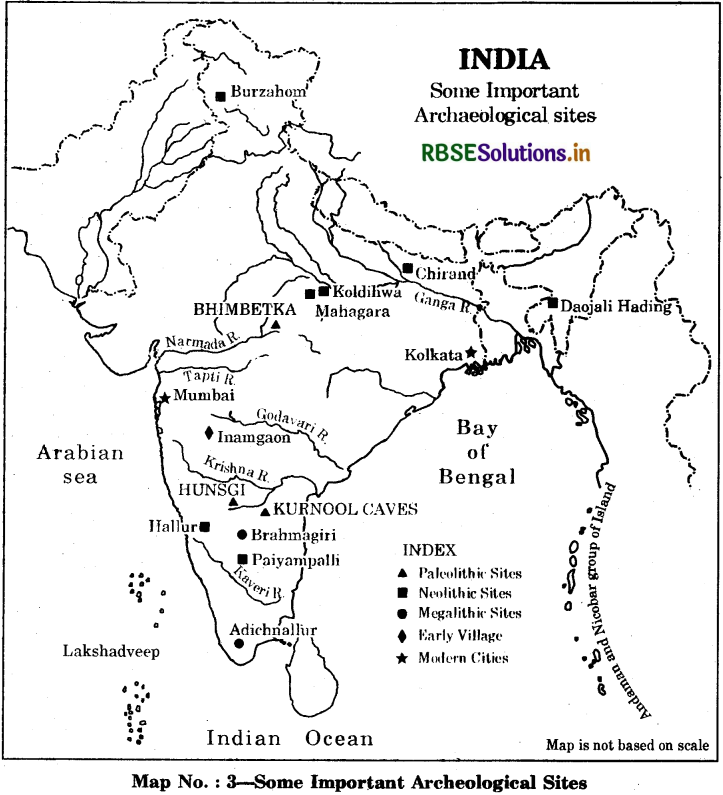
(1) Hunsgi (2) Koldihwa (3) Brahmagiri (4) Inamgaon (5) Mumbai
Answer:
Class 6 Hamara Rajasthan Map Related Questions in English 3

Question 9.
Show the following ancient places on the map of India—
(1) Kurnool caves (2) Paiyampalli (3) Adichanallur (4) Kolkata
Answer:
Class 6 Hamara Rajasthan Map Related Questions in English 3

Question 10.
Show the following major cities on the map of India—
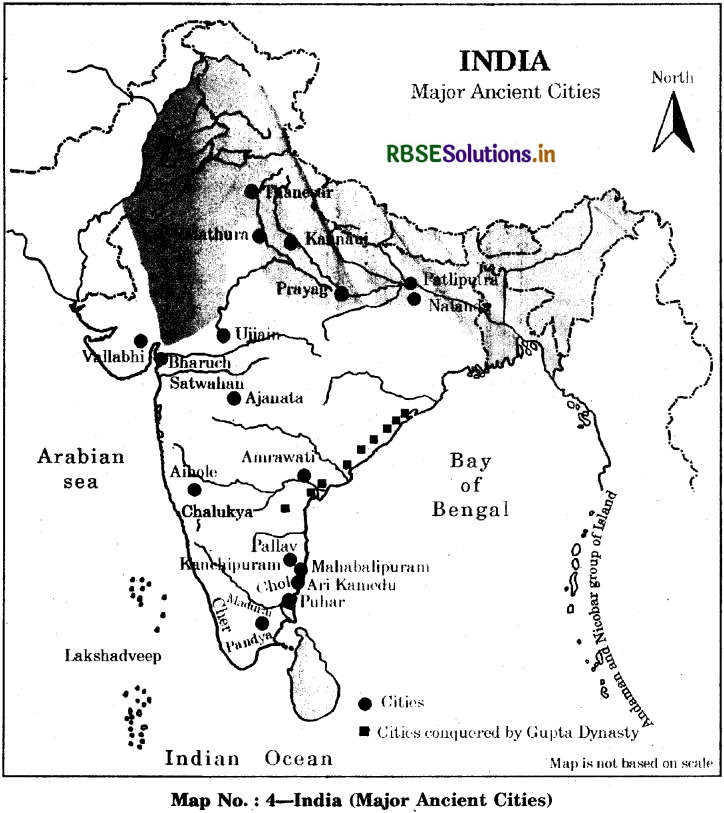
(1) Ujjain (2) Thanesar (3) Patliputra (4) Amravati (5) Kanchipuram
Answere:
Class 6 Hamara Rajasthan Map Related Questions in English 4

Question 11.
Show the following major cities on the map of India—
(1) Mathura (2) Prayag (3) Nalanda ( V) Ajanta (5) Mahabalipuram
Answer:
Class 6 Hamara Rajasthan Map Related Questions in English 4

Question 12.
Show the following district in the map of Rajasthan—
(1) Dholpur (2) Banner (3) Dungarpur (4) Bikaner (5) Pah (6) Kota (7) Sriganga- nagar (8) Jaisalmer (9) Jalaore
Answer:
Class 6 Hamara Rajasthan Map Related Questions in English 5

Question 13.
Show the following places in the map of Rajasthan—
(1) Chittorgarh (2) Hanumangarh (3) Churu (4) Jhunjhunu (5) Sikar (6) Alwar (7) Bharatpur
Answer:
Class 6 Hamara Rajasthan Map Related Questions in English 5

Question 14.
Show the following places in the map of Rajasthan—
(1) Sirohi (2) Sawai Madhopur (3) Udaipur (4) Baran (5) Jhalawad (6) Bundi (7) Bhilwada (8) Nagaur
Answer:
Class 6 Hamara Rajasthan Map Related Questions in English 5

Question 15.
Show the following places in the map of Rajasthan—
(1) Jodhpur (2) Banswara (3) Raj- sainand (4) Ajmer (5) Tonk (6) Dausa (7) Karoli (8) Pratapgarh
Answer:
Class 6 Hamara Rajasthan Map Related Questions in English 5

Question 16.
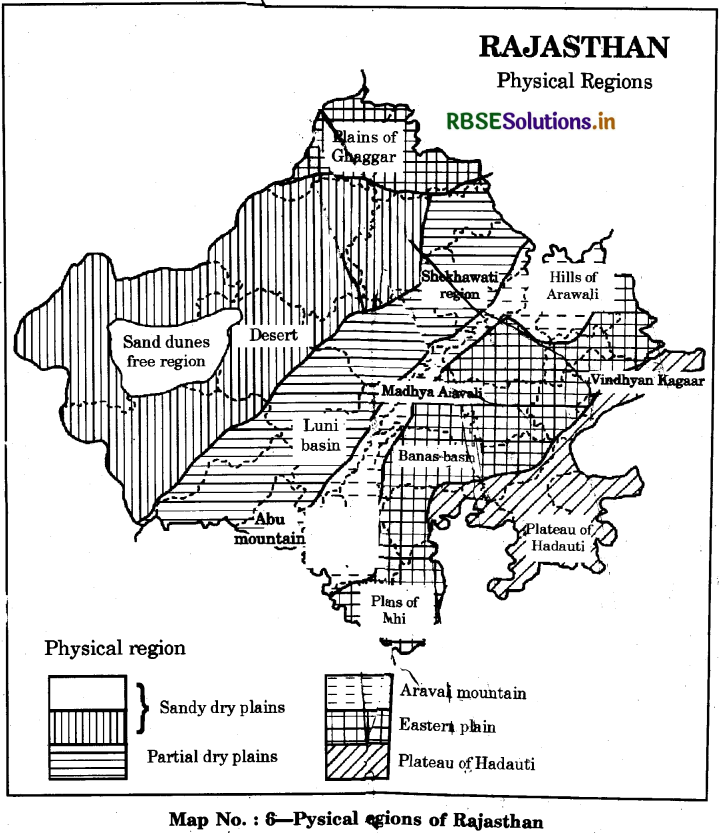
Indicate the physical regions in the map of Rajasthan.
Answer:
Class 6 Hamara Rajasthan Map Related Questions in English 6

Question 17.
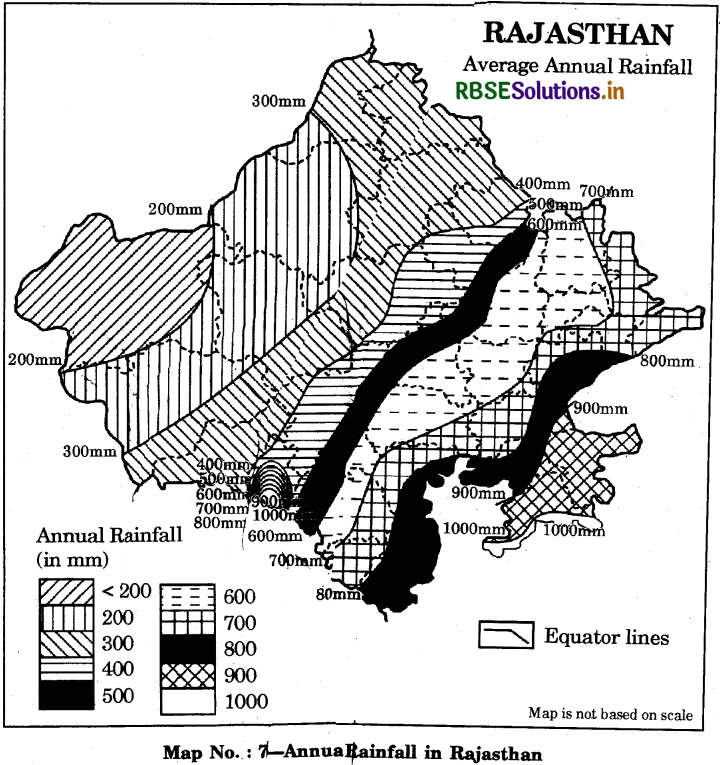
Show the average rainfall in the outline map of Rajasthan.
Answer:
Class 6 Hamara Rajasthan Map Related Questions in English 7

Question 18.
Show the relief and drainage system on the map of Rajasthan.
Answer:
Class 6 Hamara Rajasthan Map Related Questions in English 7

Class 6 Hamara Rajasthan Chapter 10 Question Answer in English Folk Culture and Art

Engaging with these Hamara Rajasthan Book Class 6 Solutions and Class 6 Hamara Rajasthan Chapter 10 Question Answer Folk Culture and Art will strengthen your knowledge and prepare you for assessments.

Class 6 Our Rajasthan Chapter 10 Question Answer Folk Culture and Art

Our Rajasthan Class 6 Chapter 10 Folk Culture and Art Question Answer

I. Write the correct option of the following questions in given bracket—

1. Which temple is known because of mice—
(a) Brahmaji Temple
(b) Kami Mata Temple
(c) Mahaveerji Temple
(d) Shivji Temple.
Answer:
(b) Kami Mata Temple

2. Who is worshipped as ‘Diety of Camels’?
(a) Ramdevji
(b) Tejaji
(c) Pabuji
(d) Jasnathji.
Answer:
(c) Pabuji

II. Fill in the Blanks

1. Blue pottery is distinguished by the ……………. dye used to colour white pottery made with china clay.
Answer:
blue

2. Tejaji sacrificed himself for the ……………. .
Answer:
protection of cows.

III. Very Short Answer Type Questions

Question 1.
Who is worshipped on the occasion of Gangaur?
Answer:
On the occasion of Gangaur, Shiv and Parvati are worshipped.

Class 6 Hamara Rajasthan Chapter 10 Question Answer in English Folk Culture and Art

Question 2.
How many dialects of western Rajasthani language are there?
Answer:
Four Dialects—(1) Marwari, (2) Mewari, (3) Bagri, (4) Shekhawati.

IV. Short Answer Type Questions

Question 1.
Why is Ramdevji known as the motivator of communal harmony?
Answer:
Ramdevji is known as the motivator of communal harmony. Ramdevji was the most prominent incarnate person. He encouraged communal harmony. Muslim community knows him as ‘Ram-Sa- pir’. A grand fair is held in the month of Bhadrapada in Ramdevra.

Question 2.
Give information about specific festivals celebrated in Rqjasthan.
Answer:
Several festivals are celebrated in Rajasthan. Some festivals are specific festivals celebarated here. Some of them are as follows—
(1) Gangaur—Gangaur is the colourful festival of Rajasthan. It begins on the third day of Shukla Paksh in the month of Chaitra. God Shiv along with Parvati is worshipped on Gangaur.

(2) Teej—Teej is celebrated in the month of Shravan on the third day of Shukla Paksh. Newly wed women swing on the swings fixed on the branches of trees. Kajli Teej and Satudi Teej are celebrated on the third day of the Krishna Paksh in the month of Bhadrapada.

(3) Sheetla Ashtami—Sheetla Ashtami is celebrated on the eighth day of the Shukla Paksh in the month of Chaitra. Sheetla Mata is worshipped on this day and food cooked before a day is eaten.

(4) Akshay Tritiya—It is a very demanding day. This day is also known as Aakha Teej. On this day all auspicious ceremonies are held without considering muhurt (auspicious time). Wheat, millet, barley etc. are worshipped on this day. Kheech of wheat and millet is also prepared on this day.

Class 6 Hamara Rajasthan Chapter 10 Important Question Answer

Multiple Choice Questions

1. Which of the following is not the representative dialect of East Rajasthani language?
(a) Bagri
(b) Dhundari
(c) Aheerwati
(d) Hadauti.
Answer:
(a) Bagri

Class 6 Hamara Rajasthan Chapter 10 Question Answer in English Folk Culture and Art

2. On which festival is ‘Basoda’ food served?
(a) Gangaur
(b) Satudi Teej
(c) Sheetla Ashtami
(d) Aakha Teej
Answer:
(c) Sheetla Ashtami

3. Where is the famous temple of Brahmaji located?
(a) Kota
(b) Udaipur
(c) Sikar
(d) Pushkar
Answer:
(d) Pushkar

4. In which district is the Jeena Mata fair held?
(a) Sikar
(b) Ajmer
(c) Dungarpur
(d) Alwar
Answer:
(a) Sikar

5. Who was the founder of Vishnoi sect?
(a) Dadu Dayal
(b) Jambho Ji
(c) Jasnath ji
(d) Gogaji
Answer:
(b) Jambho Ji

6. Bassi (Chittorgarh) is the main center of which art?
(a) Sculpture
(b) Terracotta
(c) Gota Work
(d) Woodcraft
Answer:
(d) Woodcraft

Fill in the Blanks

1. ……………. is the mother tongue of Rajasthan.
Answer:
Rajasthani

2. ……………. is also known as Aakha Teej.
Answer:
Akshay Tritiya

3. ……………. fair was started by Maharana Fateh Singh.
Answer:
Hariyali Amavasya

4. Khwaja Moinuddin Chishti came to India from ……………. .
Answer:
Iran

5. Carving of gold on glass is known as ……………. .
Answer:
Theva art.

Very Short Answer Type Questions

Question 1.
Who are the main tribals living in South Rajasthan?
Answer:
The main tribals living in South Rajasthan are Bheel, Meena, Sahariya, Garasiya, Damor etc.

Class 6 Hamara Rajasthan Chapter 10 Question Answer in English Folk Culture and Art

Question 2.
Write the names of representative, dialects of eastern Rajasthani language.
Answer:
(1) Dhundhari (Jaipuri), (2) Hadauti, (3) Mewati, (4) Aheerwati.

Question 3.
Write the names of any two sports played by Children in rural areas.
Answer:
(ii) Gilli-Danda, (2) Sitoliya.

Question 4.
Write any two forms of folk theatrical style prevalent in Rajasthan.
Answer:
(1) Khyal (2) Hela.

Question 5.
By what name is the Teej is celebrated on the third day of the Krishna Paksh in the month of Bhadrapada?
Answer:
‘Kajli Teej’.

Question 6.
When is Pushkiar Fair organized?
Answer:
Pushkar fair is celebrated on the full moon day of Kartik.

Question 7.
Write the name of any two major fairs of Rajasthan.
Answer:
(1) Pushkar Fair, (2) Kaila Devi Fair.

Question 8.
Who is known as Garib Nawaz?
Answer:
Khwaja Moinuddin Chishti is known as Garib Nawaz.

Question 9.
In which district is the Bhartrihari fair held?
Answer:
The Bhartrihari fair is held in Alwar.

Question 10.
Name the five prominent deities of Rajasthan.
Answer:
(1) Ramdevji, (2) Pabuji, (3) Mehaji, (4) Hadbuji, (5) Gogaji.

Question 11.
Where was Meera Bai born?
Answer:
Mira Bai was born in Meratiya Rathore dynasty, at Kudki village (Merata).

Question 12.
Write the names of any four famous places for priting on clothes in Rajasthan.
Answer:
(1) Bagru, (2) Sanganer, (3) Akola, (4), Banner.

Question 13.
Why Rajasthan is also called ‘Rangila Rajasthan’?
Answer:
The traditional festivals, fairs and traditions of Rajasthan are attractive and fascinating. That’s why Rajasthan is also called ‘Rangila Rajasthan’.

Short Answer Type Questions

Question 1.
In what forms is Rajasthani language mainly known? Describe.
Answer:
Rajasthani language is mainly known in two forms—
(1) Eastern Rajasthani language— There are 4 major dialects of eastern Rajasthani language—
(1) Dhuiidhari (Jaipuri), (2) Hadauti, (3) Mewati, (4) Aheerwati.

(2) Western Rajasthani language— There are 4 major dialects of Western Rajasthani language—
(1) Marwari, (2) Mewari, (3) Bagri and (4) Shekhawati.

Class 6 Hamara Rajasthan Chapter 10 Question Answer in English Folk Culture and Art

Question 2.
Describe Rajasthani Costumes.
Answer:
Rajasthani Costumes—

  1. Rajasthani costumes are known for their bright colours.
  2. Traditional Rajasthani attires are quite beautiful and attractive.
  3. Women wear Ghagra, Choli and colourful Odhni with Gota work on it.
  4. Traditional dress of men is Dhoti- Kurta and Kurta-Payjama.
  5. Rajasthani turban, which is the symbol of self respect and dignity, is .very attractive.
  6. At present, the impact of western outfits is increasing yet multicolored costumes of Rajasthan are impressive.

Question 3.
What do you know about the festival of Gangur?
Answer:
Gangaur—Gangaur is the colourful festival of Rajasthan. It begins on the thrid day of Shukla Paksh in the month of Chaitra. ‘Gan’ and ‘Gaur’ denote Shiv and Parvati respectively. God Shiv along with Parvati is worshipped on Gangaur. At some places three days’ festival is celebrated and at other places four days’ festival is celebrated on the occasion of Gangaur in Rajasthan. Gangaur ride is also taken out at many places. This festival is celebrated with great splendour in all the districts of Rajasthan.

Question 4.
When is the festival of Sheetla Ashtami celebrated? Describe.
Answer:
Sheetla Ashtami—Sheetla Ashtami is celebrated on the eighth day of Holi in the Shukla Paksh. in the month of Chaitra. On this day food cooked before a day is eaten. Fairs are organised at Shil ki Dungri at Chaksu in Jaipur and Sheetla Mata temple at Vallabhnagar town in Udaipur. Almost in every city, village and town Sheetla Mata is worshipped.

Question 5.
Name the major fairs of Rajasthan.
Answer:
Major fairs of Rajasthan—
(1) Pushkar Fair (Ajmer), (2) Kaila Devi Fair (Sawai Madhopur), (3) Mahaveerji Fair (Sawai Madhopur), (4) Dussehra Fair (Kota), (5) Hariyali Amavasya Fair (Udaipur), (6) Urs of Khwaja Moinuddin Chishti (Ajmer), (7) Beneshwar Fair (Dungarpur)j (8) Kami Mata Fair (Bikaner), (9) Khatu Shyam ji Fair (Sikar), (10) Fair of Baba Ramdev (Jaisalmer), (11) Galiakot Urs (Dungarpur), (12) Jeena Mata Fair (Sikar), (13) Bharatrihari Fair (Alwar), (14) Diggi Kalyanji Fair (tonk), (15) Tejaji Fair (Parbatsar, Nagaur), (16) Gogaji Fair (Banner) etc.

Question 6.
Briefly describe the fairs of Kaila Devi and Mahaveerji.
Answer:
(1) Kaila Devi Fair—On the eighth day of the Shukl Paksh in the month of Chaitra, a grand fair is held at Kalia Mata temple in Sawai Madhopur. It is also known as Lakhkhi fair. This fair is held from twelfth day of the Krishna-Paksh (waning moon) to the twelfth day of the Shukl Paksh (waxing moon) in the month of Chaitra. Devotees come to this fair from far off places.

(2) Mahaveerji Fair—Shree Maha¬veerji temple is located in Sawai Madhopur where a fair is organised from the eleventh day of shukla-Paksh of Chaitra to the second day of Krishn-Paksh ofVaishakh. There is a grand red coloured sculpture of 24th Jain Tirthankar Mahaveer Swami. People from all over the country participate in this fair.

Question 7.
Where is the Urs of Khwaja Moinuddin Chishti celebrated? Explain its main points.
Answer:
Urs of Khwaja Moinuddin Chishti—Khwaja Moinuddin Chishti came to India from Iran. He is also known as Garib Nawaz. His shrine in Ajmer is a center of devotion of the people of the entire country. Urs of Khawaja Sahab is celebrated in Ajmer from the first to the sixth day of Rajab month of Islamic calendar. This fair is a unique example of communal harmony.

Question 8.
Write a short comment on the following fairs.
(1) Fair of Baba Kfcindev (2) Galia-kot Urs.
Answer:
(1) Fair of Baba Ramdev—This fair is held at Runicha of Pokran town in Jaisalmer from the second to the eleventh day of Shukla-Paksh in the month of Bhadrapada. Baba Ramdev is a renowned folk deity of Rajasthan, whom people faith of all religions.

(2) Galiakot Urs—Tomb (Majar) of Fakhurddin Maula is located at Galiakot town of Sagwara Tehsil in Dungarpur district. It is also known as Majar-e- Fakhari. It is a center of devotion for the people of Daudi Bohra community. People of all sects participate in this Urs in large numbers.

Class 6 Hamara Rajasthan Chapter 10 Question Answer in English Folk Culture and Art

Question 9.
Name the major folk deities and saints of Rajasthan.
Answer:
Major Folk Deities of Rajasthan—(1) Gogaji, (2) Tejaji, (3) Pabuji, (4) Ramdevji, (5) Mehaji, (6) Hadbuji, (7) Malli Nath, (8) Devnarayan (9) Harbhunji etc.
Major Saints of Rajasthan—
(l) Meera Bai, (2) Dadu Dayal, (3) Jambhoji, (4) Jasnath ji, (5) Shraddha- nathji etc.

Question 10.
What do you know about saint Jambhoji and Saint Jasnath ji? Write in brief.
Answer:
(1) Saint Jambhoji—Jambhoji Maharaj was the founder of Vishnoi sect. He was bom at Pipasar (Nagaur) village on the eighth day of Krishn Paksh in the month of Bhadrapada in Vikram Samvat 1508. Following the teachings of Jhambhoji, Vishnoi sect is continously striving to protect the environment and opposing killing any living being, which is exemplary.

(2) Saint Jasnathji—Jasnathji was born in Katariyasar (Bikaner). He was influenced by Gorakhnath. He practised austerities and became ascetic.

Question 11.
What is Terracotta? Briefly describe this art.
Answer:
Terracotta—Making and baking of earthen sculptures and various decorative and useful things is known as Terracotta. Molela near Nathdwara is famous for this work. Terracotta artifacts are also made in Alwar and Banner. Apart from this, black pottery, golden pottery etc. are also famous. By this, designer cup-plates, other utensils and toys and decorative items like vases etc. are made.

Question 12.
What is blue pottery? Tell us about this art.
Answer:
Blue Pottery—Blue pottery is distinguished by the blue dye used to colour white pottery made with China clay. Apart from it black pottery and golden pottery is also famous. Cups, saucers, other utensils, toys and decorative articles are also made using blue pottery.

Question 13.
Briefly describe the following arts.
(1) Lakh Work, (2) Ornaments.
Answer:
(1) Lakh Work—Jaipur and Jodhpur are famous for ornaments made of Lakh. Lakh (sealing wax) is melted and mixed well with chalk, clay and Biroja. Many things are made out of it. Mirrors and pearls are used for embellishment. Jaipur and Jodhpur are famous for ornaments made of Lakh.

(2) Ornaments—Jaipur, Jodhpur, Bikaner and Udaipur are famous for studded ornaments. Precious stones are carved in Jaipur. Carving of gold on glass is known as Theva art, for which Pratapgarh is famous. Ornaments of brass and silver are famous among tribes of Pratapgarh.

Long Answer Type Questions

Question 1.
‘Rajasthan is culturally diverse. Explain.
Answer:
Cultural diversity of Rajasthan—‘Rajasthan is culturally diverse’. It is explained from following points—

  1. People belonging to different religions and sects live in Rajasthan, like Hindus, Muslims, Jains, Buddhists, Sikhs, Christians etc.
  2. A large number of tribes like Bheel, Meena, Sahariya, Garasiya and Damor live in Rajasthan.
  3. Diversity in language, costume, lifestyle and diet can be seen in the state.
  4. Rajasthani is the mother tongue of Rajasthan. Various languages are spoken in the different regions of Rajasthan. Primarily Rajasthani language is classified into two forms—
    1. Eastern Rajasthani Language
    2. Western Rajasthani Language.
  5. All the festivals are celebrated with joy and zeal in Rajasthan, like Holi, Deepavali, Raksha Bandhan, Eid, Mahaveer Jayanti, Guru Nanak Jayanti, Christmas etc. Fairs and festivals like Gangaur, Teej, Sheetla Ashtami, Akshay Tritiya; folk dances like Gavri, Ger and Rammat; and folk songs display our traditions.

Class 6 Hamara Rajasthan Chapter 10 Question Answer in English Folk Culture and Art

Question 2.
Describe the traditional means of recreation in Rajasthan.
Answer:
Traditional means of recreation in Rajasthan—
Recreation is the part of our life. In the various regions of Rajasthan recreational activities are sought through local and easily available traditional means. In rural areas, children play Gilli-Danda, Sitoliya, hide and seek, Ghoda-Dadi, Maardadi, spinning of top, marbles etc. Chopad and Chausar are played on the board made of cloth. Char-bhar and Nar-chhari are drawn and played on ground. Snake charmers, Kaalbeliyas, jugglers, magicians, kite flying and puppets are there for the entertainment of people. Khyal, Hela, Gavari, Tamsha, Turra Kalgi, Raasdhari, Ramleela, Dangal, Swang, Nautanki and Bhawai are forms of folk theatrical style. Along with these traditional games, modern games and means of entertainment also exist.

Question 3.
What do you know about the festival of Teej?
Answer:
Festival of Teej—It is celebrated in the month of Shravan. Teej holds a significant place among fairs and festivals of Rajasthan. It is none less than festival when dark clouds appear in arid Rajasthan. On the third day of the Shukl Paksh in the month of Shravan newlywed women swing on the swings fixed on the branches of trees. Kajli Teej and Satudi Teej are celebrated on the third day of the Krishn Paksh in the month of Bhadrapada. On this occasion women apply henna, worship Goddess Parvati and pray for the longevity of their husbands. This festival is a unique example of closeness between nature and man.

Question 4.
Briefly describe the following fairs—
(1) Pushkar Fair, (2) Kota Dussehra Fair, (3) Hariyali Amavasya Fair.
Answer:
(1) Pushkar Fair—On the full moon day of Kartik, a magnificent fair is organized at Pushkar in Ajmer. A. grand market is held on this occasion and many foreign toursits visit this fair. Many competitions are held here in which people participate with zeal. Famous Brahmaji Temple and lake are prime centers of attraction. Deepdan is held in Pushkar lake in the evening.

(2) Kota Dussehra Fair—Proofs, of various Royal rides, darikhana (conference hall) and worship on Dussehra festival are found during the regin of Kota Maharao Durjanshaal Singh (1729-1756). Dussehra festival was given the grand form during the reign of Maharao Ummed Singh II (1889-1940). This festival is famous for its grandeur and immensity.

(3) Hariyali Amavasya Fair—This fair w£is started by MaharEma Fateh Singh in 1899 in Udaipur. Every year a grand fair is organised on Hariyali Amavasya. In Hindu tradition people celebrate it as the culmination of a rainy season. Celebrated on the no moon day (Amavasya) of ShravEm month, this fair multiplies the joy smd happiness of rsuny season.

Question 5.
What do you know about Beneshwar Fair, Karni Mata Fair and Khatu Shyam Ji Fair? Describe.
Answer:
(1) Beneshwar Fair—It is the largest fair of tribal community of Rajasthan. This fair is held on the confluence of Mahi, Som smd Jsikham rivers on the full moon day of the month of Magh.
People also immerse ashes of their heavenly family members here.

(2) Kami Mata Fair—This fair is organised at Kami Mata temple at Deshnok in Bikaner. Karni Mata is the presiding Goddess of the rulers of Bikaner. The specialty of this temple is that many black and white rats move here freely in large numbers.

(3) Khatu Shyam Ji Fair—Khatu Shyam Ji temple in Sikar is a famous place where a fair is held from the tenth to the twelfth day of Shukl Paksh in the month of Falgun.

Class 6 Hamara Rajasthan Chapter 10 Question Answer in English Folk Culture and Art

Question 6.
Briefly describe the four major folk deities of Rajasthan.
Answer:
There have been any folk deities in Rajasthan. Four major folk deities are as follows—
(1) Gogaji—Major five detieis (Panchpir) of Rajasthan are Ramdevji, Pabuji, Mehaji, Hadbuji and Gogaji. Gogaji was influenced by Chahuan ruler and Gorakhnant. Goga Navami is celebrated on the ninth day of the Kirjn-Paksh in Bhadrapada. On this day Gogaji is worshipped. A fair is held at Gogamedi (Hanumangarh) which lasts for a month.

(2) Tejaji—Tejaji sacrificed himself for the protection of cows. A grand cattle fair is organised in the memory of Tejaji at Parbatsar on the tenth of the Shukl-Paksh in the month of Bhadrapada. Legend and songs of Tejaji Eire very famous.

(3) Pabuji—Pabuji Rathore is worshipped as ‘Deity of Camels’. Famous place of worship of Pabuji is Pabu Mand. The biography of Pabuji is depicted on Phad.

(4) Ramdevji—Ramdevji was the most prominent incarnate person. He encouraged communal harmony. Muslim community knows him as ‘R£im-Sa-pir’. A grand fair is held in the month of Bhadrapada in Ramdevra.

Question 7.
What do you know about Meera Bai and Dadu Dayal? Describe.
Answer:
(1) Meera Bai—Meera Bai was born in Meratiya Rathore dynasty, at Kudki village (Merata). Devout Meera Bai got married to the prince Maharao Bhojraj of Sisodia dynasty of Mewar. Since childhood Meera indulged herself in devotion towards Krishna. Meera Bai was widowed after sometime of her marriage. She detached herself from the world and devoted herslelf towards lord Krishna. The characteristic of Meera is simple and instinctive devotion and it is clearly visible in Padas written by her.

(2) Dadu Dayal—Scholars are not unanimous about the birthplace of Dadu Dayal. He met Akbar at Fatehpur Sikri in 1585 AD and then came to Rajasthan and spread devotion towards God. He left for his heavenly abode in Naraina in 1603 AD.

Question 8.
Briefly describe the woodwork and sculpture of Rajasthan.
Answer:
(1) Woodcraft—Woodcraft is a famous form of handicrafts in Rajasthan. In this art various artifacts are made out of wood. Bassi (Chittorgarh)is its main center. Bewan, Kawar and printing blocks are made here. Udaipur is famous for wooden toys and puppets. Jethana (Dungarpur) is known for wooden sculptures and Shekhwati and Bikaner are known for furniture.

(2) Sculpture—Rajasthan is famous for marble. Different types of stones are found at various places. For this reason sculptures and stones are carved here.

Class 6 Hamara Rajasthan Chapter 10 Question Answer in English Folk Culture and Art

Question 9.
Describe the characteristics of ‘printing on fabric’, ‘embroidery and gota work’ in Rajasthan.
Answer:
I. Printing on fabric—Following are the characteristics of printing on fabric—

  1. Various kinds of printing is done on fabric in Rajasthan.
  2. Bagru, Sanganer, Akola, Banner, Kaladera, Pali and Bassi are specially known for these works.
  3. A solution is prepared with cow dung, sesame oil, goat dung and soda. Clothes are soaked in it all night and then dried. After drying clothes are again soaked in liquid made of Harad. Then printing is done with wooden blocks.
  4. Earlier, limited and natural colours were used for printing. Now synthetic colours are also used.

II. Embroidery and gota work— Embroidery is done on fabric at many places in Rajasthan. Its main characteristics are—

  1. Primarily motifs of animals are embroidered.
  2. Fabric is cut in different shapes and sewed on Clothes this is called Patch work.
  3. Gota Kinari and Aari Tari work is speciality of Raj sthan.

Class 6 Hamara Rajasthan Chapter 9 Question Answer in English Essential Services in Rajasthan

Engaging with these Hamara Rajasthan Book Class 6 Solutions and Class 6 Hamara Rajasthan Chapter 9 Question Answer Essential Services in Rajasthan will strengthen your knowledge and prepare you for assessments.

Class 6 Our Rajasthan Chapter 9 Question Answer Essential Services in Rajasthan

Our Rajasthan Class 6 Chapter 9 Essential Services in Rajasthan Question Answer

I. Write the correct option of the following questions in given bracket—

1. What is the total literacy rate in Rajasthan according to the Census 2011—
(a) 79 19%
(b) 52-12%
(c) 66-11%
(d) None of the above.
Answer:
(c) 66-11%

2. 108 Free Emergency Service is related to—
(a) Education
(b) Health services
(c) Communication services
(d) Banking services.
Answer:
(b) Health services

II. Fill in the blanks

1. The longest national highway of Rajasthan is …………….. and the shortest national highway is …………….. .
Answer:
NH 15, NH 71-B

Class 6 Hamara Rajasthan Chapter 9 Question Answer in English Essential Services in Rajasthan

2. Bank is an institution which trades in …………….. .
Answer:
currency.

III. Very Short Answer Type Questions

Question 1.
In which districts of Rajasthan there are medical colleges?
Answer:
(1) Jaipur, (2) Jodhpur, (3) Ajmer, (4) Bikaner, (5) Kota, (6) Udaipur.

Question 2.
What do you understand by health?
Answer:
The meaning of health includes not only physical health but also mental, social and intellectual health.

IV. Short Answer Type Questions

Question 1.
What do you understand by bank?
Answer:
Bank—A bank is an institution, which deals in currency.

Question 2.
What do you understand by communication ? What are the major means of communication?
Answer:
Communication—We can understand communication through the process of sending information or news. Two or more persons exchange their messages and ideas through communication. Telephone, television, radio, telegraph are its popular means. Increasing knowledge of information and technology has revolutionized telecom sector.

Class 6 Hamara Rajasthan Chapter 9 Important Question Answer

Multiple Choice Questions

1. According to the 2011 census, the percentage of female literacy in Rajasthan is—
(a) 52-12
(b) 66-11
(c) 79-19
(d) 82-12.
Answer:
(a) 52-12

2. The traditional means for transmitting information by the postal department is—
(a) Postcards
(b) Inland letters
(c) Envelopes
(d) All of the above
Answer:
(d) All of the above

Class 6 Hamara Rajasthan Chapter 9 Question Answer in English Essential Services in Rajasthan

3. The longest length of roads in Rajasthanis—
(a) Kota
(b) Jodhpur
(c) Jaipur
(d) Dholpur
Answer:
(b) Jodhpur

4. How many railway divisions are there in Rajasthan?
(a) Two
(b) Four
(c) Five
(d) Seven.
Answer:
(c) Five

Fill in the Blanks

1. Universities and Colleges exist for …………….. in the state.
Answer:
higher education

2. …………….., for the population of 30000 people are established.
Answer:
Primary Health Care Centers (PHCs)

3. There is no …………….. in Rajasthan.
Answer:
port

4. The only international airport of the state is …………….. of Jaipur.
Answer:
Sanganer Airport.

Very Short Answer Type Questions

Question 1.
What are the major basic services?
Answer:
(1) Education, (2) Health and Medical, (3) Communications and Postal Services, (4) Bank Services, (5) Transportation.

Question 2.
The Right to Education Act provides free and Compulsory education to which age group of children?
Answer:
Right to Education Act provides free and compulsory education to the children of age group of 6 to 14 years.

Question 3.
Name two awards to be given to encourage girls education.
Answer:
(1) Indira Priyadarshini Award (2) Gargi Award.

Question 4.
Write the names of any two health care schemes for the improvement of the health of citizens in Rajasthan.
Answer:
(1) Ayushman Bharat—Mahatma Gandhi Rajasthan Swasthya Bima Yojna.
(2) Chief Minister’s free Medicine Scheme.

Question 5.
What are the means by which the post is delivered by the postal department?
Answer:
(1) Through ordinary post,
(2) Registered Post,
(3) Speed Post.

Class 6 Hamara Rajasthan Chapter 9 Question Answer in English Essential Services in Rajasthan

Question 6.
State the two main functions of the bank.
Answer:
(1) Receiving deposits from people and organizations.
(2) To provide loans to needy people and institutions.

Question 7.
Under what guidelines did banks operate?
Answer:
All banks are operated under the guidelines of Reserve Bank of India (RBI).

Question 8.
Describe the types of transport in Rajasthan.
Answer:
(1) Road Transport, (2) Rail transport, (3) Air Transport.

Question 9.
When did the Rajasthan State Transport Corporation establish?
Answer:
Rajasthan State Road Transport Corporation (RSRTC) was established on 1st October, 1964.

Question 10.
Where and when did the first train run in Rajasthan?
Answer:
In Rajasthan the first train in Jaipur State ran between Agra fort and Bandikui in 1874.

Short Answer Type Questions

Question 1.
What is the Right to Education Act? Explain.
Answer:
Right to Education Act—Right to Education Act provides free and compulsory education to the children of age group of 6 to 14 years. Through this right children of this age group get equal opportunities of education. This Act not only provides facilities of education to children but also reminds parents of their duty to admit their children in school.

Question 2.
Describe the state of literacy in Rajasthan.
Answer:
According to the census of 2011, total literacy rate of Rajasthan is 66-11%. Male literacy rate is 79-19% and female literacy rate is 52-12%.

Question 3.
Explain the work of Drug Control Organization.
Answer:
Drug Control Organization— It operates under the department of Health, which issues license for the sale and production of medicines. Along with this it also issues list of banned medicines.

Question 4.
What are the functions of Information Technology and Communication Department?
Answer:
Information Technology and Communication, Rajasthan—In Rajasthan, Department of Information Technology and Communication is functioning, which aims at the technical development of the state according to changing perspectives. It makes and executes policies related to information and communication in the state. It determines conditions related to information and communication and limits of facilities.

Question 5.
What is ‘Sukanya Samriddhi Scheme’?
Answer:
‘Sukanya Samriddhi Scheme’ is a saving scheme run by the Department of Posts. In Sukanya Samriddhi Scheme, a Sukanya Samriddhi Scheme account can be opened in the post office for the education and marraige of a girl child. After a fixed time period deposits can be withdrawn.

Class 6 Hamara Rajasthan Chapter 9 Question Answer in English Essential Services in Rajasthan

Question 6.
How many airports are there in the state under the Indian Air Force? Write their names.
Answer:
There are five airports in the state under the Indian Air Force which are as follows—

  1. Bikaner Airport
  2. Jaisalmer Airport
  3. Suratgarh Airport
  4. Barmer Phalodi Airport
  5. Ratanada Aiaport.

Long Answer Type Questions

Question 1.
What is education? What are the arrangements for school and higher education in the state?
Answer:
Education—Education paves the way for development of character and personality along with development of innate capabilities. So education is the primary medium for a person to move forward in life, to achieve success and to develop society and country.

School education is paramount in this regard. Senior secondary, secondary, upper primary and primary schools are running for school eduction in the state. Sanskrit Education is an important dimension of the education system of the state. Universities and colleges exist for higher education in the state. Similarly institutions of technical and medical education also exist.

Question 2.
What is the state government doing to provide good education to children and to encourage education?
Answer:
To ensure the quality education, children are provided with the facilities of free education, free textbooks, various incentives, awards, scholarships, hostel, food and milk distribution in Rajasthan. The state government gives incentives to the students who achieve better results in examinations. To encourage girls education, Indira Priyadarshini Award and Gargi Award are significant measures. We can observe and understand the condition of the schools in Rajasthan through Shala Darpan Portal.

Question 3.
What does health mean? What arrangements have been made to provide health facilities to the citizens?
Answer:
Health—The meaning of health includes not only physical health but also mental, social and intellectual health.

The government provides sufficient health facilities to the citizens keeping in mind public welfare. The government is trying to frudtify the concept of ‘health for everybody’ and to provide better health facilities to the citizens.

  1. For the betterment of the healthcare facilities Sub Centers for a population of 2000 people, Primary Health Care Centers (PHCs), for the population of 30,000 people and Community Health Centers (CHCs) for the population of 1 lakh people are established.
  2. In case of emergency, 108 free Emergency Service is provided to the citizens for their safety.
  3. In Rajasthan special medical facilities are available in the medical colleges of Jaipur, Jodhpur, Bikaner, Kota and Udaipur.
  4. Soon there will be 30 medical colleges in 33 districts of Rajasthan.

Question 4.
What schemes are being run for the health of citizens in Rajasthan?
Answer:
The government has come up with many healthcare schemes for the improvement of the health of citizens. Ayushman Bharat, Mahatma Gandhi, Rajsthan ,Swasthya Bima Yojna, Chief Ministers Help and Mukhya Mantri Jeevan Raksha Kosh, Mukhya Mantri Rajshri Yojna, Chief Minister’s Free Medicines Scheme, Rajsthan Janani Shishu Suraksha Yojna are some of its major examples. Many national programs are organised by the Medical, Health and Family Welfare Department to control tuberculosis, malaria, blindness, iodine deficiency of diseases, AIDS and to eradicate leprosy.

Question 5.
Explain the postal services in detail.
Answer:
Postal Services—The facility of the exchange of messages and goods is provided by communication and postal services. To exchange messages, information and various goods physically or to deliver them from one place to another, is an important contribution of the Department of Posts. It is an important department works under the Government of India. Ample facilities related to posts are available in Rajasthan also.

Three traditional means of sending information are (i) Postcards, (ii) Inland letters and (iii) Envelopes. Ordinary mail is delivered through Ordinary Post, Registered Post and Speed Post. The Department of Posts not only delivers mails but also provides facilities of savings accounts and money order.

Question 6.
What dp you mean by bank? Describe banking services.
Answer:
Banking Services—A bank is an institution, which deals in currency. The bank earns interest through currency transactions. Banks provide many types of services. A bank is an institution, which deals in currency. People and institutions deposit their savings in banks. Bank pays interest on deposits. Bank also gives loan to the needy and takes interest on loan. Deposited money can be withdrawn through ATM, cheque or draft. Banks also provide locker facilitity to its customers.

All banks- are operated under the guidelines of Reserve Bank of India (RBI).

Class 6 Hamara Rajasthan Chapter 9 Question Answer in English Essential Services in Rajasthan

Question 7.
Briefly describe the means of transport in Rajasthan.
Answer:
(1) Roadways—Roadways is a significant means of transport among transport means in Rajasthan. Rajasthan State Road Transport Corporation (RSRTC) was established on 1st October 1964. Maximum length of roads is in Jaipur whereas minimum length is in Dholpur. The longest national highway in the state is NH 15 whereas the shortest national highway is NH 71-B.

(2) Railways—Rail transportation is an important means of transport from both the point of view, transportation of goods as well as passengers. There are two railway zones (North-Western Railway Zone and West
Central Railway Zone) and five disivions Jaipur, Jodhpur, Ajmer, Bikaner and Kota in Rajasthan. The biggest railway model room is located at West Zonal Railway Training Institute Udaipur.

(3) Airways—Air transportation continues to develop in the state. In Rajasthan Jaipur, Jodhpur, Udaipur, Kota and Ajmer are linked to airways. The only international airport of the state is Sang- aner Airport of Jaipur. Airports of Bikaner, Jaisalmer, Suratgarh, Banner, Phalodi and Ratanada are Indian Air force bases.

Class 6 Hamara Rajasthan Chapter 8 Question Answer in English Major Means of Livelihood

Engaging with these Hamara Rajasthan Book Class 6 Solutions and Class 6 Hamara Rajasthan Chapter 8 Question Answer Major Means of Livelihood will strengthen your knowledge and prepare you for assessments.

Class 6 Our Rajasthan Chapter 8 Question Answer Major Means of Livelihood

Our Rajasthan Class 6 Chapter 8 Major Means of Livelihood Question Answer

I. Write the correct option of the following questions in given bracket—

1. Which is the mqjor Rabi crop?
(a) Maize
(b) Millet
(c) Cotton
(d) Wheat
Answer:
(d) Wheat

2. Which cereal is grown most in the desert area of Rajasthan?
(a) Wheat
(b) Millet
(c) Rice
(d) Maize.
Answer:
(b) Millet

II. Fill in the Blanks—

1. Kharif is sown in the beginning of ……………. season.
Answer:
rainy

Class 6 Hamara Rajasthan Chapter 8 Question Answer in English Major Means of Livelihood

2. According to the 20th animal census in Rajasthan there is a worrying decrease in the number of ……………. and ……………. .
Answer:
camels, donkeys.

III. Very Short Answer Type Questions

Question 1.
Write any two benefits of animal husbandry.
Answer:
Through animal husbandry, industries based on dairy, wool, transportation, leather, fodder etc. are encouraged and export of animal products from animal husbandry provides foreign exchange.

Question 2.
In which minerals does Rajasthan have monopoly?
Answer:
Rajasthan has monopoly in the minerals such as lead, zinc, gypsum, silver marble etc.

IV. Short Answer Type Questions

Question 1.
Write two problems of animal husbandry.
Answer:
(1) Due to poverty livestock farmers cannot provide nutritious food and proper treatment to animals.
(2) Livestock farmers have animals that are weak and of poor breed.

Question 2.
What are the repercussions of illegal mining in Rajasthan?
Answer:
Problem of environmental pollution is increasing day by day due to illegal gravel mining. Many hills of Aravalli mountain range are vanished due to illegal mining. It can lead to serious environmental reperscussions.

Class 6 Hamara Rajasthan Chapter 8 Important Question Answer

Multiple Choice Questions

1. Which of the following is Zaid crop?
(a) Watermelon
(b) Groundnut
(c) Sesame
(d) Sugarcane
Answer:
(a) Watermelon

Class 6 Hamara Rajasthan Chapter 8 Question Answer in English Major Means of Livelihood

2. Which district is first in the production of wheat in the state?
(a) Jaipur
(b) Kota
(c) Jaisalmer
(d) Sriganagnagar
Answer:
(d) Sriganagnagar

3. What is the place of Rajasthan in the country in terms of animal husbandry?
(a) First
(b) Second
(c) Third
(d) Fourth
Answer:
(b) Second

4. Which is the most available mineral in Rajasthan?
(a) Marble
(b) Copper
(c) Rock Phosphate
(d) Mica
Answer:
(c) Rock Phosphate

Fill in the Blanks

1. ……………….. of geographic area of Rajasthan is desert.
Answer:
60%

2. Major crop of Southern Rajasthan is ………………..
Answer:
Maize

3. Through ……………….. we get nutrition products like clarified butter (ghee), butter, buttermilk, curd etc.
Answer:
animal husbandry

4. ……………….. is called ‘Museum of Minerals’.
Answer:
Rajasthan.

Very Short Answer Type Questions

Question 1.
Why is the agriculture of Rajasthan known as ‘gamble of monsoon’?
Answer:
In Rajasthan, maximum agricul¬ture depends upon monsoon. So, the agriculture of Rajasthan is known as ‘gamble of monsoon’.

Class 6 Hamara Rajasthan Chapter 8 Question Answer in English Major Means of Livelihood

Question 2.
How many crops are there in Rajasthan ? Name them.
Answer:
Three types of crops—(1) Rabi, (2) Kharif, (3) Zaid.

Question 3.
What percentage of India’s livestock is found in Rajasthan?
Answer:
11-27% of livestock of India is found in Rajasthan.

Question 4.
How many types of minerals are mined in Rajasthan?
Answer:
There are approximately 67 types of minerals are mined in Rajasthan.

Question 5.
Name two Rabi Crops.
Answer:
(1) Wfheat, (2) Barley.

Question 6.
Name two Kharif Crops.
Answer:
(1) Jowar, (2) Millet.

Short Answer Type Questions

Question 1.
On what factors does the work of earning a livelihood depend in an area?
Answer:
The work of earning a livelihood in an area depends on the following factors—
(1) Natural resources, (2) Environment,. (3) Economic status, (4) Social status, (5) Educational status.

Question 2.
What are the main areas of livelihood in Rajasthan?
Answer:
Rajasthan is a rich state in mineral resources. Different types of climate are found here. So here people primarily depend on agriculture, animal husbandry and mining. The number of people working in the tourism industry and service sector has increased with economic development.

Question 3.
Describe the major reasons of agricultural backwardness in Rajasthan.
Answer:
Following are the major reasons of agricultural backwardness in Rajasthan—

  1. Natural Reasons—frequent droughts, sandy, barren and unproductive land soil erosion
  2. Economic Reasons—poverty among farmers, low value of production, agricultrue with soil erosion
  3. Organisational Reasons—problem of land owning, weakness of policy.

Question 4.
What are the problems of animal husbandry? Write.
Answer:
Animal husbandry has the following problems—

  1. Due to poverty livestock farmers cannot provide nutritious food and proper treatment to animals.
  2. Livestock farmers have animals that are weak and of poor breed.
  3. Lack of sufficient land for pastures.
  4. Animal husbandry is done through traditional methods and there is a lack of commercial outlook.
  5. Livestock is decreasing due to frequent droughts and famines.

Long Answer Type Questions

Question 1.
How many types of crops occur in Rajasthan?
Answer:
Crops in Rajasthan—Three types of crops are produced here in a year.
(1) Rabi Crops—Rabi crops are sown in the beginning of winters and are harvested in March-April in the beginning of summer. Principal Rabi crops are wheat, barley, rice, gram etc.

(2) Kharif Crops—Kharif crops are seeded in the beginning of the rainy season and harvested in the beginning of winters. Its major crops are jowar, millet, green gram, cotton, sugarcane, groundnut, seasame etc.

(3) Zaid Crops—Zaid crops are cultivated between March-April to June- July. During this period muskmelons, watermelons and cucumbers are grown.

Question 2.
What are the characteristics of agriculture in Rajasthan? Write.
Answer:
Following are the characteristics of agriculture in Rajasthan—

  1. In Rajasthan, maximum agriculture depends upon monsoon.
  2. Three types of crops are produced here in a year—(i) Rabi, (ii) Kharif, (iii) Zaid.
  3. Rajasthan produces the highest amount of millet, mustard seeds and cluster bean (guar) in India.
  4. Rajasthan stands at second place in the production of barley and gram after Uttar Pradesh.
  5. Millet is the highest sown cereal in west Rajasthan.
  6. Major crop of southern Rajasthan is maize.
  7. Sri Ganganagar stands first in the production of wheat in Rajasthan.
  8. Irrigation facility in 17.5 lac hectares in west Rajasthan has been developed through Indira Gandhi canal.
  9. Irrigation facilities are available in only 35% of crop area. 66% of gross irrigated area is irrigated through wells and tube wells. 33% area is irrigated through canals. Limited area is irrigated by ponds.

Question 3.
Why animal husbandry is one of the major mediums of livelihood in Rajasthan? Describe.
Answer:
Animal Husbandry in Rajasthan—Animal husbandry is one of the major means of livelihood in Rajasthan. Due to scanty rain and different geographical conditions in desert and hilly areas of Rajasthan animal husbandry is the feasible source of livelihood in Rqjasthan. In these areas opportunities for agriculture are limited alongwith insufficient opportunities of employment too. In such conditions rural population gets employment as well as essential commodities through animal husbandry.

Rajasthan stands second from the. point of view of livestock in India. 11.27% livestock of India is found in Rajasthan. Except for desert and hilly areas, maximum farmers in Rajasthan rear animals along with farming.

Question 4.
Which animals are reared in Rajasthan? State the findings of 20th animal census.
Answer:
Domestic animals .in Rajasthan—In Rajasthan cows, oxen, buffaloes, camels, sheep horses, donkey etc. are reared. In the desert area of Rajasthan camels, goats and sheep are reared in large numbers.

Findings of 20th animal census—

According to the 20th animal census (2019) of Rajasthan there is a worrying decrease in the number of camels and donkeys.

Number of sheep and goats has also decreased. There is a partial increase in the number of cows and buffaloes. Poultry farming is growing speedily in Rajasthan.

Class 6 Hamara Rajasthan Chapter 8 Question Answer in English Major Means of Livelihood

Question 5.
Describe the mining business in Rtgasthan.
Answer:
Mining business in Rajasthan—There are approximately 67 types of minerals are mined in Rggasthan. Rajasthan has the highest deposits of rock phosphate. Rajasthan has monopoly in the production of lead, zinc, gypsum, silver marble, etc. Other major minerals are limestone, tungsten, mica, copper and building stones. Owing to availability of minerals in Rajasthan there are many opportunities of the establishment of industries based on minerals. For this reason our state government is paying attention to establish mineral based industries in the state.

Class 6 Hamara Rajasthan Chapter 7 Question Answer in English Water Resources and Conservation

Engaging with these Hamara Rajasthan Book Class 6 Solutions and Class 6 Hamara Rajasthan Chapter 7 Question Answer Water Resources and Conservation will strengthen your knowledge and prepare you for assessments.

Class 6 Our Rajasthan Chapter 7 Question Answer Water Resources and Conservation

Our Rajasthan Class 6 Chapter 7 Water Resources and Conservation Question Answer

In-text Questions

Let’s Practice

Question 1.
Make a list of advantages of dams on rivers.
Answer:
Advantages of dams on rivers—
(1) Hydroelectricity generation, (2) Irrigation facility, (3) Drinking water, (4) Plantation plan, (5) Rise in gfound water level, (6) Flood Control, (7) Soil erosion Control, (8) Construction of tourist places, (9) Fishing etc.

Question 2.
Is there any river valley project in your district ? If yes, collect information about it.
Answer:
I live in Banswara district. There is a Mahi BEy’sg Sagar Project in our district. The project is located on the, Mahi river.
This is a joint venture of Rajasthan and Gujarat state. Irrigation and hydropower facilities are made available in these states through this project.

Textbook Questions

I. Write the correct option of the following questions in given bracket—

1. The Banas is the tributary of which river?
(a) The Chambal River
(b) The Luni River
(c) The Banganga River
(d) The Mahi River.
Answer:
(a) The Chambal River

2. Mahi Bajaj Sagar Project developed at—
(a) Banswara
(b) Dungarpur
(c) Udaipur
(d) Kota.
Answer:
(a) Banswara

II. Very Short Answer Type Questions

Question 1.
Write the names of major tributaries of the Chambal River.
Answer:
The major tributaries of the Chambal river are the Banas, the Berach, the Kothari, the Kalisindh, the Parvati etc.

Class 6 Hamara Rajasthan Chapter 7 Question Answer in English Water Resources and Conservation

Question 2.
Write the names of major river valley projects of Rajasthan.
Answer:
(1) The Chambal Project, (2) The Mahi Bajaj Sagar Project. (3) The Bisalpur Project (4) The Sardar Sarovar Project.

III. Short Answer Type Questions

Question 1.
Write a short note on the Chambal River Project.
Answer:
The Chambal Project—It is a common project between Rajasthan and Madhya Pradesh. Four dams have been constructed under this project. Out of these dams the Gandhi Sagar Dam is located at Mandsaur district in Madhya Pradesh. Iii Rajasthan the Rana Pratap Sagar Dam is located in Chittorgarh, the Jawahar Sagar and the Kota Barrage are located in Kota district. Both these states get benefits of hydropower and irrigation through this project.

Question 2.
Explain briefly about traditional water harvesting techniques of Rajasthan.
Answer:
Water harvesting in Rajasthan has been very important since ancient times. Traditional water harvesting techniques have been adopted in almost every region of Rajasthan. Traditional sources of water like wells, Baori, Johad, Tanka, Khadeen etc. are used as traditional water harvesting techniques of Rajasthan. King and rulers made many efforts for the construction of lakes to harvest and conserve water.

Class 6 Hamara Rajasthan Chapter 7 Important Question Answer

Multiple Choice Questions

1. The river of drainage system of Arabaian Sea—
(a) Parvati
(b) Kalisindh
(c) Banas
(d) Luni
Answer:
(d) Luni

2. Som and Jakham rivers are the tributaries of which river?
(a) Mahi
(b) Chambal
(c) Ghaggar
(d) Banas
Answer:
(a) Mahi

Class 6 Hamara Rajasthan Chapter 7 Question Answer in English Water Resources and Conservation

3. Which river is known as The Ganga of Arjun’?
(a) Ghaggaar
(b) Banganga
(c) Mahi
(d) Luni
Answer:
(b) Banganga

4. In which state is the Rana Pratap Sagar dam situated?
(a) Udaipur
(b) Kota
(c) Chittorgarh
(d) Jaipur
Answer:
(c) Chittorgarh

5. Which is considered to be the largest fresh water man-made lake of the world?
(a) Jaisamand
(b) Pokaran
(c) Rajsamand
(d) Kaylana lake.
Answer:
(a) Jaisamand

Fill in the blanks

1. River drainage system of Rajasthan is divided into …………….. categories.
Answer:
three

2. The Ghaggar river is an example of …………….. drainage system.
Answer:
inland

3. Garisar lake is in …………….. .
Answer:
Jaisalmer

4. We should not dump domestic and industrial waste in …………….. .
Answer:
Water bodies.

Very Short Answer Type Questions

Question 1. What is water often used for?
Answer:
Water is used for drinking, daily domestic chores, irrigation and in industries.

Class 6 Hamara Rajasthan Chapter 7 Question Answer in English Water Resources and Conservation

Question 2.
What are the major water resources of Rajasthan?
Answer:
Major water resources of Rajasthan are lakes, rivers, dams made on rivers, canals, ponds, wells and tubewells.

Question 3.
What is a river system?
Answer:
A particular system of water flow created by a river or its tributaries, governed by topography of land and geological structure, is known as a river system or water system.’

Question 4.
What do you mean by ‘tributaries’?
Answer:
Small rivers which pour into a larger river later on, are known as ‘tributaries’.

Question 5.
Where does the Banganga river originate?
Answer:
The Banganga originates from Bairath hills of the Aravalli in Jaipur.

Question 6.
Name the nugor tributaries of Banas.
Answer:
Megor tributaries of Banas are the Menal, the kothari, the Berach and the Khari.

Question 7.
Which river is considered as the ancient Saraswati river or its tributary?
Answer:
The Ghagghar river.

Question 8.
Sardar Sarovar Project is a joint project of which states?
Answer:
This is a joint venture of Gujarat, Madhya Pradesh, Maharashtra and Rajasthan.

Question 9.
In how many categories is Rajasthan river drainage system divided?
Answer:
River drainage system (Apvaah. Tantra) of Rajasthan is divided into three categories—
(1) Bay of Bengal Drainage system,
(2) Arabian Sea Drainage System,
(3) Inland Drainage System.

Question 10.
Who is considered as the watershed of Rajasthan?
Answer:
The Aravalli mountain range.

Question 11.
Name the major rivers of Rajasthan included in the drainage system of Bay of Bengal.
Answer:
Chambal, the Kalisindh, Parvati, the Baiias and their tributaries.

Question 12.
Which are the main river of Rajasthan which falls in the Arabian sea?
Answer:
The Mahi, the Luni, the Sabarmati, the West Banas and their tributaries.

Question 13.
What is meant by ‘inland drainage system’?
Answer:
A river, which does not pour into the sea, and gets exinct on plains or drains into a lake, is known as an inland or underground drainage system.

Class 6 Hamara Rajasthan Chapter 7 Question Answer in English Water Resources and Conservation

Question 14.
Which rivers from inland river drainage system in Rqjasthan?
Answer:
The Ghaggar, the Banganga, the Kantali, the Sabi, the Ruparel, and the Mendfia river etc.

Question 15.
Name the dams built in Rajasthan under the Chambal project.
Answer:
(1) Rana Pratap Sagar Dam, (2) Jawahar Sagar Dam, (3) Kota Barrage.

Question 16.
Chambal project is a joint/ common project of which states?
Answer:
It is a common project between Rajasthan and Madhya Pradesh!

Question 17.
Which city is known as ‘the city of lakes’?
Answer:
Udaipur is known as the City of Lakes’.

Question 18.
Write the names of two saline water lakes.
Answer:
(1) Sambhar lake, (2) Lunka- ransar lake. .

Question 19.
What is a Tanka?
Answer:
A cylindrical under ground rain water storage in specially west Rajasthan is known as tanka.

Question 20.
Define Johad.
Answer:
Traditional harvested rain water storage tank is known as Johad.

Question 21.
What do you mean by Khadeen?
Answer:
In western Rajasthan, the structure built for water conservation for agriculture is called Khadeen.

Question 22.
Who called river valley projects as the temples of modern India, and why?
Answer:
Owing to the importance of the river valley projects, first Prime Minister of India Pandit Jawaharlal Nehru called them as ‘the temples of modem India’.

Question 23.
What do you understand by the Watershed?
Answer:
A highland between two water systems, which sheds rainwater in different directions, is known as watershed.

Short Answer Type Questions

Question 1.
Tell us about the Luni river.
Answer:
Luni river—River Luni orignates at the confluence of two streams Saraswati and Sagarmati near Gonvindgarh in Ajmer. After flowing through Ajmer, Nagaur, Pah, Jodhpur, Banner and Jalore, it drains into the Rana of Kutch. Its water remains fresh (sweet) till Balotra of Barmer district afterwards it becomes saline. Its tributaries include the Jojri, the Bandi, the Jawai, the Mithari, the Khari, the Sukri, the Sagi and the Guhiya etc.

Class 6 Hamara Rajasthan Chapter 7 Question Answer in English Water Resources and Conservation

Question 2.
Briefly describe the following rivers—
(1) Mahi, (2) Banganga.
Answer:
(1) Mahi—The Vindhya Range in Madhya Pradesh is the place of its origin. After flowing in Banswara and Pratapgarh districts of Rajasthan it pours into the Bay of Khambhat. Its main tributaries are the Som and the Jakham.

(2) Banganga—The Banganga originates from Bairath hills of the Aravalli in Jaipur. The water of this river creates wetland in Ghana National Park in Bharatpur. It is also known as ‘the Ganga of Arjun’.

Question 3.
What do you know about the Ghaggar river?
Answer:
The Ghaggar—This is the river of inland flow, which originates in the Shivalik Range in the Himalyas in Himachal Pradesh. This river enters Hanumangarh in Northern Rajasthan and goes underground in Shree Gangangar. This river is said to be either the ancient Saraswati river or its tributary.

Question 4.
Why are river valley projects called as multipurpose projects?
Answer:
Many objectives’ are fulfilled by making dams on rivers like production of hydropower, irrigation, drinking water, tree plantation, and increase in groundwater level, flood control and tourism. For these reasons dams are referred to as multipurpose projects.

Question 5.
Name the eight river valley projects of Rajasthan.
Answer:
The eight river valley projects of Rajasthan are—
(1) The Chambal Project, (2) The Sardar Sarovar Project, (3) The Mahi Bajaj Sagar Project, (4) The Bisalpur Project, (5) The Jawai Project (Pali), (6) The Som Kamla Amba Project (Dungarpur), (7) The Jakham project (Pratapgarh), (8) The Mansi Vakal Project (Udaipur).

Question 6.
Briefly describe Bisalpur project and Saratdar Sarvoar Project.
Answer:
(1) The Bisalpur Project—This project is built on the Banas river near Bisalpur village at Todaraisingh Nagar in Tonk district to fulfil the purpose of irrigation and drinking water. Through this project drinking water is supplied to the different areas of the state including Jaipur, Ajmer and Tonk.
(2) The Sardar Sarovar Project—
This is a joint venture of Gujarat, Madhya Pradesh, Maharashtra and Rajasthan. It was built on the Narmada river in Gujarat. Under this project irrigation and drinking water facilities are made available in Barmer and Jalore districts of south¬western Rajasthan.

Question 7.
Describe the classical water management systems of Udaipur.
Answer:
Classical water management system of Udaipur—Classical water management systems were developed for water conservation in Udaipur from the 14th to 19th century. Ranas of Udaipur constructed Pichhola, Uday Sagar, Fateh Sagar, Goverdhan Sagar, Rang Sagar, Swaroop Sagar and Jana Sagar lakes from time to time and connected them through canals. During the rainy season water gets transferred from one lake to another. Due to these lakes Udaipur is known as ‘the city of lakes’.

Question 8.
Describe saline water lakes in Rajasthan.
Answer:
There are many saline water lakes in Rajasthar Among them Sambhar lake in Jaipur, Ajmer and Nagaur, Pachpadra lake in Barmer, Deedwana lake in Nagaur, Lunkaransar lake in Bikaner, Pokaran lake in Jaisalmer and Falaudi lake in Jodhpur etc. are saline water lakes.

Class 6 Hamara Rajasthan Chapter 7 Question Answer in English Water Resources and Conservation

Question 9.
What do you know about Tooftop water harvesting’ and ‘Water harvesting’ techniques?
Answer:
At present ‘rooftop water harvesting’ and ‘water harvesting’ techniques are prevalent. In rooftop water harvesting technique rainwater is captured from the roof and collected in underground wells while in water harvesting technique ranoff rainwater is stored under the ground. There is an absolute necessity to adopt these techniques on a large scale.

Long Answer Type Questions

Question 1.
What do you understand by river drainage system? Describe the river drainage system of Rajasthan.
Answer:
River Flow System—A
particular system of water flow created by a river or its tributaries, governed by topography of land and geological structure, is known as a river system or water system. River Drainage System of Rajasthan River drainage system (Apvaah Tantra) of Rajasthan is divided into three categories—

(i) Bay of Bengal Drainage System—Rivers like the Banas, the Kalisindh, the Parvati etc. flow on the eastern part of the Aravali mountain range and drain into the Yamuna river. Later on the Yamuna river drains into the bay of Bengal. So these rivers form the drainage system of the Bay of Bengal.

(ii) Arabian Sea Drainage System— Rivers like the Mahi, the Luni, the Sabarmati, the West Banas and their tributaries, which flow on the western side of the Aravalli mountain range and drain into Arabian Sea form Arabian Sea drainage System.

(iii) Inland Drainage System—A River, which does not pour into the sea, and gets extinct on plains or drains into a lake, is known as an inland or underground drainage system. The Ghaggar, the Banganga, the Kantali, the Sabi, the Ruparel and the Mendha rivers form inland river drainage system in Rajasthan.

Question 2.
Describe the Chambal and Banas river.
Answer:
(1) The Chambal— It originates from the Vindhya Mountain Range in Madhya Pradesh. It is the longest and only river of Rajasthan which flows throughout the year. This river enters Rajasthan from Bhainsrorgrah in Chittorgarh district. It flows through Kota, Bundi, Sawai Madhopur, Karauli and Dholpur then it joins the Yamuna river in Uttar Pradesh. The major tributaries of the Chambal are the Banas, the Berach, the Kothari, the Kalisindh and the Parvati etc. Kota, the industrial city of Rajasthan, is located on the banks of the Chambal.

(2) The Banas—River Banas originates from the hills of Khamnor in Rajsamand district. It flows through Rajasmand, Chittorgarh, Bhilwara and Tonk districts and drains into the Chambal river at Rameshwar in Sawai Madhopur. It is a seasonal river. It is the longest river that flows completely within Rajasthan. It is approximately 480 kilometres long. Tonk and Sawai Madhopur are located on the banks of the Banas. Major tributaries of the Banas are the Menal, the Kothari, the Berach and the Khari.

Question 3.
Describe the lakes of Rajasthan as a water resource.
Answer:
Lakes of Rajasthan—Lakes are also a major form of water resources in Rajasthan. Many lakes are found here. They can be divided into two parts—
(1) Fresh water Lake—Udaipur has many freshwater lakes, due to which it is also called ‘the city of lakes’.
Ranas of Udaipur constructed Pichhola, Uday Sagar, Fateh Sagar, Goverdhan Sagar, Rang Sagar, Swaroop Sagar and Jana Sagar lakes from time to time and connected them through canals. During the rainy season water gets transferred from one lake to another. Due to these lakes Udaipur is known as ‘the city of lakes’.

Maharana Jaisingh of Mewar constructed Jaisamand lake on the Gomati river from 1687 to 1691 AD. It is the largest freshwater man-made lake of the world. Pushkar in Ajmer is a natural lake of religious importance. Aana Sagar is also a famous lake of Ajmer. Nakki Lake at Mount Abu in Sirohi is the natural lake, which is situated at the highest level in the state. Rajsamand lake on Rajsamand is well- known. Its northern part is known as Nau Chowki.

Besides these lakes Bal Samand, Kaylana and Ummed Sagar in Jodhpur, Garisar in Jaisalmer, Gepsagar in Dungarpur, Kolayat in Bikaner, Silisedh in Alwar are important sources of water in the state.

(2) Sambhar lake among Jaipur, Ajmer and Nagaur, Pachpadra lake in Banner, Deedwana lake in Nagaur, Lunkarnasar lake in Bikaner, Pokran lake in Jaisalmer and Falaudi lake in Jodhpur etc. are saline water lakes.

Class 6 Hamara Rajasthan Chapter 7 Question Answer in English Water Resources and Conservation

Question 4.
What measures should he taken to conserve water?
Answer:
Measures to conserve water—

  1. Every citizen should cooperate with the administration for the conservation of water.
  2. We should not dump domestic and industrial waste in water bodies.
  3. We should not bathe aroiind the sources of drinking water.
  4. It is possible by water harvesting, population control, use of advanced ‘ techniques of irrigation, afforestation, rational exploitation of groundwater and reuse of water.
  5. The government is providing favourable conditions to people and industries by transferring water through canals from the areas of heavy rainfall to the areas of low rainfall.

Class 6 Hamara Rajasthan Chapter 6 Question Answer in English Physical Formation of Rajasthan

Engaging with these Hamara Rajasthan Book Class 6 Solutions and Class 6 Hamara Rajasthan Chapter 6 Question Answer Physical Formation of Rajasthan will strengthen your knowledge and prepare you for assessments.

Class 6 Our Rajasthan Chapter 6 Question Answer Physical Formation of Rajasthan

Our Rajasthan Class 6 Chapter 6 Physical Formation of Rajasthan Question Answer

In-text Questions
(Activity)

Looking at the map of Rajasthan with the help of teacher name the physical regions and their districts.

Name of physical region Name of Districts
1. Thar Desert Sri Ganganagar, Hanumangarh, Bikaner, Nagaur, Churu, Jhunjhunu, Jodhpur, Barmer, Jaisalmer, Pali, Jalore and Sikar.
2. Aravalli Mountain Sirohi, Udaipur, Raj samand, Ajmer, Dausa, Jaipur and Alwar.
3. Eastern Plains Bharatpur, Alwar, Dholpur, Karauli, Sawai madhopur, Jaipur, Dausa, Tonk, Bhil-wara, Dungarpur, Banswara, Chittorgarh and Prat.apgarb.
4. Southem- Eastern Plateau Kota, Bundi, Bar an, Jhalawar and Chittorgarh.

Textbook Questions

I. Write the correct option of the following questions in given bracket—

1. Which physical region is not situated in Rajasthan—
(a) Aravalli Mountain
(b) Eastern Plains
(c) Thar desert
(d) Mount Himalaya
Answer:
(d) Mount Himalaya

Class 6 Hamara Rajasthan Chapter 6 Question Answer in English Physical Formation of Rajasthan

2. The highest peak of Aravalli range is—
(a) Guru Shikhar
(b) Everest
(c) Jargaji
(d) Kanchenjunga
Answer:
(a) Guru Shikhar

II. Fill up the blanks—

1. ……………… region close to Chambal river has become extremely rugged because of erosion.
Answer:
Dang

2. The transformation of fertile land into barren and sandy is called ……………… .
Answer:
desertification.

III: Very Short Answer Type Questions

Question 1.
Which place in Rajasthan faces famine every year?
Answer:
Especially western Rajasthan faces famine every year.

Question 2.
What is Mavath?
Answer:
In India, the rain that occurs in winter is called ‘Mavath’.

IV. Short Answer Type Questions

Question 1.
Name the physical regions of Rajasthan and their chief characteristics.
Answer:
Physical regions of Rajasthan and their chief characteristics—
(1) Thar Desert or Western Desert— It is extended in the western part of Rajasthan in 12 districts of the state and covers nearly 61 percent of area, around 40 percent of Rajasthan’s population resides here, the richest desert of the world etc.

(2) Aravalli Mountain—It extends over almost 9 percent of mid Rajasthan running from south-west to north-east direction, among the most ancient mountains of the world, highest terrain of Rajasthan, Rajasthan’s lifeline etc.

(3) Eastern Plains—Formed from Chambal, Banas, Banganga and their tributaries, extends almost 23 percent of the state, most fertile and most densely populated region of state.

(4) Southern-Eastern Plateau—It extends nearly 7 percent of the state area, soil is made from lava, is fertile and medium black.

Class 6 Hamara Rajasthan Chapter 6 Question Answer in English Physical Formation of Rajasthan

Question 2.
Write about the seasons of Rajasthan.
Answer:
There are mainly three seasons in Rajasthan—
(1) Summer season—In Rajasthan, summer season lasts from March to June. In this season the temperature normally is higher than 30 to 40 degree centigrade in different regions. In some western districts of Rajasthan, temperature reaches upto 40 to 45 degree centigrade.

(2) Rainy season—In Rajasthan, rainy season lasts from July to September. Rajasthan has 90 to 95 perce: t of rains during this season. Jhalawar has highest rainfall and Jaisalmer has lowest rainfall. Rain decreases continously from south-eastern part to north-western part of Rajasthan.

(3) Winter season—In Rajasthan, winter season lasts from October to February. In western Rajasthan, sand gets extremely cold, and the temperature falls to 0° centigrade or less than it, at some places. Due to height, Mount Abu in Rajasthan, remains colder. In winter season, rain occurs due to ‘Mavath’ or Western Disturbance.

Class 6 Hamara Rajasthan Chapter 6 Important Question Answer

Multiple Choice Questions

1. Which is the most extensive physical part of Rajasthan?
(a) Thar Desert
(b) Aravalli Mountain
(c) Eastern Plains
(d) Southern-Eastern Plateau
Answer:
(a) Thar Desert

2. How many physical regions have Rajasthan been divided into?
(a) Two
(b) Three
(c) Four
(d) Five
Answer:
(c) Four

3. What is the height of Guru Shikhar?
(a) 1472 metre
(b) 1576 metre
(c) 1772 metre
(d) 1722 metre
Answer:
(d) 1722 metre

4. Lasadiya plateau is located at—
(a) Sirohi
(b) Udaipur and Pratapgarh
(c) Bhilwara
(d) Chittorgarh
Answer:
(b) Udaipur and Pratapgarh

Fill in the blanks

1. …………….. is among the most ancient mountains of the world.
Answer:
Aravalli mountain

2. Rajasthan is the only state of the country where …………….. types of climatic conditions prevails.
Answer:
five

3. Rajasthan is …………….. in comparison to other regions of India.
Answer:
drier

4. Soil erosion (Cutting) by water or wind is called …………….. .
Answer:
erosion.

Very Short Answer Type Questions

Question 1.
What is Great Indian Desert region called?
Answer:
The region of sandy desert situated at Barmer, Jaisalamer, and Bikaner is called Great Indian Desert.

Class 6 Hamara Rajasthan Chapter 6 Question Answer in English Physical Formation of Rajasthan

Question 2.
Which is the highest terrain of Rajasthan?
Answer:
Aravalli mountain is the highest terrain of Rajasthan.

Question 3.
How many seasons are found in Rajasthan? Write the names.
Answer:
There are mainly three seasons found in Rajasthan.
(1) Summer Season,
(2) Rainy Season,
(3) Winter Season.

Question 4.
Which crop benefits from Mavath?
Answer:
Mavath benefits the crop of wheat.

Question 5.
Where do Western Disturbances came from and rain?
Answer:
Western Disturbances come from Mediterranean sea and causes rain in Rajasthan along with northern-western India.

Question 6.
What is meant by an ‘Analogue line’?
Answer:
The imaginary lines on map that connects places of same rain is known as ‘ahalogue line’.

Question 7.
What are the monsoon winds?
Answer:
The winds, that change their direction according to the season are called as the monsoon winds.

Short Answer Type Questions

Question 1.
Into how many physical parts is Rajasthan divided?
Answer:
Rajasthan is divided into four physical parts on the basis of land structure. These are—
(1) Thar Desert, (2) Aravalli Mountain, (3) Eastern Plains, (4) Southern-Eastern Plateau.

Class 6 Hamara Rajasthan Chapter 6 Question Answer in English Physical Formation of Rajasthan

Question 2.
Why is the Thar desert called the world’s richest desert?
Answer:
The Thar desert is considered the world’s richest desert in comparison to other deserts of the world due to following reasons—
(1) Population density, (2) Animal density, (3) Rain, (4) Mineral diversity, (5) Vegetation, (6) Agriculture, (7) Sources of Irrigation, (8) Highest bio-diversity etc.

Question 3.
What are dunes or Dhora?
Answer:
The region of sandy desert situated at Barmer, Jaisalmer,.and Bikaner is called Great Indian Desert. Sand dunes and sandy soil is found in this region, which change their place with the force of winds. These are called dunes and in local language, ‘Dhora’.

Question 4.
Why is Aravalli called lifeline of Rajasthan?
Answer:
Aravalli is called the lifeline of Rajasthan because of the following reasons—

  1. Different types of mineral resources are found in this mountain range.
  2. The Aravalli mountain range stops, the spreading of desert towards east.
  3. This mountain range is the place of origin of most of the rivers.
  4. Various types of vegetation, wildlife and medicinal herbs are found in this region.
  5. Aravalli range stops the monsoon and causes rain in eastern and southern Rzgasthan.

Question 5.
What is called as ‘Chhappan ka Maidan’?
Answer:
There are some plains formed by Mahi and its tributaries in district of Banswara and Pratapgarh in southern part of Rajasthan, which are known as plains of Mahi. It is known as ‘Chhappan ka Maidan’ because this plain comprises of a group of 56 villages and is made by 56 river-drains.

Question 6.
Describe the southern-eastern plateau.
Answer:
It is situated in the southern- eastern part of Rajasthan. In ancient times Rajasthan’s southern-eastern part was the region of rulers of Hada dynasty so it is called Plateau of Hadauti. Most of the soil of this plateau made from lava, is fertile and medium black, that extends nearly 7 percent of the state area.

Question 7.
Tell us about the major plateaus in Rajasthan.
Answer:
In Rajasthan’s southern-eastern part the plateau- of Hadauti is situated. It is the largest plateau in the state. Other major plateaus of Rajasthan are Udiya and Abu Situated at Sirohi, Plateau of Bhorat located in Udaipur and Rajsamand, Mesa at Chittorgarh, Upermal at eastern part of Chittorgarh and Bhilwara and plateau of Lasadiya at Udaipur and Pratapgarh etc.

Question 8.
What is ‘Loo’? Explain.
Answer:
Loo—Extreme hot dusty winds moving in Rajasthan during summer is called ‘Loo’. Sometimes their speed is more than 100 km per hour.

Question 9.
What is desertification? What is being done in Rajasthan for this?
Answer:
Desertification—The process of degradation or transformation of fertile land into barren and sandy soil by physical conditions and human activities is called desertification. Desert is expanding persistently in western part of Rajasthan, though efforts are being made to reduce it. by tree plantation.

Long Answer Type Questions

Question 1.
Describe the salient features of Thar Desert.
Answer:
Features of Thar Desert—

  1. The Vast Thar desert is situated in the western part of Rajasthan extending from India’s western border to Aravalli in mid Rajasthan.
  2. It is extended in 12 districts of the state and covers nearly 61 percent of area.
  3. Around 40 percent of Rajasthan’s population resides here.
  4. This desert is considered the richest in comparison to other deserts of the world because of its population density, animal density, rain, mineral diversity, vegetation, agriculture, sources of irrigation, highest bio- diversity etc.
  5. Sand dimes and sandy soil is found in this region, which change their place . with the force of winds.
  6. Thar desert is divided into desert, the Plains of Ghaghar, Semi desert region, Naguar’s upper land, and in-flow regions on the basis of its surficial structure.

Class 6 Hamara Rajasthan Chapter 6 Question Answer in English Physical Formation of Rajasthan

Question 2.
Tell us about the Aravalli mountain, the physical part of Rajasthan.
Answer:
Aravalli Mountain—

  1. The Aravalli range extends over almost 9 percent mid Rajasthan running from south¬west to north-east direction.
  2. It is among the most ancient mountains of the world, extending over 692 km from Khedbrahma of Gujarat in the south to Raiseena Delhi in the north.
  3. The Aravalli range divides Rajasthan into two parts—(i) Eastern Rajasthan and (ii) Western Rajasthan.
  4. Aravalli Mountain is the highest terrain of Rajasthan. .
  5. Different types of mineral resources are found in this mountain range.
  6. The Aravalli mountain range stops the spreading of desert towards east.
  7. This mountain range is the place of origin of most of the rivers.
  8. Various type of vegetation, wildlife and medicinal herbs are found in this region.
  9. Aravalli range stops the monsoon and causes rain in eastern and southern Rajasthan.
  10. The highest peak of Aravalli mountain Range in Rajasthan is Guru Shikhar. This is situated at Mount Abu in Sirohi district. It’s height is 1722 metre.

Question 3.
Discuss the main features of the Eastern Plains.
Answer:
Main features of the Eastern Plains—

  1. The eastern plain is the main physical region of Rajasthan.
  2. Chambal, Banas, Banganga and their tributaries, forms Rajasthan’s eastern plain, which extensively is the flow of the Gangetic plain only.
  3. This plain extends almost 23 percent of the state.
  4. The region close to Chambal river from Kota to Dhaolpur has turned into rough bump because of river erosion which is known by the name of Chambal’s forest or ‘Dang’ or hilly area [bad land topography or utkhat bhoomi].
  5. Almost 40 percent of population of Rajasthan resides in this most fertile and most densely populated region of state.
  6. The plains of Mahi is located in its southern part.

Question 4.
What do you know about the climate of Rajasthan?
Answer:
Climate of Rajasthan—

  1. Monsoon has a clear effect on the climate of Rajasthan.
  2. Rajasthan is the only state of the country where five types of climatic conditions prevails due to state’s latitudinal position and north-western position in the
    Indian sub-continent, distance from sea, position of Aravalli mountain and the extension of state.
  3. Nearly 61 percent of the north of the state has dry and semi dry desert climatic conditions, in Jaipur and northern eastern districts east to Aravalli, is semi humid climate, from Sawai Madhopur to Udaipur there is humid climate and in south Banswara and south-east of Jhalawar district has extreme humid climate.
  4. On the basis of average conditions of climate, it can be said that Rajasthan is drier in comparison to other regions of India.

Question 5.
Describe in detail the conditions of summer season in Rajasthan.
Answer:
The conditions of summer season in Rajasthan—

  1. The summer season in Rajasthan is often uneven. This season lasts from March to June.
  2. In this season the temperature normally is higher than 30 to 40 degree centigrade in different regions.
  3. In western Rajasthan especially in Jaisalmer, Banner, Bikaner, Jodhpur, Shri Ganganagar, Churu etc. temperature reaches up to 40 to 45 degree centigrade.
  4. Thar Desert, being sandy is among one of the hottest places in India. Sand heats up fast and cools down fast hence in the day time, in this season, the temperture rises up and, in the night, it lowers down, so difference of daily temperature and annual temperature is much more.
  5. In this season, Mount Abu remains the coldest place of Rajasthan due to its height.

Question 6.
Describe the characteristics of rainy season in Rajasthan.
Answer:
Features/Characteristics of rainy season—

  1. In Rajasthan rainy season lasts from July to September.
  2. Rains occur due to monsoon winds.
  3. Rajasthan has 90 to 95 percent of rains during this season.
  4. It rains from the monsoon streams of both Arabian Sea and Bay of Bengal, here.
  5. Bay of Bengal monsoon causes more rain in Rajasthan, which mostly occurs in eastern Rajasthan. Arabian Sea causes most of the rain in southern Rajasthan.
  6. Jhalawar has highest rainfall approx, 100 cm.
  7. Jaisalmer has lowest rainfall approx. 10 cm.
  8. Mount Abu gets the highest rainfall of about average 150 cm.
  9. Rain decreases continuously from south-eastern part to north-western part of Rajasthan.
  10. In east of Aravalli it rains more than 50 cm and in west less than 50 cm.

Class 6 Hamara Rajasthan Chapter 6 Question Answer in English Physical Formation of Rajasthan

Question 7.
What is a Famine? What is the reason for this?
Or
Describe the Famine in Rajasthan.
Answer:
The condition of shortage of fodder, water for animals and for human beings, scarcity of drinking water and grains occur, it is called famine.

Rajasthan and especially western Rajasthan suffers famine (drought) repeatedly. The main cause behind this is the indefinite, insufficient, irregular, and periodic nature of rains here. Scanty rain is the natural character of the climate here. But because of the human-interest, forest are cut or destroyed in an unscrupulous way, exploitation of ground water, ignoring the traditional way of water resource management affects the economic and social life of this region badly.

Class 6 Hamara Rajasthan Chapter 5 Question Answer in English Pre-Independence form of Government

Engaging with these Hamara Rajasthan Book Class 6 Solutions and Class 6 Hamara Rajasthan Chapter 5 Question Answer Pre-Independence form of Government will strengthen your knowledge and prepare you for assessments.

Class 6 Our Rajasthan Chapter 5 Question Answer Pre-Independence form of Government

Our Rajasthan Class 6 Chapter 5 Pre-Independence form of Government Question Answer

I. Write the correct option of the following questions in given bracket—

1. To give wages to military and other army related responsibility was of—
(a) Treasurer
(b) King
(c) Bakshi
(d) Pradhan.
Answer:
(c) Bakshi

2. Rajasthan’s first elected chief miniter was—
(a) Mohan Lai Sukhadiya
(b) Teeka Ram Paliwal
(c) Jainarayan Vyas
(d) Haridev Joshi.
Answer:
(b) Teeka Ram Paliwal

II. Match the following

Column ‘A’ Column ‘B’
1. Village Administrative system of Mughal era.
2. Mansabdari A letter in which the estate given by ruler was mentioned.
3. Estate lease State’s smallest unit.

Answer:

Column ‘A’ Column ‘B’
1. Village State’s smallest unit.
2. Mansabdari Administrative system of Mughal era.
3. Estate lease A letter in which the estate given by ruler was mentioned.

III. Very Short Answer Type Questions

Question 1.
Write the duties of the sub- divisional (Pargana) Officer.
Answer:
The responsibility of the Sub- Divisional Officer (Pargana) was to maintain the peace in system.

Class 6 Hamara Rajasthan Chapter 5 Question Answer in English Pre-Independence form of Government

Question 2.
Descendants of which dynasties ruler the princely states of Rajasthan?
Answer:
Rulers of Sisodiya, Rathore, Kachwaha and Chauhan dynasty etc. ruled at several princely states of Rajasthan.

IV. Short Answer Type Questions

Question 1.
Explain the form of Jagirdari system.
Answer:
The form of Jagirdari system—

  1. In Rajasthan Jagirdari system was blood relation based Endogamous kin arrangement.
  2. King appointed feudal lords on important administrative posts.
  3. Relationship of kings and jagirdar was not of master or servant relationship rather it was based on brotherhood and harmony.

Question 2.
Name the administrative transformation happened in Rajasthan during British era.
Answer:
There were several administrative transformation happened in Rajasthan during British era—

  1. With the establishment of British rule, administratively India was divided into two parts first, British India, second, princely states India.
  2. India of British era was made of union territories and 11 provinces. Every province had different governors who were responsible to India’s governor general.
  3. Administration of India then came under the direct control of British Crown and parliament after 1857 revolution.
  4. British government governed India by passing many acts.
  5. India Government Act 1935 which was regulated on 1 April, 1937 brought the changes in Ajmer-Merwada administration and was brought under Indian government’s home department instead of foreign and political department. The main effect of its coming under home department was that the laws of this region were made by federal executive, not by the governor.

V. Long Answer Type Questions

Question 1.
Write an essay on pre-independence Jagirdari System of Rajasthan.
Answer:
Pre-Independence Jagirdari system of Rajasthan—
Rajasthan’s complete governance of medieval era was based on king and Jagirdari system. In Rajasthan Jagirdari system was administrative and military system (sainik system), based on blood relations and kinship.

The main element of Rajasthan’s Jagirdari system or feudal system was, that the eldest son of king became the king after his death. King allotted lands to his younger brothers for their livelihood. The owner of these lands were called feudal Lords or Jagirdars. The work of there Jagirdar S was to protect and conduct the governance of that place. Later the states were also allotted on the basis of some merit.

King appointed feudal lords on important administrative posts. Relationship of kings and Jagirdar was based on brotherhood and harmony.

The dependency of kings lessened on Jagirdaras during Mughal era.

Class 6 Hamara Rajasthan Chapter 5 Important Question Answer

Multiple Choice Questions

1. What did the minister in chief call during the royal rule in Rajasthan?
(a) Bakshi
(b) Deewan
(c) King
(d) Sub Divisional Officer
Answer:
(b) Deewan

Class 6 Hamara Rajasthan Chapter 5 Question Answer in English Pre-Independence form of Government

2. Who was the India’s first viceroy?
(a) Lord Canning
(b) Lord Dalhousie
(c) Lord Mountbatten
(d) Lord William Bentinck.
Answer:
(a) Lord Canning

3. When did the elections for the first legislative assembly of Rajasthan take place?
(a) 1947
(b) 1950
(c) 1951
(d) 1952
Answer:
(d) 1952

Fill in the Blanks

1. Kings appointed to help them in their government works.
Answer:
ministers

2. In rajasthan Jagirdari system was based Endogamous Kin arrangement.
Answer:
blood relation

3. Rule of East India Company ended after revolution.
Answer:
1857

4. The process of of Rajasthan started after independence of the country.
Answer:
unification.

Very Short Answer Type Questions

Question 1.
When did our Rajasthan come into its present form?
Answer:
After independence, Rajasthan came into its present form.

Question 2.
Define monarchy.
Answer:
The rule in which the king is the chief center of the entire power of the state is called monarchy.

Class 6 Hamara Rajasthan Chapter 5 Question Answer in English Pre-Independence form of Government

Question 3.
What was the work of Village Panchayat?
Answer:
Village was governed by Village Panchyat.

Question 4.
On which system is the Rajasthan’s complete governance of medieval era based on?
Answer:
Rajasthan’s complete governance of medieval era was based on King and Jagirdari system.

Question 5.
What were the reasons for introducing the Jagirdari system?
Answer:
Rulers initiated Jagirdari system for the protection and governance of princely states.

Question 6.
During British rule, into how many parts was India divided administratively? Write the names.
Answer:
In two parts—(1) British India, (2) Princely states India.

Short Answer Type Questions

Question 1.
State the main features of the rule of princely states.
Answer:

  1. Princely states conducted their rule as an indpenedent state.
  2. Rulers of princely states ruled their states with the help of ministers and Jagirdars.
  3. King was chief center of the power. The type of rule was called monarchy.
  4. There were officers of central system, king, ministers, paymasters (bakshi), treasurer, sub-divisional officers to conduct the governance in various princely states.

Question 2.
Tell about the beginning of Jagirdari system in Rajasthan.
Answer:
Beginning of Jagirdari system started in Rajasthan during the period of Rajput dynasty. Different branches of Rajputs established their states in Rajasthan, which were called their princely states or Riyasat. Rulers initiated Jagirdari system for the protection and governance of princely states.

Question 3.
What changes occurred in the administration of India after the 1857 period?
Answer:
Rule of East India Company ended after 1857 revolution. Administration of India then came under the direct control of British Crown and parliament. Lord Canning was appointed governor general along with India’s first viceroy. British government governed India by passing many acts.

Long Answer Type Questions

Question 1.
Describe the central govern¬ment system in princely states.
Answer:
Central government system in princely states—Before independence, there were several princely states in Rajasthan, Governance system was the same. There were following officers of central system to conduct the governance in various princely states—

  1. King—King was the top core to the absolute power of state. King usually governed with the help of advisors and members of council of ministers.
  2. Ministers—Kings appointed ministers to help them in their government works. Minister in chief was called Deewan. King used to consulted with the ministers about the regime affairs, to solve the problems of government.
  3. Pay Master (Bakshi)—To give wages to military and monitor variant works related to army was the responsibility of Bakshi.
  4. Treasurer—Treasure’s job was to keep the balance of income and expenses and keep safe the savings and to increase in the treasury of government.
  5. Sub Divisional Officer—State was divided into sub-divisions and the responsibility of the sub-divisional officer was to maintain the peace in system.

Class 6 Hamara Rajasthan Chapter 5 Question Answer in English Pre-Independence form of Government

Question 2.
Describe the transformation in the form of Medieval Jagirdari System.
Answer:
Transformation in the form of Medieval Jagirdari System—

  1. The dependency of kings lessened on Jagirdars during Mughal era because of the treaty with them.
  2. Mughals became Mansabdar and they got the patronage of Mughals. So rulers started behaving like masters with Jagirdars.
  3. In the beginning they used to give serivce to king during, peace and war but in medieval era, tax was also levied with these services’ which was mentioned in estate lease.
  4. Some arrangement of Mughal governance system effected Rajasthan too. Princely states divided their administration in divisions (parganas) and villages.

Class 6 Hamara Rajasthan Chapter 4 Question Answer in English Sites of Ancient Civilization in Rajasthan

Engaging with these Hamara Rajasthan Book Class 6 Solutions and Class 6 Hamara Rajasthan Chapter 4 Question Answer Sites of Ancient Civilization in Rajasthan will strengthen your knowledge and prepare you for assessments.

Class 6 Our Rajasthan Chapter 4 Question Answer Sites of Ancient Civilization in Rajasthan

Our Rajasthan Class 6 Chapter 4 Sites of Ancient Civilization in Rajasthan Question Answer

I. Write the correct option of the following questions in given bracket—

1. In which of the following district Kalibanga is situated?
(a) Jalore
(b) Hanumangarh
(c) Sikar
(d) Udaipur.
Answer:
(b) Hanumangarh

2. Ashoka’s Bhabhru inscription has been found from?
(a) Bairath
(b) Ganeshwar
(c) Ahad
(d) Balathal
Answer:
(a) Bairath

II. Fill in the blanks—

1. In ……………… in Neem Ka Thana tehsil of Sikar district, remains of a distinct culture are found.
Answer:
Ganeshwar

Class 6 Hamara Rajasthan Chapter 4 Question Answer in English Sites of Ancient Civilization in Rajasthan

2. Ahad township in ancient times was known by the name of ……………… town.
Answer:
Tambawati.

III. Very Short Answer Type Questions

Question 1.
Write any two sites of Copper Stone Era.
Answer:
(1) Ahad, (2) Ganeshwar.

Question 2.
From which district Remnants of Balathal civilization are found?
Answer:
Remnants of Balathal civilization are found from Udaipur district.

Question 3.
At the bank of which river Ahad civilization developed?
Answer:
Ahad civilization was developed on the bank of Ahad (Bedach) river.

IV. Short Answer Type Questions

Question 1.
Which are the ancient sites of civilization in Rajasthan? Give, des-cription of any two.
Answer:
There are many ancient sites of civilization in Rajasthan. The main are as follows—Kalibanga, Aghatpur or Ahad, Balathal, Ganeshwar, Bairath etc. A brief description of two of these is as follows—
(1) Kalibanga—Kalibanga is situated in Hanumangarh district on the banks of Ghagghar river. In the excavation a town of Sindu—Saraswati civilization period is found where bricks were used in houses. For the drainage of dirty water, drains were made and fire pits (agnikund) are also found. Remains of a fort are found in the excavation of another cliff.

(2) Ahad—Ahad is situated in the east of Udaipur, on the bank of Ahad (Bedach) river. The walls found in this place are made of stones and mud and the roofs are made of bamboo and kelu (terracotta tiles). The people of Ahad were deft in the art of making vessels. Several things are obtained during excavation. It was a copper stone civilization.

Question 2.
Mention the features of ancient site of Kalibanga.
Answer:
The main features of ancient site of Kalibanga are as follows—

  1. In the excavation a town of Sindhu- Saraswati civilization period is found where bricks were used in houses.
  2. There were Four-five large room and some small rooms in the houses.
  3. For the drainage of dirty water from the town, drains made of wood and bricks were there.
  4. Here platforms (chabutaras) are also found on which fire pits (agnikund) are made up. Probably these were used for religious activities,
  5. Remains of a fort are found in the excavation of another cliff.
  6. In this region evidence of tilled agricultural land outside the ramparts of the town are also found.
  7. During excavation, cow faced bowls, ox of copper, mirrors of bronze, ivory combs, earthen wares, glass beads, toys etc. are found.
  8. This prosperous town was ruined over the period of time due to the drying of the river water and extending of desert.

Class 6 Hamara Rajasthan Chapter 4 Important Question Answer

Multiple Choice Questions

1. The early age is—
(a) Iron age
(b) Copper-Bronze age
(c) Stone age
(d) Kalyug
Answer:
(c) Stone age

Class 6 Hamara Rajasthan Chapter 4 Question Answer in English Sites of Ancient Civilization in Rajasthan

2. Which metal did man start using first?
(a) Copper
(b) Gold
(c) Iron
(d) Aluminium.
Answer:
(a) Copper

3. Knitted cloth is found in which of the following place—
(a) Kalibanga
(b) Balathal
(c) Ahad
(d) Ganeshwar
Answer:
(b) Balathal

4. In which district is the ancient civilization site Bagore located?
(a) Jaipur
(b) Udaipur
(c) Hanumangarh
(d) Bhilwara
Answer:
(d) Bhilwara

Fill in the blanks

1. Gradually humans started making ……………. in place of stone.
Answer:
metal

2. The city planning of Kalibanga looks similar to that of ……………. .
Answer:
Sindhu Valley

3. The people of ……………. were deft in the art of making vessels.
Answer:
Ahad

4. ……………. tools are found in abundance at Ganeshwar.
Answer:
Copper.

Very Short Answer Type Questions

Question 1.
Why is the early age called ‘stone age’?
Answer:
In early age, majority of equipments discovered are mainly made up of stones, so the early age is called ‘stone age’.

Question 2.
From which regions are the remains of copper civilization found in Rajasthan?
Answer:
The remains of copper civilization in Rajasthan are found from Kalibanga, Ganeshwhar and Ahad regions.

Class 6 Hamara Rajasthan Chapter 4 Question Answer in English Sites of Ancient Civilization in Rajasthan

Question 3.
In which district is the ancient civilization centre Tilwara located?
Answer:
The ancient civilization centre Tilwara is located in Banner district.

Question 4.
What was the reason for the destruction of propsperous town of Kalihanga?
Answer:
The destruction of prosperous town of Kalibanga was due to the drying of the river water and extending of desert.

Question 5.
What is Dhoolkot?
Answer:
In the east of Udaipur, on the bank of Ahad (Bedach) river, two cliffs are seen, the native people call them Dhoolkot.

Question 6.
What is the culture of Ganeshwar called?
Answer:
The culture of Ganeshwar is called copper accumulated culture.

Question 7.
Which civilization sites descriptions are notable for knowing the history of iron age?
Answer:
Description of the sites of Bairath, Sambhar, Bagor, Redh etc. are important to know about the iron age civilization.

Question 8.
In which district is Bairath town located?
Answer:
Bairath town is located in Jaipur district.

Question 9.
From the point of view of archaeology, name two important areas of Bairath.
Answer:
(1) Hill of Beejak, (2) Bheem Dungari.

Question 10.
Which ancient cultural site is located in Jalore district?
Answer:
Bheenmal.

Short Answer Type Questions

Question 1.
Which were the oldest evidences obtained from excavation?
Answer:
Several chief ancient testimonies obtained from excavation. They are dwelling sites, wood, cereals, weapons and equipments made from bones and stones.

Question 2.
What kind of equipments did humans make in stone age and why?
Answer:
In stone age, humans made equipments like axe, knife and gandasa (pole axe). Because in stone age, humans hunted animals or gathered root vegetables from forests to fulfill their requirement and fill their stomach.

Question 3.
In which places are the tools of stone age found in Rajasthan in abundance?
Answer:
In Rajasthan, the equipments of stone age have been discovered in abundance mainly in Banas, Gambhiri, Bedach and Chambal river valleys and rock shelters.

Question 4.
Who discovered Kalibanga? Describe.
Answer:
Archaeologist Amlanand Ghosh, discovered Kalibanga. He discovered almost two dozen historic sites on the banks of Saraswati and Drishdwati river valley. Kalibanga in Hanumangarh district on the bank’s of Ghagghar river is prominent among them. Later the excavation was done here under the direction of Dr. B.B. Lai and B.K. Thapar.

Question 5.
Explain the history of naming ‘Aghatpur’.
Answer:
In the east of Udaipur, on the bank of Ahad (Bedach) river, two cliffs are seen, the native people call them Dhoolkot. This town was earlier known by the name of Tambawati. It was the centre of production of copper tools. This is probably why it got this name. It came to be known by the name of Aghatpur in the tenth or eleventh century.

Class 6 Hamara Rajasthan Chapter 4 Question Answer in English Sites of Ancient Civilization in Rajasthan

Question 6.
What type of earthenware are found in Ganeshwar?
Answer:
Two types of earthenware are found in Ganeshwar—

  1. Light red coloured thin vessels of Pre-Harrapan culture.
  2. Strong vessels of distinct painting in red smooth soil. Jar pitcher, bowls, pans, lids-vessels etc. are prominent among these vessels.

Question 7.
What are the major ancient centres of civilization in Rajasthan?
Answer:
There are several ancient centres of civilization in Rajasthan. Out of these Kalibanga in Hanumangarh district; Ahad and Balathal in Udaipur district; Ganeshwar in Sikar district; Bagore and Ojhiyana in Bhilwara district; Bairath, Sambhar, Jodhpura situated at Jaipur district; Nagar, Rendh situated in Tonk district; Nagari at Chittor; Nuh at Bharatpur; Bheenmal at Jalore; Rajsamand’s Pachmata, Gilund etc. are the major ancient sites of civilization in Rajasthan. These unveil cultures of stone, copper stone, and copper-iron period.

Long Answer Type Questions

Question 1.
Describe the characteristics of the ancient archaeological site Ahad.
Answer:
The characteristics of the ancient archaeological site Ahad are as follows—

  1. The walls found in this place are made of stones and mud. The roofs of which are made of bamboo and kelu (terracotta tiles). .
  2. A large room was divided into smaller rooms (overas) by applying the mud in between layers of bamboo.
  3. The four to six hearths found in houses are evidence of the system of joint family.
  4. Rice of superior quality was produced here.
  5. In Ahad a furnace kind of hearth is found. This is believed that copper was melted at this place.
  6. Red and brown earthenenware found here are excellent in terms of art and ornamentation.
  7. Dishes, lamps, incense holders, bowls, pots, pitchers, bangles, toys, 26 types of beads, 6 coins of copper and three seals are obtained during excavation carried out in 1951-52 at Dhoolkot.
  8. This civilization, was destroyed due to a natural outbreak, moved towards north-east and south-east and settled down in places like Gilund and Bhagwan pura.

Question 2.
Describe Balathal as an ancient site of civilization.
Answer:
Balathal—

  1. Balathal Civilization is related to Ahad culture of Copper Stone Age.
  2. The traces of a large building of eleven rooms and a fort are also found here.
  3. Knives of copper, axe, chisel and arrows like tools and flower earrings, pendant of necklace etc. ornaments are found in Balathal.
  4. Mixed economy was popular among the inhabitants here! Agricult lire, animal husbandry and hunting, all three, were the means of livelihood.
  5. The signs of iron melting furnaces are found here.
  6. Balathal is the only place, besides Bairath, where knitted cloth is found.

Class 6 Hamara Rajasthan Chapter 4 Question Answer in English Sites of Ancient Civilization in Rajasthan

Question 3.
What do you know about Ganeshwar? Describe.
Answer:
Ganeshwar—

  1. Ganeswar is the site in Neem Ka Thana Tehsil of Sikar district.
  2. The remains of a distinct culture are found at Ganeshwar.
  3. This culture flourished in the regions of eastern Rajasthan and Gangaghati.
  4. Copper tools are found in abundance at Ganeshwar. The reason behind this must have been the proximity to Khetri copper store.
  5. The main equipments are arrows, chisels, fishing hook, razor plates, and rings etc.
  6. It seems double helical venous copper pins were exported to western and Middle Asia from here.
  7. Earthenware are also found in Ganeswhar.

Question 4.
Explain the features of Bairath as a place of Worship.
Answer:
The features of Bairath as a place of worship are as follows—

  1. Bairath town situated in Jaipur district has remained a chief centre of culture and civilization in every epoch.
  2. The Hill of Bqejak and Bheem Dungari here are aracheologically important.
  3. This is mentioned as Viratnagar, the capital of Matsya Janapada in Maha- baharat, where Pandavs spent their last days of exile in anonymity.
  4. This centre was also important in Muryan-period. Two pillar edicts (Babharu or Birath inscription) of Ashoka and remains of Buddhist monastery are found here.
  5. 36 silver coins are found in one room here. Of these 8 are of ‘panchmark’ and 28 belong to Indian Greek rulers.
  6. In excavation pots adorned with swastika and three gem wheel mark, lamps, dancing bird, stone boxes, iron nails, and handmade cloth are found.

Class 6 Hamara Rajasthan Chapter 3 Question Answer in English Sources of History

Engaging with these Hamara Rajasthan Book Class 6 Solutions and Class 6 Hamara Rajasthan Chapter 3 Question Answer Sources of History will strengthen your knowledge and prepare you for assessments.

Class 6 Our Rajasthan Chapter 3 Question Answer Sources of History

Our Rajasthan Class 6 Chapter 3 Sources of History Question Answer

I. Write the correct answers of the following questions given in bracket—

1. Who is the writer of Vansh Bhaskar?
(a) Banki Das
(b) Shyamal Das
(c) Suryamall Misan
(d) Dayal Das
Answer:
(a) Banki Das

II. Fill in the blanks

1. A record written in praise is called …………… .
Answer:
Prashasasti

Class 6 Hamara Rajasthan Chapter 3 Question Answer in English Sources of History

2. Engraved in Sanskrit …………… Inscription gives the information till the period of Rawal Samar Singh.
Answer:
Cheerwa

III. Very Short Answer Type Questions

Question 1.
Write names of any three prominent forts of Rajasthan.
Answer:
(1) Chittor Fort (2) Ranthambhore Fort (3) Meharangarh.

Question 2.
What are archaeological sources?
Answer:
The relics of ancient times which help us to understand the context of places and incidents are called archaeological sources.

Question 3.
Explain the contribution of currencies in writing of History?
Answer:
Religious, political and economic condition of certain period is known through currencies which is helpful in writing history.

VI. Short Answer Type Questions

Question 1.
What are Tamra Patra’ and what information we get through these?
Answer:
Tamra Patra—Writings engraved on copper’s large-small plates are called Tamra Patra’. Related to charity and virtue (punya) these are also called ‘Dan Patras’. Through these we come to know about the kings, period, festivals, religion, lands, types of lands, measurements and charity etc.

Question 2.
Give the information about Rajasthan’s prominent historical texts.
Answer:
Literature plays an important role in knowing history.

  1. We get the help from Veda-Purana, Ramayana, Mahabarat, Buddhist and Jain texts to know the ancient history of Rajasthan.
  2. We get the description of achievements of Chauhans by epic, ‘Prathiviraj Vijay’ written by Jayanak in latter part of the 12th century.
  3. Through Nayan Chand Suri’s epic ‘Hammeer Mahakavya’ we get the information about history of Chauhans along with Allauddin Khilji’s Ranthambore victory as well as the social, religious, condition of that time.
  4. Prithvi Raj Raso, Vachnika of Achal Das Khinci, Padmnabh written Kanhad Dev Prabandh, Dalpat—Vilas written by Dalpat Singh of Bikaner, Vachnika written by Khidiya Jagga etc. are especially noteworthy.
  5. Nainsi’s Khyat, Dayal Das’s Khyat, Khyat of Jodhpur state, helps us to know the history.
  6. Persian—Urdu literary texts (Persian—Urdu Tvarikho) helps us to understand the history of medieval Rajasthan specially.
  7. The historical texts ‘Annals and Antiquities of Rajasthan’ and “A Journey of western Rajasthan” written by Colonel James Todd, “Vansh Bhaskar” written by the great writer of Bundi Suryamall Misan, ‘Veer Vinod’ written by poet laureate Shyamal Das, History of Marwar State (Marwar Rajya Ka Itihas) written by Vishweshar Nath Reu, History of Udaipur, Jodhpur, Sirohi, Dungarpur, Banswara and Pratapgarh written by Gauri Chand Ojha are notable.

Class 6 Hamara Rajasthan Chapter 3 Important Question Answer

Multiple Choice Questions

1. The means of knowing the history of Pratiharas—
(a) Inscription of Cheerwa
(b) Ghatiyala Abhilekh
(c) Bijoliya Inscription
(d) Kiradoo Abhilekh
Answer:
(b) Ghatiyala Abhilekh

Class 6 Hamara Rajasthan Chapter 3 Question Answer in English Sources of History

2. The text written by poet Shyamaldas—
(a) Kanhad Dev Prabandh
(b) Vansh Bhaskar
(c) Hammeer Mahakavya
(d) Veer Vinod
Answer:
(d) Veer Vinod

Fill in the blanks

1. The art and skill can be seen in the relics of ……………… (Neem Ka TTiana, Sikar) Copper Culture.
Answer:
Ganeshwar

2. ……………… inscriptions are important resources to know the history of Chauhans.
Answer:
Bijoliya

3. Writings engraved on copper’s large-small plates are called ……………… .
Answer:
Tamra Patra.

Very Short Answer Type Questions

Question 1.
Define Prashasti.
Answer:
Inscriptions written in praise are called Prashasti.

Question 2.
Write the names of any two archaeological sources.
Answer:
(1) Records (Abhilekh) (2) Currencies.

Question 3.
In which style are records found?
Answer:
These are found in various langauges in both the forms poetry and prose.

Question 4.
Name any two records found in Rajasthan.
Answer:
(1) Nagri record, (2) Ghatiyala abhilekh.

Class 6 Hamara Rajasthan Chapter 3 Question Answer in English Sources of History

Question 5.
What did we obtain from excavation?
Answer:
We obtained earthenware, bowls, dishes, incense pots, lamps from excavation.

Question 6.
From which places in Rajasthan did black and red earthen¬ware obtain from excavation?
Answer:
Black and red earthenware were obtained from Jodhpura (Jaipur) and Noh (Bharatpur).

Question 7.
Who is the author of Kanhad Dev Prabandh?
Answer:
The author of Kanhad Dev Prabandh is Padmnabh.

Question 8.
What things are described in the famous Khyat thematic literature?
Answer:
In Khyat thematic literature there is a description of establishment of famous Rajput dynasties, lineage of kings, state area, etc.

Question 9.
Write the names of any two famous Khyat.
Answer:
(1) Nainsi ri Khyat (2) Banki Dari Khyat.

Question 10.
Name the famous historical text composed by Colonel James Todd.
Answer:
‘Annals and Antiquities of Rajasthan’.

Short Answer Type Questions

Question 1.
Which material is included in archaeological sources?
Answer:
Following materials are included in archaeological sources—
(1) Records (Abhilekh), (2) Monuments, (3) Currencies, (4) Vessels and artworks from excavation, (5) Copper Plates.

Question 2.
What do you understand by ‘Records’ (Abhilekh)?
Answer:
Records—These are found engraved on inscriptions (plates of stones), stone edicts (big blocks of stone), pillars, buildings, walls of caves, idols-statues, stupas, monasteries, ponds, blocks erected in farms and copper plates.

Class 6 Hamara Rajasthan Chapter 3 Question Answer in English Sources of History

Question 3.
Describe the importance of records (abhilekh).
Answer:
Importance of records—
(1) On these records the names, and the dates of incidents, administrative duties, decrees and ordlers of kings, their dependents, queens, princes, feudal lords are mentioned. (2) We get the knowledge of contemporary political, religious, cultural life through these.

Question 4.
Tell us about the major records found in Rajasthan.
Answer:
Major records of Rajasthan—
The major records found in Rajasthan are Nagri record, Kanswa record, Ghatiyala record, Kiradoo record, Nandsa and Barnalayup (pillar) inscription, Samoli inscription etc. We get the information about religious arrangement, types of Yajnas, land and Dravyadaan (Material donations), political boundary etc., from these.

Question 5.
Describe the major monu¬ments of Rajasthan. What information does these provide?
Answer:
Forts of Chittor, Jalore, Gagron, Ranthambore, Amemr, Meharangarh, Taragarh, Kumbhalgarh etc. are important among Rajasthan. Except these buildings, Rajaprasad (palaces), public buildings, bathrooms, homes of the commons, Vihars, Monasteries, Chetya, Stupas, Temples, Stepwells, Tombs, Wells etc. are also monuments.

These also provides the knowledge of contemporary architecture, religious beliefs,worship methods, conscience of human and prosperity.

Question 6.
Who composed the epic ‘Hammeer Mahakavya’ ? What information does this provide?
Answer:
Nayan Chand Suri composed the epic ‘Hammeer Mahakavya’. Through ‘Hammeer Mahakavya’ we get the information about history of Chauhans along with Allauddin Khilji’s Ranthambhore victory as well as the social, religious condition of that time.

Long Answer Type Questions

Question 1.
Describe currencies as a source of knowing history.
Answer:

  1. Currency is the archaeological material for the source, of history.
  2. Religious, political and economic condition of certain period is known through currencies or coins, stamps or other symbols.
  3. Symbols, language, script, year, names with samvat and purity of metal, measurements etc. graved on the currencies, give us the knowledge about the prosperity of that period.
  4. Coins also indicate the power of king and state.
  5. Coins and currencies excavated from Ahad, Red, Bairtah, Rangmahal, Sambhar, Sukhaniya gives information about the period of dynasty, rule, kingdom, and occupied borders of chhatraps, Maalavas, Chauhans, Guhils etc.

Class 6 Hamara Rajasthan Chapter 3 Question Answer in English Sources of History

Question 2.
Describe vessels and artefacts as sources of history.
Answer:

  1. Vessels and artefacts have great importance as a source of history. We have obtained vessels and artefacts excavation.
  2. In the Artwork we see the drawings on vessels, engravings on pillars, and the workmanship on doors and windows (gokhars).
  3. The vessels obtained and their structure, polish, colour, etc. depicts the excellent art of that period.
  4. We can understand the art and skill of our ancestors from the earthenware, bowls dishes incense pots, lamps excavated from different places in Rajasthan.
  5. The art and skill can be seen in the relics of Ganeshwar (Neem ka Thana, Sikar) Copper Culture, black and red earthenware obtained from Jodhpura (Jaipur) and Noh (Bharatpur), Prastar (engraved stones/jewels), Falak (banners) etc. obtained from Ahad and Gilund.